# Silver Prices May Stay Trapped Between $50 and $100 for Years
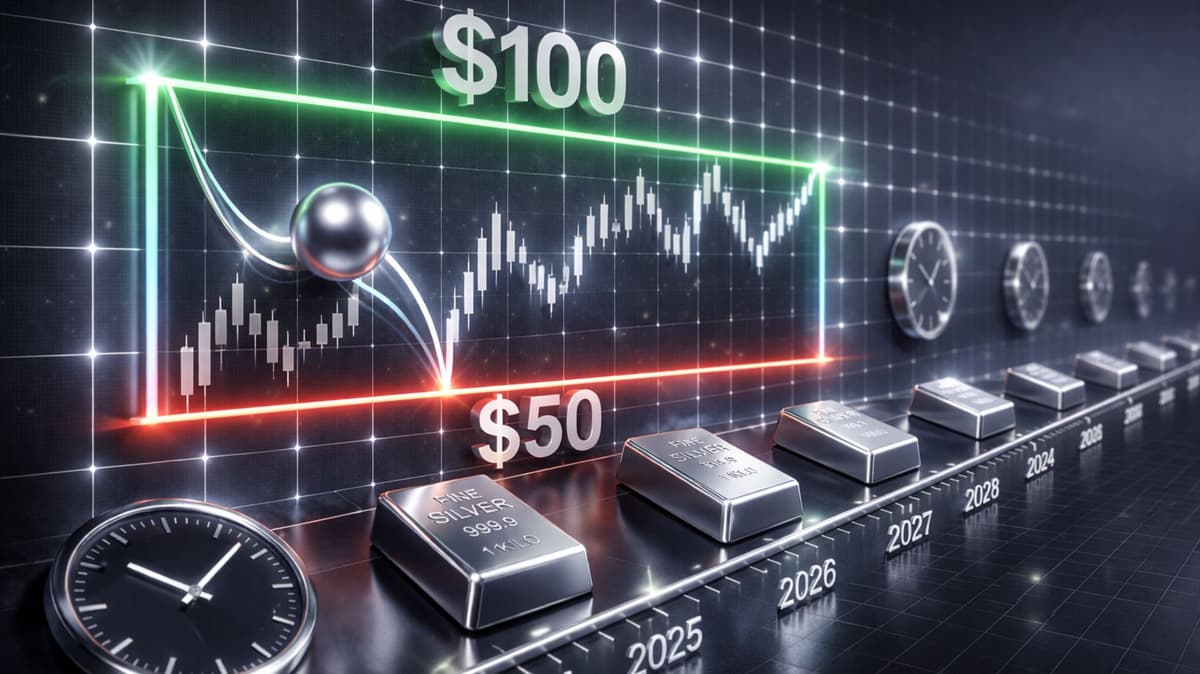
Silver prices could remain stuck in a broad $50-$100 range for years, according to Bloomberg Intelligence Senior Market Strategist Mike McGlone. Even with the silver market heading for its sixth straight annual supply deficit, he argued that tight supply alone may not be enough to push bullion back to its January highs above $120 an ounce.
Spot silver was last at $78.69 per ounce, down 0.22% on the day, and still struggling to hold above the key $80 an ounce resistance zone. For Indian investors, that matters because global silver and gold price moves often feed directly into domestic bullion rates after adjusting for the rupee, import costs, and local premiums.
Why does Mike McGlone think silver prices could languish between $50 and $100?
Mike McGlone’s core view is that silver has already seen a parabolic price adjustment, and that extreme rallies usually change the supply-demand balance rather than sustain it. In his latest note, the Bloomberg Intelligence strategist reiterated his muted outlook and said silver prices could “languish between $50 and $100 for years.”
McGlone said higher silver prices themselves could trigger a fundamental shift in the market. According to Mike McGlone, “A top takeaway is that what was a supply deficit will shift due to the parabolic price adjustment, which may transition to a low-price-cure phase.”
That means a market that looked structurally tight at lower prices may not remain as tight after a major rally. Elevated prices can curb demand, encourage more supply, and reduce the pressure that originally drove the move higher.
What is happening to silver prices right now?
Silver prices are struggling to break higher in a sustained way. Spot silver last traded at $78.69 an ounce, down 0.22% on the day, while the market remained unable to consistently hold gains above initial resistance at $80 an ounce.
McGlone said he does not rule out another rally toward the January highs above $120 an ounce. However, he believes the more important signal is that silver is no longer behaving like a market ready to extend a straight-line surge.
He compared current conditions with earlier speculative peaks. According to McGlone, silver’s rally began in earnest in mid-2025 and later peaked at a 2.6x premium to its 10-year moving average, a setup he said resembles silver’s last parabolic move in 2011.
How does silver’s current rally compare with past parabolic moves?
McGlone said the present setup closely mirrors earlier periods when silver rose too far, too fast. He wrote that at about $79 on April 15, silver appeared stuck between $50 and $100 for an extended period, with the risks favoring mean reversion instead of a lasting break above $100.
His exact assessment was blunt: “We see parallels. At about $79 on April 15, silver appears stuck between $50 and $100 for an extended period, with normal reversion risks leaning toward its 10-year moving average near $33 instead of the potential to stay above $100.”
That comparison matters because historical parabolic rallies in precious metals often end with long consolidation phases. For traders in XAGUSD and investors tracking the broader precious metals complex, McGlone’s analysis suggests silver may be entering a prolonged range-bound period rather than a fresh breakout phase.
What does the 10-year moving average signal?
The 10-year moving average points to a much lower long-term anchor for silver prices. McGlone said the market’s reversion risk leans toward near $33, which is far below current spot levels.
He also said a trend reversion could push silver prices down to $50 an ounce. That level is well above the 10-year moving average, but still significantly below the current market and far below the January highs above $120.
Why is volatility so important for silver now?
Volatility shows how unstable the current price structure has become. McGlone pointed out that silver’s 180-day volatility is now more than five times greater than that of the S&P 500, which he described as the highest since 1980.
That is a major historical signal. In 1980, silver peaked just below $50, a high that was matched in 2011 and not exceeded until 2025.
For bullion investors, unusually high volatility often means larger price swings in both directions. In India, that can amplify the impact of rupee moves on local silver and gold rates, making short-term entries more difficult for retail buyers.
If silver is in deficit, why are prices not breaking higher?
A supply deficit alone may not be enough because demand is changing and high prices can weaken the underlying fundamentals. McGlone’s cautious view comes as the market digests the Silver Institute’s annual Silver Survey, which forecasts a 46.3 million ounce annual deficit.
That would mark the sixth consecutive annual supply deficit in the silver market. Under normal conditions, repeated deficits could support a stronger silver price outlook.
But the demand side is becoming less supportive. The survey said industrial demand is expected to decline 3% this year, led by a projected 19% drop in silver consumption in photovoltaic solar panels.
That decline matters because industrial use is a major pillar of silver demand. If fabrication demand slows while prices remain elevated, the deficit may not tighten the market enough to drive a lasting breakout.
What does the Silver Survey say about investment demand?
Investment demand is expected to be the biggest driver of the silver market this year. According to Metals Focus, the research firm behind the Silver Survey, investment flows rather than industrial consumption are likely to shape price direction in the near term.
The survey expects investment demand to rise 18% this year. It also projects support from 30 tonnes of physical inflows into silver-backed exchange-traded products.
That means investor appetite for bullion, ETFs, and safe-haven precious metals could still cushion prices even if industrial demand softens. However, McGlone’s argument is that stronger investment demand may support a range rather than launch a durable move back above $100.
What does this mean for Indian silver and gold investors?
Indian investors should read this as a caution against assuming that supply deficits automatically translate into higher silver prices. Global silver prices near $78.69 per troy ounce remain elevated, but resistance at $80 and the possibility of a retreat toward $50 suggest a more volatile path ahead.
For Indian bullion buyers, the domestic impact will depend not only on international silver and gold price trends but also on the INR-USD exchange rate. A weaker rupee can keep local precious metals prices firm even if global silver corrects, while a stronger rupee can soften imported bullion costs.
Silver’s price path also matters for sentiment across the precious metals complex, including gold. If silver remains range-bound and volatile while investment demand shifts between bullion, ETFs, and safe-haven assets, Indian investors may prefer staggered buying instead of aggressive chasing at higher levels.
The key watchpoint now is whether silver can decisively reclaim $80 per ounce and build toward the January highs above $120, or whether the reversion McGlone expects starts pulling prices toward $50 and, over time, closer to the 10-year moving average near $33.