After a strong start to the year, platinum prices remain under pressure, but the bigger story for investors is that the hydrogen economy could become a major long-term demand driver for the precious metal over the next decade, according to the World Platinum Investment Council (WPIC). For Indian investors tracking bullion and precious metals beyond gold price trends, this matters because platinum group metals could see structural support even as traditional autocatalyst demand weakens.
Spot platinum last traded at $1,925 per troy ounce, down more than 2% on the day, and the market looked set to end the week with a 2.5% loss. Even so, analysts said platinum prices have remained capped near $2,000 an ounce while the market searches for fresh demand catalysts.
Why is platinum struggling even though long-term demand hopes are improving?
Platinum is struggling in the short term because prices are capped near $2,000 an ounce and traditional demand from internal combustion engine vehicles faces long-term pressure. The rise of electric vehicles is reducing the future market share of internal combustion engine vehicles, which use catalytic converters and support platinum group metals demand.
That shift has forced analysts and market participants to look for new sources of demand for platinum and the broader platinum group metals sector. While platinum has enjoyed a strong start to the year, its momentum has weakened as investors weigh slower industrial growth and changing auto-sector dynamics.
Some analysts also believe the global energy crisis, driven by the ongoing war in Iran, could eventually create fresh momentum for platinum. The logic is that energy insecurity may push governments and industries to accelerate alternative energy systems, including hydrogen technologies that use platinum.
For Indian investors, platinum is a smaller market than gold or silver, but it remains relevant in the broader precious metals space. Any sustained move in platinum can affect investor sentiment toward bullion, exchange-traded commodity exposure, and jewelry demand trends in India, especially when the rupee and imported metal prices add volatility.
How could the hydrogen economy reshape platinum demand over the next decade?
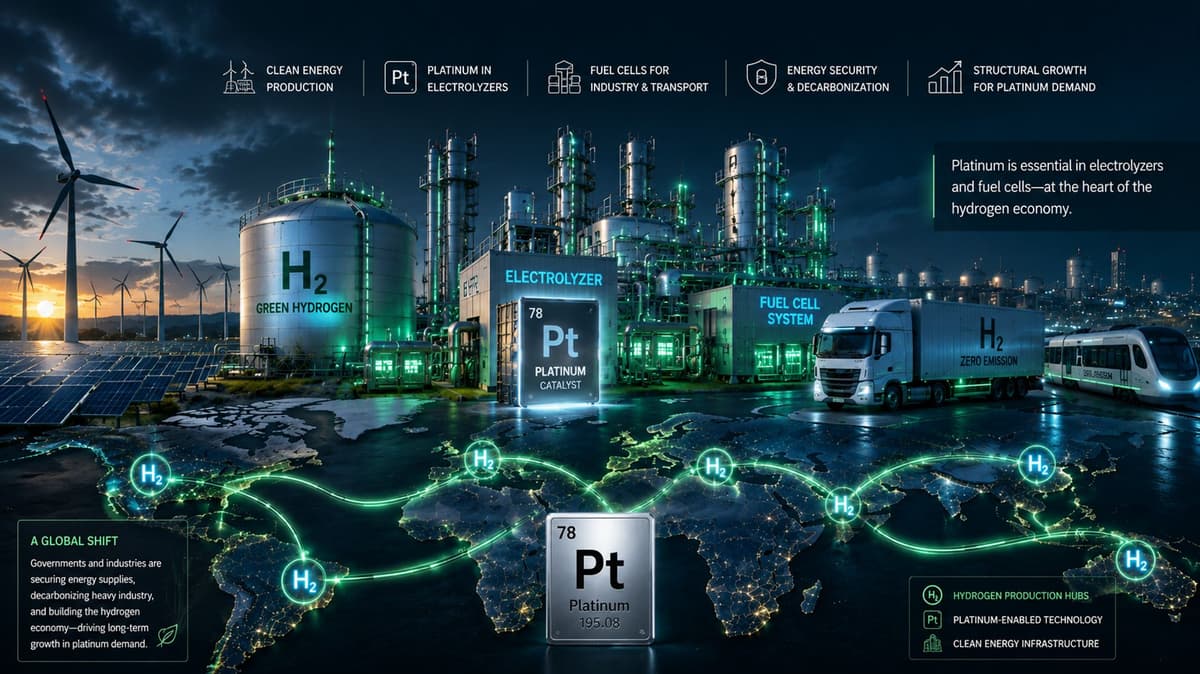
The hydrogen economy could sharply increase platinum demand because platinum is used in proton exchange membrane electrolyzers and fuel-cell technologies. WPIC currently estimates platinum demand linked to the hydrogen economy at roughly 90,000 ounces annually, including fuel-cell electric vehicles, and says that figure could rise to about 400,000 ounces by 2030.
In an interview with Kitco News, Edward Sterck, director of research at WPIC, said the hydrogen economy is quietly becoming one of the most important structural growth drivers for platinum demand. He said governments and industries are intensifying efforts to secure regional energy supplies and decarbonize heavy industry.
Sterck said the current geopolitical backdrop is helping this theme. He pointed to energy insecurity, de-globalization, and rising concerns over industrial supply chains as conditions that could accelerate hydrogen adoption over the next decade.
His comments came as London Platinum Week wrapped up, where hydrogen demand and emerging industrial applications were major themes across the annual gathering of platinum market participants.
What did Edward Sterck say about regional energy security?
Edward Sterck said hydrogen is likely to become a key tool for regional energy security in a more fragmented global economy. He noted that renewable energy potential is significant across Europe, East Asia, Australia, the Middle East, North Africa, the Namib Desert, and South America, but added that the world may not develop into one seamless global energy network.
“We see significant renewable energy generating potential in places like Europe, East Asia, Australia, the Middle East, North Africa, the Namib Desert and South America. But we’ll probably see a disconnect in terms of this global network,” Sterck said. “Hydrogen’s going to be a key component of providing regional energy security.”
That view matters for India because energy security is a strategic priority for the country. If hydrogen infrastructure expands globally and regionally, Indian investors may want to watch platinum as part of a wider clean-energy and precious-metals allocation, especially since India imports most of its energy needs and remains sensitive to geopolitical supply shocks.
Why does hydrogen matter if battery electrification is already growing fast?
Hydrogen matters because some industrial processes cannot be fully electrified and still require hydrogen as a feedstock or energy input. Sterck argued that while battery electrification dominates headlines, hydrogen remains essential for sectors such as steel, fertilizer, and ammonia.
“You can electrify all vehicles, let’s say, you can electrify people’s houses,” Sterck said. “But you can’t produce steel with electricity. You can’t produce fertilizer or ammonia with electricity; you have to use hydrogen.”
That makes hydrogen different from purely transport-focused clean-energy narratives. It also broadens platinum’s potential role beyond passenger mobility and into industrial decarbonization.
How does green hydrogen support decarbonization?
Green hydrogen could cut emissions sharply because conventional hydrogen production from natural gas creates heavy carbon output. Sterck said that when producers use steam methane reformation to strip hydrogen from natural gas, every one ton of hydrogen produced from natural gas generates eight tons of CO2.
“At the moment, you use steam methane reformation to strip the hydrogen off natural gas,” he explained. “Every one ton of hydrogen you produce from natural gas produces eight tons of CO2. So if you can switch to green hydrogen, that is a really big win from an environmental perspective.”
For India, this point is especially relevant because fertilizer demand, industrial expansion, and emissions reduction targets all intersect with energy policy. If green hydrogen becomes more commercially viable, platinum demand could gain from that transition over time.
How fast is the hydrogen economy already growing?
The hydrogen economy has already expanded meaningfully, even though investor attention has faded. According to WPIC data, green hydrogen production increased six-fold between 2021 and 2025, rising from roughly 50 kilotons per annum to about 300 kilotons.
During the same period, global electrolysis capacity expanded from 0.6 gigawatts to 4.9 gigawatts, a nine-fold increase. At the same time, the global fleet of fuel-cell electric vehicles doubled to about 103,000 vehicles.
Sterck said these gains happened largely out of the spotlight. “Hydrogen has been secretly growing quite strongly behind the scenes, just not as strongly as previously anticipated,” he said. “Investor attention, with the end of ESG considerations, has been elsewhere, so we haven’t been talking about it because no one cared.”
He added that it would not be unreasonable to expect “mid-double-digit growth rates” over the next five years across hydrogen-related sectors, although he cautioned that annual growth may remain volatile.
For investors in India, this suggests platinum may offer a different kind of precious-metals exposure than gold or silver. Gold price movements often track safe-haven demand, XAUUSD, U.S. yields, and the dollar, while platinum may increasingly respond to industrial policy, clean energy investment, and hydrogen deployment.
What new demand sources are analysts watching besides hydrogen?
Analysts are also watching a broader range of emerging industrial technologies that are creating new platinum group metal demand. As electric vehicle adoption grows, the long-term decline in autocatalyst consumption remains a central concern for platinum group metals.
That is why analysts are searching for replacement demand drivers. At London Platinum Week, analysts at BMO Capital Markets said discussions around green hydrogen were “noticeably more pragmatic” this year.
What did BMO Capital Markets say?
BMO Capital Markets said the market is now focused on credible industrial applications rather than speculative narratives. In a recent research note, the bank said hydrogen discussions centered less on hype around fuel-cell vehicles and more on realistic industrial use cases.
“The search for new demand continues in earnest,” the analysts said.
BMO also said WPIC highlighted a growing list of emerging technologies that are adding new platinum group metal demand, including optical devices, e-glass fabrics, hard drives, and silicone manufacturing.
According to the Canadian bank, WPIC estimates these newer applications have generated roughly 500,000 ounces of incremental PGM demand over the last 12 to 24 months. However, analysts cautioned that no single technology has yet emerged as a “silver bullet” that can fully replace declining autocatalyst demand.
What is WPIC’s broader outlook for platinum prices and supply?
WPIC remains constructive on platinum because supply deficits and low above-ground inventories are keeping the market tight. In its latest quarterly demand trends report, the council said platinum prices continue to draw support from persistent supply deficits and critically low inventories.
WPIC estimates that above-ground platinum stocks have fallen to roughly three months of supply. That low inventory buffer is helping maintain tight market conditions despite broader economic uncertainty.
This backdrop is important because it means platinum does not need a single explosive catalyst to stay supported. Instead, a combination of tight supply, low inventories, hydrogen-related demand growth, and emerging industrial applications could underpin the market over time.
For Indian investors, the near-term platinum price trend may still look soft compared with gold price action in a risk-off environment. But if hydrogen adoption accelerates and supply remains tight, platinum could become one of the more closely watched precious metals alongside bullion, silver, and other strategic commodities. The key watchpoint now is whether hydrogen-linked demand grows fast enough over the next five years to offset the structural decline in autocatalyst demand and push platinum decisively beyond the $2,000 per ounce ceiling.