# Gold Price Holds $4,500 as Fed Hike Fears Keep Wall Street Bearish
Gold prices ended another volatile week near the key $4,500 level as geopolitical safe-haven demand offset pressure from a stronger U.S. dollar, rising U.S. Treasury yields, and growing worries that the Federal Reserve could stay hawkish for longer. For Indian investors, this global tug-of-war matters because any sustained move in XAUUSD, combined with rupee swings against the U.S. dollar, can quickly feed into domestic bullion rates.
Why did gold price struggle to hold gains this week?
Gold struggled because safe-haven buying linked to the Iran conflict repeatedly ran into macro headwinds from higher bond yields, a firmer dollar, and renewed inflation fears.
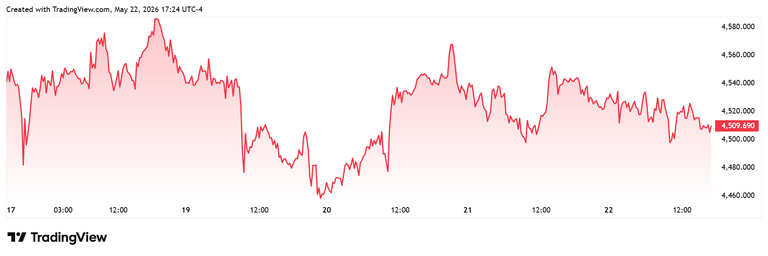
Spot gold started the week at $4,539.09 per troy ounce on Sunday evening. After a brief dip early in Asian trading, bullion climbed through Monday and into Tuesday as traders reacted to persistent geopolitical uncertainty around Iran and broader risk aversion.
That rally stalled just below $4,600, with spot gold posting its weekly high at $4,588.64 per ounce. Sellers then regained control as the U.S. dollar strengthened and markets repriced the inflation outlook amid higher energy prices and expectations that the Federal Reserve may keep policy tight.
Gold then broke below $4,500. Selling extended into Wednesday, when spot gold fell to the weekly low of $4,453.00 per ounce ahead of the release of the April FOMC minutes.
The market later recovered back above $4,500 on Thursday. Traders tried once more to stabilize prices on Friday as hopes of de-escalation in the Middle East briefly eased bond yields, but weaker U.S. consumer sentiment, rising inflation expectations, and hawkish comments from Federal Reserve Governor Christopher Waller kept pressure on precious metals into the weekend.
Spot gold closed the week at $4,508.25 per ounce.
What does this mean for Indian gold investors?
Indian investors should read this as a market caught between safe-haven demand and higher-rate pressure. If global gold remains rangebound near $4,500, domestic gold prices in India may depend even more on the USD/INR exchange rate, import costs, and local jewellery demand.
A stronger U.S. dollar typically raises landed bullion costs for India. That can keep rupee-denominated gold prices elevated even when international spot prices pause or soften.
What did the April FOMC minutes and U.S. inflation signals show?
The April FOMC minutes confirmed that Federal Reserve officials remain worried about inflation, especially from energy prices and tariffs, and that reduced gold’s ability to stage a lasting rebound.
This mattered because gold usually performs better when markets expect lower real rates or future rate cuts. Instead, traders had to price in the risk that sticky inflation could delay easing or even reopen debate around tighter policy.
According to the source article, PPI and CPI both came in markedly higher last week, with PPI hitting multi-year highs, reinforcing hawkish expectations. That backdrop weighed on bullion because higher interest rates tend to reduce the appeal of non-yielding assets such as gold.
Why are Fed rate hike fears negative for gold?
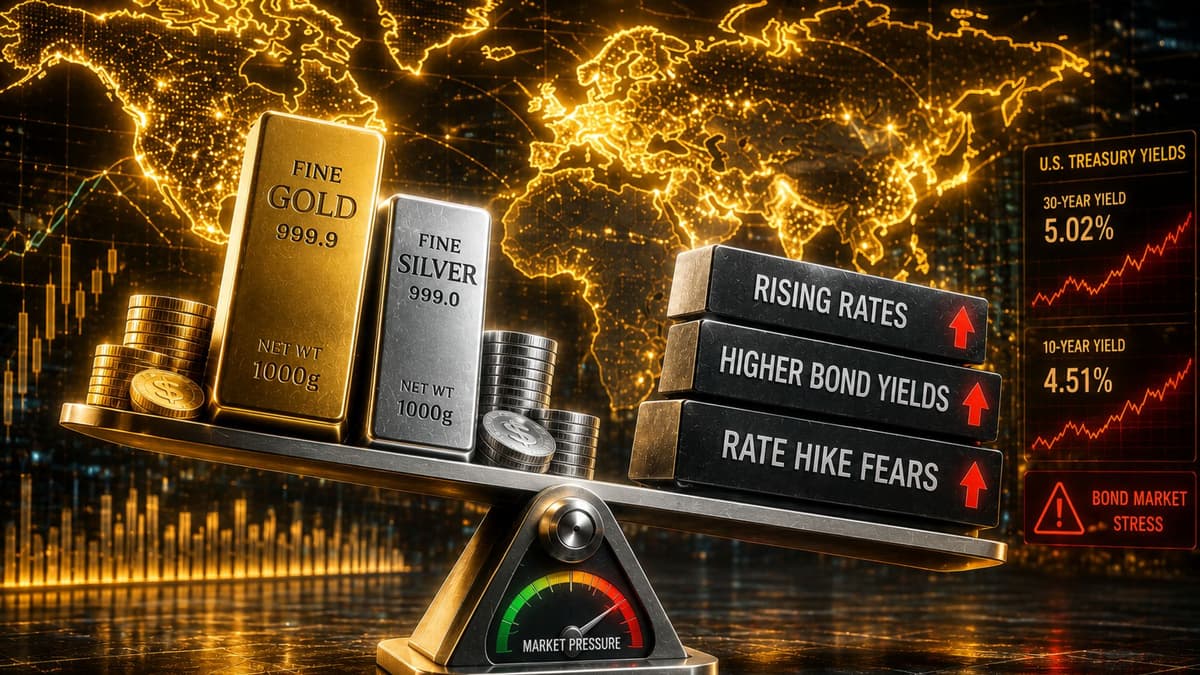
Fed rate hike fears are negative for gold because rising rates and yields increase the opportunity cost of holding a non-interest-bearing asset.
Rich Checkan, president and COO of Asset Strategies International, said rate cuts have been off the table for some time and that interest rate increases are now coming back up on the menu. He added that while real returns are still not especially attractive, higher interest rates generally push gold prices lower.
For Indian investors, that means every major U.S. inflation print, Federal Reserve speech, and Treasury yield move can influence near-term price direction in global bullion markets.
What are Wall Street and Main Street saying about the gold price outlook?
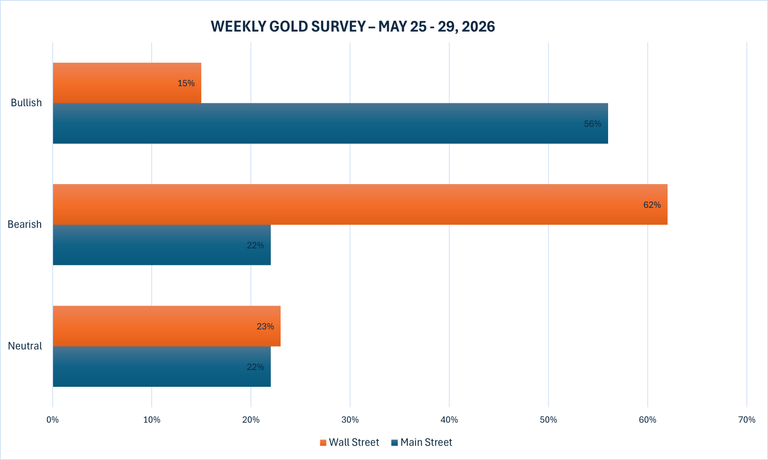
Wall Street remained bearish in the near term, while Main Street stayed bullish despite recent losses in gold.
The latest Kitco News Weekly Gold Survey showed a clear split between professional market participants and retail sentiment. Wall Street stayed firmly cautious on the short-term outlook, while Main Street maintained what the article described as a stubborn bullish bias.
What did Marc Chandler say about gold support and resistance?
Marc Chandler, managing director at Bannockburn Global Forex, said gold has weakened support at $4,500 but has still spent most of the week consolidating above that level.
Chandler said gold has not yet proved itself on the upside. In his view, that would likely require a move above the $4,600 area.
He also warned that even with a rally in bonds, gold bulls could not regain control. He said downside risk could extend toward the 200-day moving average near $4,370.
Chandler added another key geopolitical risk: the longer the Middle East war continues, the greater the chance of further official gold sales from countries such as Turkey and Gulf states.
Why is Adrian Day still constructive on gold?
Adrian Day, president of Adrian Day Asset Management, said he expects a continuation of the recent back-and-forth trade, but with an upward bias in the week ahead.
His exact call was clear: “So UP.” That view suggests he still sees support from underlying safe-haven demand even as macro pressure remains intense.
Why is Rich Checkan bearish on gold?
Rich Checkan turned bearish because he sees geopolitical deterioration and hotter inflation data combining into a negative setup for gold.
Checkan said the fragile cease-fire between the U.S. and Iran is showing signs of fraying, with nuclear weapons remaining the key sticking point. He argued that the situation has deteriorated as both sides dig in and that this conflict has not helped gold since it began.
He also pointed to sharply higher inflation data, saying that stronger PPI and CPI figures have revived concerns that higher interest rates could return to the policy discussion.
How do low futures volumes and contract rollovers affect gold prices?
Low futures volume reduces conviction and can leave gold trapped in a range because traders hesitate to take large directional positions.
Kevin Grady, president of Phoenix Futures and Options, said he wanted no part of the gold market at current volumes, with Iran headline risk, a long weekend, and a short trading week all clouding the outlook.
He said the market had just hit 80,000 contracts, but that total reflected a rollover. Of those 80,000 contracts, nearly 30,000 were spreads.
Grady said traders were largely rolling positions from the June contract to the August contract, rather than expressing a strong bullish or bearish view. When he spoke, there were still 145,000 June contracts left to roll, with traders having until the following week to complete that process.
Why does Grady think gold is not moving decisively?
Grady said the chart shows a market with very little fresh interest. In his view, many participants are simply waiting rather than actively trading.
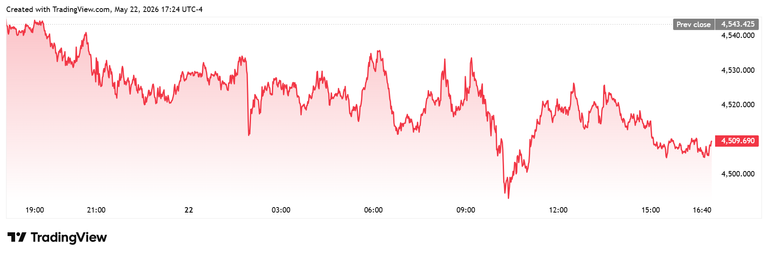
He said the people still in the market are mainly handling spreads and rollover activity, not building aggressive new positions. That helps explain why every rally has struggled to hold and why breakdowns have not yet turned into a full-blown collapse.
What downside levels are traders watching?
Traders are watching whether gold retests deeper support levels, especially the $4,128 low from March 23.
Grady said the key question is whether the market goes back to that low. He also warned that if gold sells off toward $4,100 and gets swept, traders do not want to be caught in a thin market where exits become difficult.
He noted that with liquidity limited, market participants are reluctant to position themselves heavily in either direction.
Will gold break higher or fall further from here?
In the near term, gold appears rangebound, and analysts do not expect sustained upside momentum unless the Middle East situation changes materially.
Grady said gold carries roughly as much downside risk as upside risk because any news headline can move the market sharply. He said traders should wait, especially heading into a holiday weekend, because the risk of being trapped in a large position is too high.
He stressed that he would not want to hold a large position in any direction in the current environment. That cautious stance reflects a market driven by event risk more than conviction.
Even so, Grady also said spot gold dipped as low as $4,492 on Friday, yet under current conditions it remains just as capable of surging higher as dropping lower.
What should Indian investors watch next?
Indian investors should watch three signals closely: developments in the Iran conflict, incoming U.S. inflation and rate expectations, and the behavior of the U.S. dollar and Treasury yields.
A clear break above $4,600 would strengthen the bullish case for bullion. A fall toward $4,370, and especially a retest of $4,128, would signal growing downside pressure in XAUUSD.
For investors in India, the next move in domestic gold prices will not depend only on global spot gold. It will also depend on how the rupee reacts to U.S. dollar strength and how local buyers respond if international bullion stays volatile near the $4,500 per ounce zone.