# Silver Price at $75: Analysts Blast $1,000 Call Option Hype
Silver prices have steadied near $75 an ounce, but analysts say viral chatter around $1,000 silver call options is misleading investors rather than signaling a realistic bullion breakout. For Indian investors tracking precious metals alongside the gold price, the key message is simple: extreme out-of-the-money silver options reflect speculation, high option costs, and social-media hype more than any fundamental case for silver reaching $1,000.
Why are analysts warning about $1,000 silver call options?
Analysts are warning because the $1,000 silver calls for December are not being treated as credible price targets by professionals. Instead, they say these trades look speculative, unrealistic, and in some cases potentially manipulative.
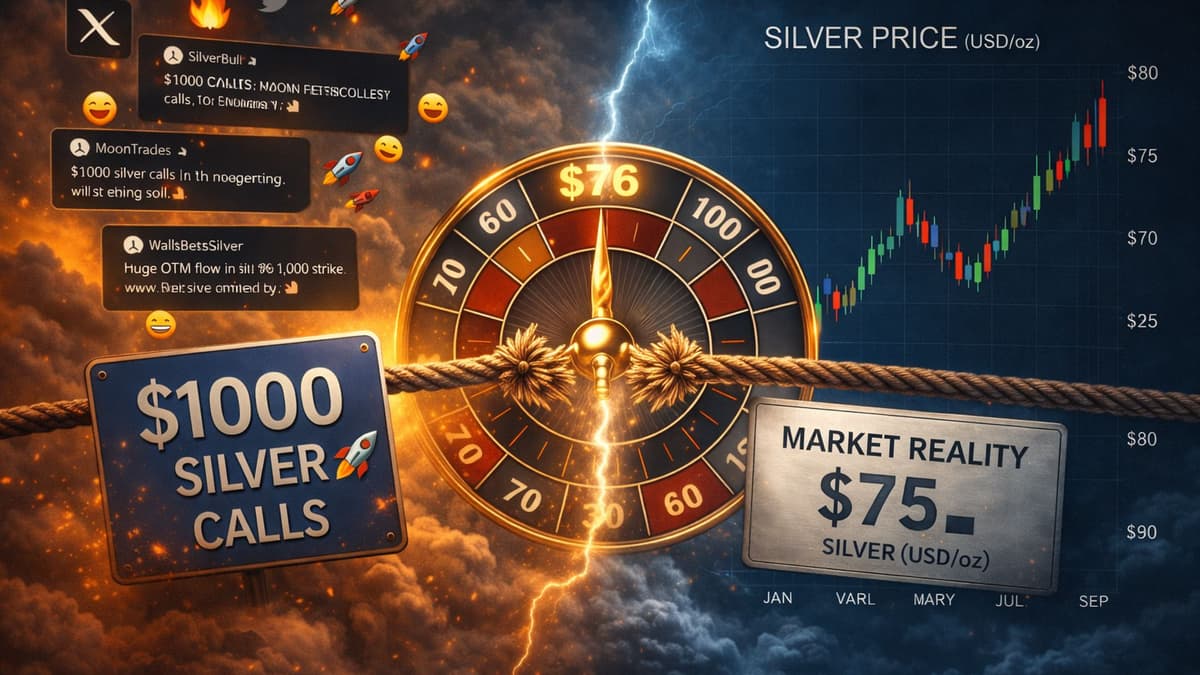
A trending topic on social media platform X on Tuesday focused on the rise of extreme out-of-the-money call options in the silver market. Some users pointed to December options with a $1,000 strike price and claimed the huge spread suggested “smart money” was betting on sharply higher silver prices by year-end.
Commodity analysts pushed back hard on that interpretation. Some described these call options as bordering on ridiculous and called them “garbage” trades.
One market analyst told Kitco News that he sees the call-option frenzy as an attempt to hype silver prices back to the January highs, a move he believes could ultimately trigger another price collapse.
For investors in India, that distinction matters. A viral options trade in the U.S. futures market does not automatically translate into a sustainable rise in physical silver, bullion demand, or domestic precious metals prices.
What is happening in the silver market right now?
The silver market is showing signs of stability, with prices pushing back to $75 an ounce. That rebound has improved sentiment, but analysts say optimism is now mixing with speculation.
The latest move has created fresh excitement across the precious metals market. When silver rallies sharply, retail traders often begin projecting much bigger upside targets, especially on leveraged platforms and social media.
That enthusiasm can spill over into broader bullion discussions, including gold price, safe-haven demand, and cross-market trades in precious metals. But analysts caution that a stable silver price near $75 per troy ounce is very different from a credible path toward $1,000.
For Indian investors, the silver rally can still matter. Higher global silver prices can influence domestic rates in rupees, especially when combined with INR moves against the U.S. dollar. But speculative options activity should not be confused with physical-market fundamentals.
What did Carley Garner say about the $1,000 silver calls?
Carley Garner, co-founder of DeCarley Trading, said the CME may list a $1,000 silver call for December, but there is currently not a single contract with open interest. In practical terms, that means nobody has actually traded it, according to her comment to Kitco News.
That point directly challenges the social-media narrative. If there is zero open interest, then the contract cannot be cited as proof that sophisticated traders are aggressively positioning for silver at $1,000.
Garner said the existence of the listed strike price does not mean the market sees it as likely. Exchanges can list far-out strikes, but listed availability is not the same as active institutional conviction.
For Indian readers following global XAGUSD and bullion trends, this is a critical distinction. A listed option can become a headline on X, yet still have no real trading activity behind it.
Why are retail traders buying such extreme silver call options?
The main reason is cost: silver options have become so expensive that smaller retail traders are being pushed into wildly out-of-the-money calls because those are the only contracts they can afford.
Garner explained that the current pricing structure in the silver derivatives market is forcing speculators further out on the curve. She said the margin to hold silver futures is currently over $50,000, while an at-the-money call option for December 2026 is going for about $60,000.
How does affordability change investor behaviour?
It changes behaviour by pushing traders toward cheap lottery-ticket-style bets. Garner said that if an investor wants a long-term silver play and only wants to risk a few thousand dollars, that investor may end up buying the December $1,000 calls simply because they are cheaper than more realistic contracts.
Her exact explanation was clear: retail traders are not necessarily buying these calls because they truly expect silver to hit $1,000. They may just want exposure to upside without posting futures margin.
Has this happened in other commodity markets?
Yes. Garner said the natural gas options market saw similar price action in 2022, with strike prices extending out to $40.
That comparison suggests the silver market is not unique. In periods of high volatility and expensive derivatives, traders often reach for extreme strikes because conventional positions become too costly.
For Indian investors, this means viral option strikes are often more about market structure than about a true long-term price forecast for silver or gold.
Could these silver options trigger a squeeze like GameStop?
Yes, analysts say that is one possible motive, but they also warn that such a move would be unhealthy and disconnected from fundamentals. Garner said a coordinated wave of buying in wildly out-of-the-money calls can pressure dealers and market makers to hedge by buying futures.
According to Garner, this mechanism resembles what Reddit retail investors used during the GameStop squeeze. If enough traders buy these options, the firms that sold them may eventually need to buy silver futures to manage risk.
How would that squeeze work?
The process is straightforward. Retail investors buy far-out calls, dealers and market makers face rising exposure, and then those dealers may have to buy futures to hedge. That futures buying can push prices higher, which then feeds even more speculative momentum.
Garner described the dynamic bluntly. She said: “If enough people buy wildly out-of-the-money calls, the dealers and market makers that sold them will be forced to buy futures at some point to hedge their risk, then the rally feeds on itself. It isn't healthy, and it has nothing to do with fundamentals; it is a modern-day pump-and-dump scheme.”
That warning matters for Indian investors in bullion, silver ETFs, and physical precious metals. A squeeze-driven price spike can be dramatic, but it can also reverse quickly once momentum fades.
Why does Carley Garner see the silver options hype as bearish?
Garner sees the options frenzy as potentially bearish because surging demand for these contracts drives implied volatility higher, and elevated option volatility often appears near trend reversals.
She has been fairly bearish on gold and silver, arguing that the parabolic rally over the last few months is unsustainable. In her view, the current excitement in the options market reinforces that concern rather than invalidating it.
What is implied volatility signaling?
Garner said: “The buying of such options en masse runs up implied volatility in the market.” She added that elevated option market volatility is always temporary, and it almost always accompanies a trend reversal.
In other words, if traders aggressively pile into speculative silver calls, the result may not be a lasting bull market. It may instead be the kind of overstretched setup that often comes before a pullback.
For Indian investors watching both silver price and gold price trends, this is an important signal. Rapid gains in bullion can attract momentum buying, but when price action turns parabolic and options volatility spikes, risk also rises sharply.
What does this mean for Indian gold and silver investors?
The practical takeaway is that Indian investors should separate social-media hype from tradable fundamentals. A silver price near $75 per ounce is real, but a narrative around $1,000 silver is not supported by active open interest in the December call highlighted by analysts.
Indian investors also need to think in rupee terms. Global silver and gold prices, the U.S. dollar, and the INR exchange rate together shape local bullion pricing. Even if overseas option activity causes short-term volatility in XAGUSD or the broader precious metals complex, domestic buyers should assess whether the move is backed by actual demand, macro trends, and physical market conditions.
Silver enthusiasm can sometimes spill into gold sentiment because both belong to the same precious metals trade. But analysts are clearly saying that this specific options story looks more like leverage-driven speculation than a reliable signal for long-term bullion allocation.
The next key watchpoint is whether silver can hold around $75 an ounce without the market becoming even more dependent on momentum-driven options activity. If implied volatility keeps rising while fundamentals fail to catch up, investors may need to prepare for the kind of reversal analysts are already warning about.