# Silver Market Deficit in 2026 Raises Volatility Risks
The silver market is expected to remain in deficit in 2026, and that shortfall could keep silver prices volatile as tight supply meets shifting investment demand. For Indian investors, the outlook matters because India remains one of the most important physical silver markets, with strong retail buying helping to tighten global bullion supply.
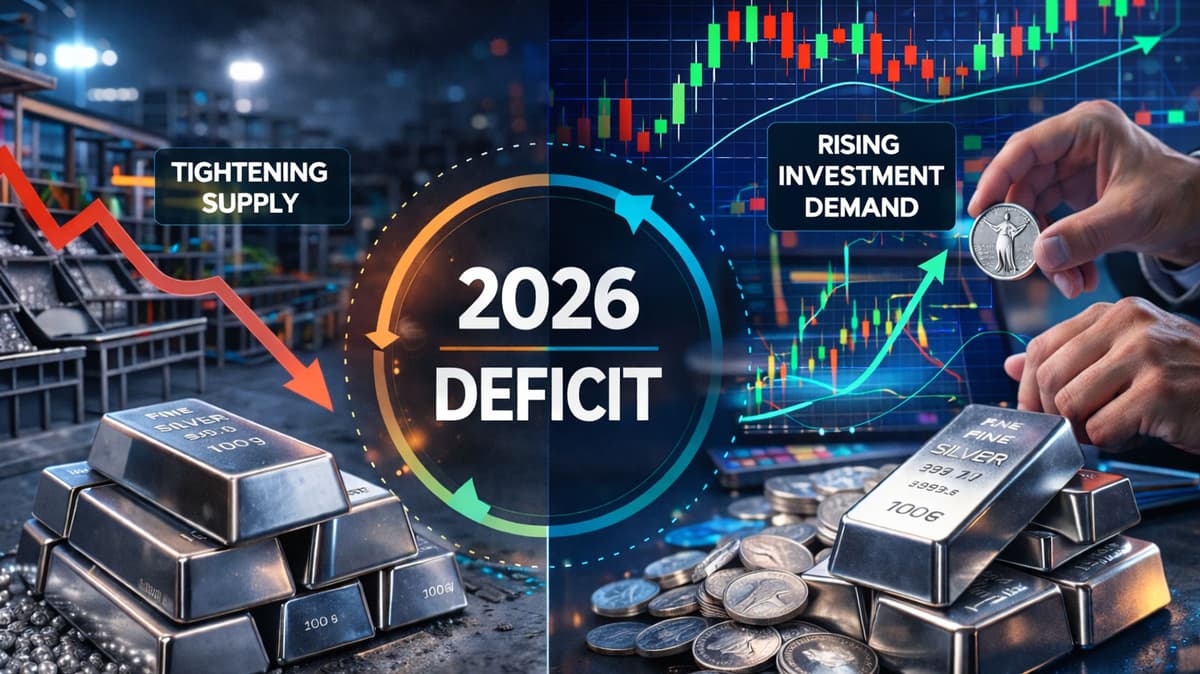
According to the Silver Institute’s annual Silver Survey, conducted by British research firm Metals Focus, the silver market is on track for its sixth consecutive annual deficit, with a projected shortfall of 46.3 million ounces. The report says years of undersupply have reduced above-ground stocks and left the precious metals market more vulnerable to liquidity stress and sudden price swings.
Why is the silver market expected to stay in deficit in 2026?
The silver market is expected to stay in deficit in 2026 because supply growth is not enough to match overall demand. Even with recycling rising to multi-year highs and mine output broadly flat, the market still faces a projected shortfall of 46.3 million ounces.
The Silver Institute survey said this would mark the sixth straight annual deficit. That matters because persistent undersupply steadily erodes above-ground inventories, leaving less physical silver available to absorb new demand shocks.
As inventories shrink, the silver price becomes more sensitive to investment flows, physical buying and macroeconomic events. In practice, that means tighter liquidity and a greater chance of sharp moves in XAG/USD and the wider precious metals market.
What does tighter liquidity mean for bullion investors?
Tighter liquidity means less silver is readily available in the physical market. When supply is constrained, even modest shifts in ETF demand, coin and bar buying, or industrial use can have an outsized impact on price.
That can create sudden rallies as well as abrupt pullbacks. For investors in bullion and silver-linked products, the report suggests volatility may persist through the rest of the year and into 2026.
What is driving silver price volatility now?
Investment flows are becoming a bigger driver of silver price volatility than before. Philip Newman, Managing Director of Metals Focus, told Kitco News that the silver market is increasingly shaped by investment flows, macroeconomic uncertainty and tightening liquidity conditions.
Metals Focus remains bullish on silver through 2026, but Newman said the outlook is not risk-free. Global economic uncertainty, elevated geopolitical tensions and continued instability in the Middle East could pressure industrial demand even as safe-haven and retail investment interest supports the market.
How are ETFs affecting the physical silver market?
ETFs are affecting the physical silver market by changing how much metal is available for immediate use. Metals Focus expects global exchange-traded products and ETFs to post modest inflows of around 30 million ounces, following record inflows in 2025.
However, Newman said the headline number hides significant volatility beneath the surface. He told Kitco News: “This is quite a swing from where we are given the sizable liquidations we’ve already seen this year.”
Large ETF inflows can pull silver out of circulation, tightening supply and worsening liquidity squeezes. Large outflows can return metal to the market quickly, which can amplify silver price swings in both directions.
How important is retail investment demand?
Retail investment demand is becoming a major support for silver. Newman said retail buying could offset weakness in some industrial sectors.
He told Kitco News: “You could see losses in the industrial sectors being mopped up by the retail investment. It’s not out of the realms of impossibility.” This is especially important for physical bullion demand, including bars and coins.
How is industrial demand for silver changing in 2026?
Industrial demand for silver is expected to soften in 2026, but it remains historically strong. The Silver Survey projects industrial demand will fall 3% to 639.6 million ounces, marking a second consecutive annual decline.
Even so, Philip Newman said industrial use remains well above pre-pandemic levels. That reflects silver’s central role in modern technologies and advanced manufacturing.
Why is solar demand for silver falling?
Solar demand for silver is falling because higher prices are forcing manufacturers to use less silver and explore substitutes. Analysts expect silver consumption in the solar sector to decline 19% this year.
The report said the solar segment, once the strongest source of industrial growth, has become the weakest link in industrial consumption. Newman added that substitution pressure started before silver reached extreme price levels, and that the speed of the rally over the past year accelerated those adjustments.
Which sectors are still supporting silver demand?
Demand from data centers, electrification and electric vehicle manufacturing is still supporting silver demand. Newman said the industrial picture is more diverse than the solar slowdown alone suggests.
Silver remains important in a broad range of technologies, and that diversification is helping cushion the impact of weaker photovoltaic demand. For long-term investors, this supports the argument that industrial use still provides a structural base for silver prices.
Why does Indian silver demand matter so much?
Indian silver demand matters because India is one of the most important physical silver markets in the world. Strong retail buying, limited selling and steady seasonal demand continue to support global consumption even at elevated prices, according to Philip Newman.
That gives India a direct role in tightening the global physical silver market. When Indian buyers continue to accumulate silver bullion instead of selling into rallies, less metal returns to circulation.
Are Indian investors selling silver into higher prices?
No, Indian investors are largely holding silver rather than selling into price rallies. Newman said this behavior is reinforcing tightness in the physical market and limiting available supply.
For Indian investors, this is an important signal. It suggests domestic buyers still see value in silver as both an investment asset and a store of value, even after strong gains.
Could Indian retail spending on silver rise further?
Yes, spending by Indian retail investors could rise further even if higher silver prices affect volumes. Newman said stronger prices are not expected to weaken overall demand.
He told Kitco News: “I think you’re going to see dramatically higher spending by retail investors.” In rupee terms, that means Indian households may spend more on silver even if they buy fewer ounces at higher prices.
What does the outlook mean for Indian precious metals investors?
The outlook suggests silver could remain volatile but fundamentally supported by tight supply and resilient investment demand. For Indian investors tracking bullion, silver ETFs, coins, bars and related precious metals trends, the key story is that deficits are continuing while above-ground stocks keep shrinking.
The survey also forecasts that coin and bar demand will rise 18% in 2026, reaching its highest level since 2022. That points to stronger physical investment appetite at a time when the market is already tight.
Newman said India should remain a critical pillar of support. Despite record demand in 2025, he said the Indian market is nowhere near saturated.
He told Kitco News: “I don’t feel that it’s saturating when you look at the levels of buying that we’ve seen.” He added: “If there’s another decent monsoon season, it can be another positive year.”
For Indian investors, that makes monsoon performance, rural income trends, global ETF flows and industrial demand shifts key watchpoints for the silver price outlook through 2026. If supply stays tight and Indian physical demand remains firm, silver may continue to see sharp but supported moves in the global precious metals market.