# Russia Gold Sales Hit 21.8 Tonnes as Budget Deficit Widens
Russia has already sold 21.8 tonnes of gold in 2026 to help fund a fast-rising budget deficit, underscoring how even major sovereign bullion holders may tap reserves when fiscal pressure and currency weakness intensify. For Indian investors, the development matters because official-sector gold flows can shape global bullion sentiment, even as strong central-bank buying and safe-haven demand continue to support the broader gold price trend.
Why is Russia selling gold in 2026?
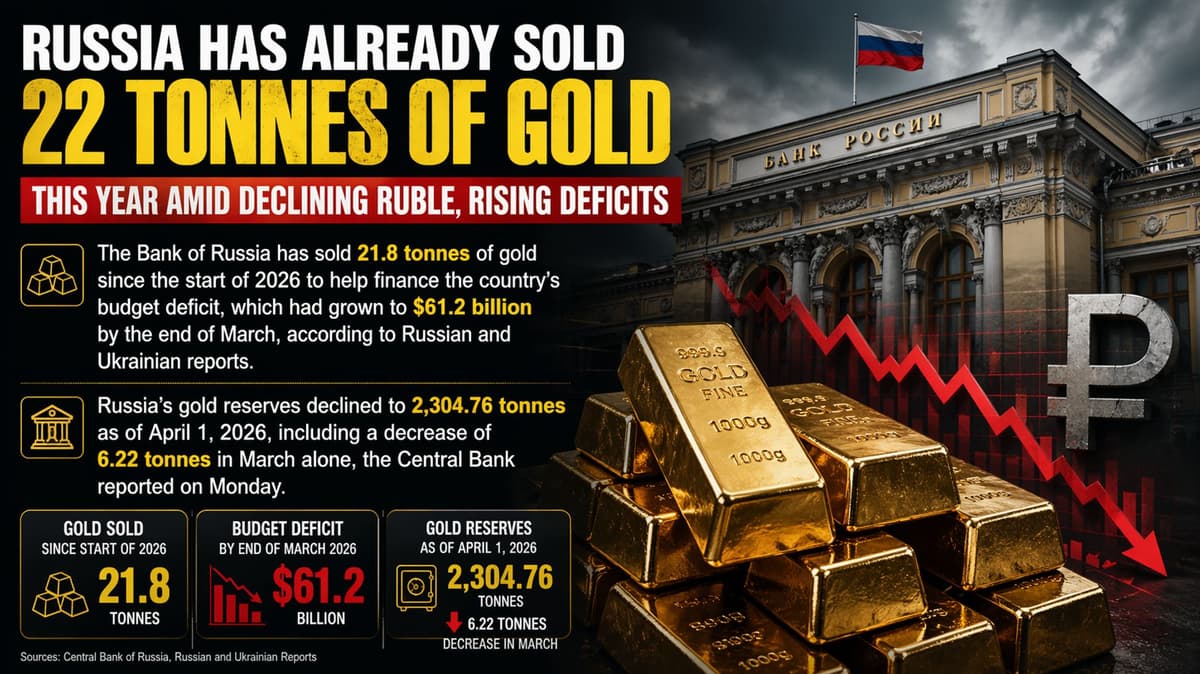
Russia is selling gold to help finance its budget deficit as government spending rises and the ruble remains under pressure. According to Russian and Ukrainian reports cited by Kitco News, the Bank of Russia sold 21.8 tonnes of gold since the start of 2026.
Russia’s budget deficit had widened to $61.2 billion by the end of March 2026. The Central Bank reported on Monday that Russia’s gold reserves fell to 2,304.76 tonnes as of April 1, 2026.
That decline included a 6.22-tonne drop in March alone. The reserve reduction highlights how bullion can serve as a liquid sovereign asset when fiscal needs become urgent.
What analysts say about the sales
Natalia Milchakova, lead analyst at Freedom Finance Global, told Reuters that these sales may continue if government spending keeps rising faster than budget targets. She said, “Sales to finance the budget deficit may continue amid a sharp increase in government spending compared to budget targets.”
Milchakova added that reserve gold sales are not unusual for central banks under financial pressure, especially in developing economies. In her view, “Such sales of gold from reserves by the Central Bank of Russia are entirely consistent with what other central banks are doing, especially in developing countries.”
Finam analyst Nikolai Dudchenko also said several central banks are selling gold to cover expenses. He said those needs include defense costs, rising energy prices, and support for national currency exchange rates.
How much gold has Russia sold and what is it worth?
Russia’s central bank disclosed earlier that it sold 300,000 ounces of gold in January after prices rose to record highs above $5,500 per ounce. On Feb. 20, the bank said the sale lowered total gold holdings to 74.5 million ounces.
This was Russia’s first decline in gold reserves since October. Gold prices averaged roughly $4,700 per ounce in January, but peaked at $5,600 per ounce.
Based on that price range, the January bullion sale likely generated about $1.41 billion to $1.68 billion. Even after the sale, the value of Russia’s gold reserves still rose 23% in January to $402.7 billion because the gold price climbed sharply.
How reserves changed in tonnage terms
As of April 1, 2026, Russia’s gold reserves stood at 2,304.76 tonnes. Since the beginning of 2026, the reserves have declined by 21.8 tonnes.
Russia had built most of its reserve stockpile between 2002 and 2025. During that period, it bought more than 1,900 tonnes of gold, including just over 500 tonnes between 2008 and 2012, and 1,200 tonnes between 2014 and 2019.
According to Nikolai Dudchenko of Finam, Russia’s net gold purchases have totaled only 55.4 tonnes since 2020. That marks a sharp slowdown from the aggressive reserve accumulation seen in earlier years.
How strong is domestic gold demand in Russia?
Domestic demand for gold in Russia has surged as households and institutions seek protection from currency weakness and economic stress. The economy is now in the fifth year of Russia’s war with Ukraine, and demand for precious metals has risen sharply.
According to the Moscow Exchange, gold transaction volumes in March 2026 jumped more than 350% from March 2025 to 42.6 tonnes. That total included 28.6 tonnes in swap transactions and 14 tonnes in spot transactions.
Measured in rubles, the increase was even steeper because of the currency’s decline. Transaction value rose 500% year-on-year to 534.4 billion rubles, or $7.1 billion.
Why Russians are buying more bullion
Russian consumers have been buying gold to protect the value of their savings. Record retail demand already emerged in 2024, when Russian consumers purchased 75.6 tonnes of gold.
That amount represented around 25% of Russia’s annual gold production. Strong retail buying has helped domestic miners even as export patterns and sanctions pressures have changed the market.
What does Russia’s gold trade with China show?
Russia’s precious metals exports to China have risen strongly, helped by higher prices and shifting trade flows. Bloomberg reported in July that Russia’s precious metals exports to China nearly doubled in value in the first half of 2025.
According to Bloomberg, citing Trade Data Monitor and China’s customs office, Chinese imports of Russian precious metal ores and concentrates, including gold and silver, jumped 80% year-on-year to $1 billion. The report noted that bullion prices had climbed about 28% in 2025, supported by geopolitical risks, trade tensions, and buying by central banks and exchange-traded funds.
Russia’s gold exports to China are higher in volume terms, but not all of the increase reflects shipment growth alone. A large part also comes from the gold price rally, with spot gold up nearly 43% over the last 12 months.
Russia’s position in global gold supply
Russia remains the world’s second-largest gold producer after China. Its annual output exceeds 300 tonnes.
The Bank of Russia was also one of the world’s biggest sovereign gold buyers before purchases slowed after the full-scale invasion of Ukraine in 2022. By contrast, the People’s Bank of China has remained among the leading central-bank gold buyers in recent years.
What does this mean for global gold prices and Indian investors?
Russia’s gold sales are notable, but they do not automatically signal a bearish turn for global gold prices. The volumes are meaningful, yet the broader bullion market is still influenced by central-bank buying, ETF flows, geopolitical risks, currency moves, and safe-haven demand.
For Indian investors, the bigger implication is that sovereign reserve sales can add volatility to XAUUSD and international bullion pricing, especially when they coincide with a stronger U.S. dollar or changing risk appetite. At the same time, any sustained rise in global gold prices can keep domestic rates elevated when converted into INR.
Why the India angle matters
Indian gold buyers should watch both the international gold price and the rupee exchange rate. If global bullion stays firm and INR weakens against the U.S. dollar, local gold prices can remain high even if some sovereign sellers release reserves into the market.
This matters for jewellery buyers, long-term savers, and investors using sovereign gold bonds alternatives, coins, bars, or ETFs. Russia’s actions show that official gold holdings still play a strategic role in fiscal management, but the wider precious metals market remains driven by a mix of safe-haven demand and macroeconomic stress.
How are other precious metals affecting Russia’s mining revenues?
The rally in other precious metals is also lifting revenues for Russian miners. Bloomberg noted that MMC Norilsk Nickel PJSC, one of the world’s top producers of palladium and platinum, has increased exports to China this year.
Prices for palladium and platinum jumped 38% and 59%, respectively, in 2025. That means Russia’s mining sector is benefiting not only from gold and silver demand, but also from strength across the broader precious metals complex.
For Indian investors tracking bullion, the next key watchpoint is whether Russia continues drawing down reserves beyond March 2026 as its fiscal deficit and currency pressures persist. If further official sales emerge alongside strong central-bank buying elsewhere, the gold price outlook could become more volatile rather than decisively weaker.