# Gold Price Outlook: Goldman Sees Stronger Central Bank Buying
Goldman Sachs says central bank gold buying has been stronger than previously estimated in 2026, and the bank now expects sovereign purchases to increase further through the second half of 2026. For Indian investors, that matters because sustained official-sector demand can support global gold prices, which in turn influences domestic bullion rates in rupees.
Why is Goldman Sachs bullish on central bank gold demand in 2026?
Goldman Sachs is bullish because it believes official-sector gold demand has been underestimated and remains structurally strong. The bank revised its central bank gold demand model on Friday to reflect gaps in official trade data that had masked the true scale of sovereign buying.
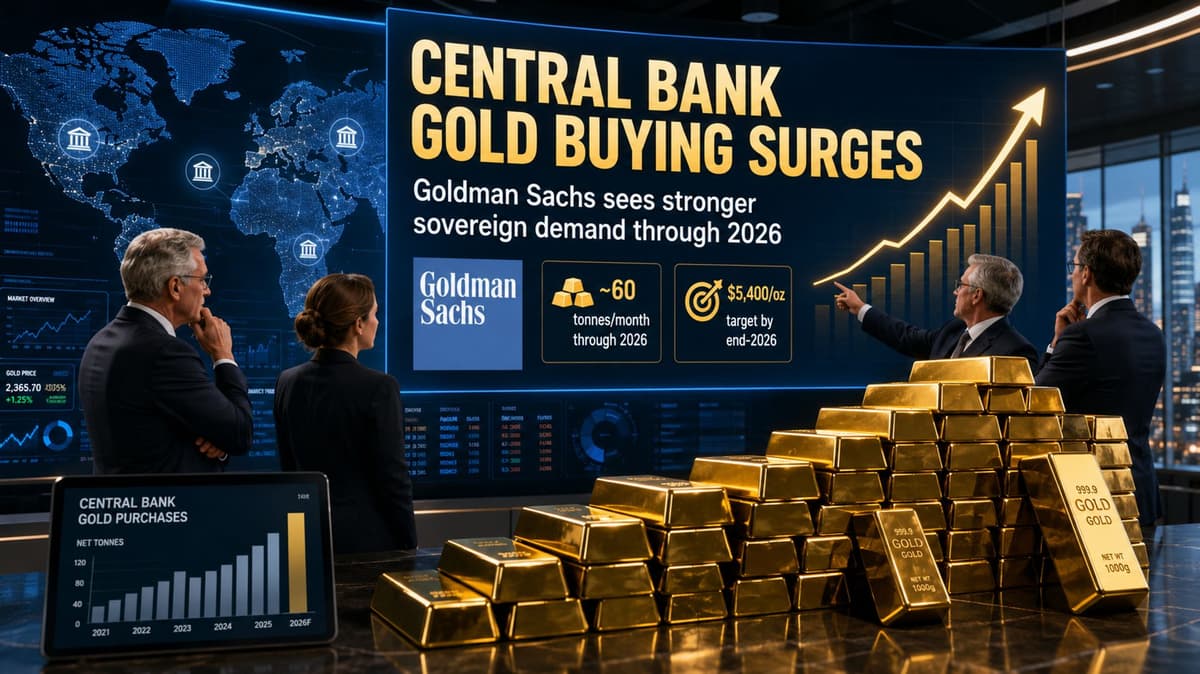
Back in March, Goldman Sachs raised its nowcast of central bank purchases to about 50 tonnes per month on a 12-month moving average basis, up from 29 tonnes under its earlier methodology. The latest revision goes further, with the bank now expecting central banks to average around 60 tonnes per month through 2026.
Goldman Sachs said continued reserve diversification and geopolitical uncertainty should keep central banks buying bullion. That demand trend is especially relevant for XAUUSD because official buying has become one of the most important structural supports for the gold price.
What changed in Goldman Sachs' gold demand model?
Goldman Sachs changed its model because official trade flows were missing part of the picture. The bank said its earlier estimates had underestimated sovereign gold demand since August 2025.
How did UK trade data distort the picture?
According to Goldman Sachs, UK trade data began failing to fully capture gold outflows from London vaults starting in August 2025. That gap meant some sovereign purchases were effectively unrecorded in the official flow data.
This matters because London remains one of the most important global bullion storage and trading hubs. If gold leaves London vaults without being fully captured in trade records, analysts can understate actual central bank accumulation.
What does Goldman Sachs say about underlying demand?
Goldman Sachs said, "Strong underlying interest in gold remains evident," citing its own central bank survey and recent geopolitical developments. The bank added that these factors are likely to support higher demand over time from both governments and private investors.
For Indian market participants, that suggests the global gold price may continue to find support even during bouts of volatility. A firmer international gold price, combined with rupee moves against the U.S. dollar, can directly affect Indian bullion and jewellery prices.
What is Goldman Sachs' gold price target for 2026?
Goldman Sachs reiterated its $5,400 per ounce gold price target for year-end 2026. The bank kept that forecast even as it acknowledged the possibility of near-term pressure on bullion if investors sell liquid assets to raise cash during periods of market stress.
Back in late January, when gold was setting fresh record highs above $5,000 per ounce, Goldman Sachs raised its December 2026 target to $5,400 an ounce. At that time, analysts Daan Struyven and Lina Thomas said the upgraded forecast reflected their view that private investors who bought gold as a hedge against macro policy risks would keep those positions through the end of the year.
That distinction is important. Goldman Sachs argued these gold holdings are not short-term tactical trades tied to a single event, but longer-duration hedges linked to deeper concerns about fiscal sustainability and macro policy.
Why does Goldman Sachs think private investors will keep buying gold?
Goldman Sachs thinks private investors will keep buying gold because macro policy risks have become more persistent. The bank said these hedges are "stickier" than past positions because they are tied to long-term concerns rather than one-off events.
The analysts contrasted current positioning with earlier hedges linked to specific catalysts such as the November 2024 US election. They said gold positions built to protect against risks such as fiscal sustainability are unlikely to be fully resolved this year.
What is the debasement trade?
The debasement trade is the idea that investors buy gold and other hard assets when they worry that long-term monetary and fiscal policy will erode the value of fiat currencies. Goldman Sachs said this theme is prompting physical bullion purchases by high-net-worth families and call-option buying by investors.
According to the bank, those flows reflect rising concern over the long-run monetary and fiscal policy trajectories in major economies. That is bullish for precious metals because gold often benefits when investors seek safe-haven assets and inflation-resistant stores of value.
What role do emerging market central banks play?
Goldman Sachs said emerging market central banks are "likely to continue the structural diversification of their reserves into gold." This is one of the clearest long-term bullish pillars in the bank's gold price outlook.
For India, this trend matters in two ways. First, stronger reserve diversification across emerging markets can support global bullion prices. Second, Indian investors often track central bank buying as a confidence signal for long-term gold allocation.
What risks could change Goldman Sachs' gold forecast?
Goldman Sachs said risks to its updated forecast are still tilted upward, but not one-sided. The bank wrote that risks are "significantly skewed to the upside" because private-sector investors may diversify further if global policy uncertainty remains elevated.
At the same time, Goldman warned that gold could face downside pressure if perceived long-run fiscal and monetary risks fall sharply. In that scenario, investors could unwind macro policy hedges, leading to liquidation in gold positions.
The bank also cautioned that bullion may suffer in the near term if market stress triggers forced selling. In such episodes, investors sometimes sell liquid assets such as gold to raise cash, even when the long-term outlook remains constructive.
How does this gold outlook matter for Indian investors?
This outlook matters for Indian investors because sustained central bank buying can keep global gold prices elevated, and any rise in XAUUSD can flow into Indian prices once converted into rupees. Domestic gold rates depend not only on international bullion prices per troy ounce, but also on the INR-USD exchange rate, import costs, and local demand.
If Goldman Sachs is right that central banks will buy around 60 tonnes per month through 2026, global price support could remain firm. That would be relevant for Indian households, jewellers, ETF investors, and portfolio allocators watching whether gold can continue to act as a safe-haven asset alongside inflation protection.
Goldman Sachs also highlighted a broader portfolio point in its 2026 Commodities Outlook published in late December. The bank called gold the best bet in the entire commodities complex, while also arguing for diversification across commodities more broadly.
The analysts said, "Even as gold remains our single favorite long commodity, we see a strong role for broader commodity length in strategic portfolio allocations." They added that the high geographic concentration of commodity supply, along with rising geopolitical, trade, and AI competition, has increased the use of commodity dominance as leverage.
According to Goldman Sachs, that raises the risk of supply disruptions and strengthens the insurance value of commodities. The bank also warned that equity-bond portfolios are not well-diversified when commodity supply shocks cause weaker growth, higher inflation, and strong commodity returns at the same time.
For Indian investors, the key watchpoint now is whether official-sector buying continues to track above earlier estimates and whether private investors add further bullion exposure as fiscal and geopolitical risks evolve through 2026.