# Gold Price Outlook: Central Banks Keep Buying on Dips
Central banks are still supporting the gold price even as bullion trades in a consolidation phase. The latest World Gold Council data showed central banks were net sellers of 30 tonnes in March, but that headline masks continued buying from major official-sector players including China, Poland, Uzbekistan and Kazakhstan.
For Indian investors, the message is important: sovereign demand is still acting as a long-term support for gold. Even when XAUUSD faces pressure from bond yields or a stronger U.S. dollar, central bank accumulation suggests that deeper pullbacks could continue to attract strategic buying.
Why are central banks still buying gold in 2026?
Central banks are still buying gold because they see bullion as a strategic reserve asset. Their purchases are tied to reserve diversification, geopolitical uncertainty, and efforts to reduce dependence on the U.S. dollar.
This trend has built steadily over the last four years. Rather than responding only to short-term price swings, many official institutions now treat gold as a core part of long-term reserve management.
That shift matters for the precious metals market because central bank buying tends to be more stable than speculative flows. ETF investors and futures traders can amplify short-term volatility, but sovereign buyers usually act with a longer horizon.
What did the World Gold Council data show for March?
The World Gold Council reported that central banks were net sellers of 30 tonnes of gold in March. The selling was driven largely by substantial sales from Turkey and Russia.
However, the broader trend remained constructive for the gold market. Several countries continued to add to reserves during the price pullback, showing that official demand did not disappear.
Poland, Uzbekistan and Kazakhstan remained active buyers in March. China also extended its multi-month accumulation streak, reinforcing the view that official-sector demand remains intact despite temporary net selling at the aggregate level.
How much gold did China buy, and why does it matter?
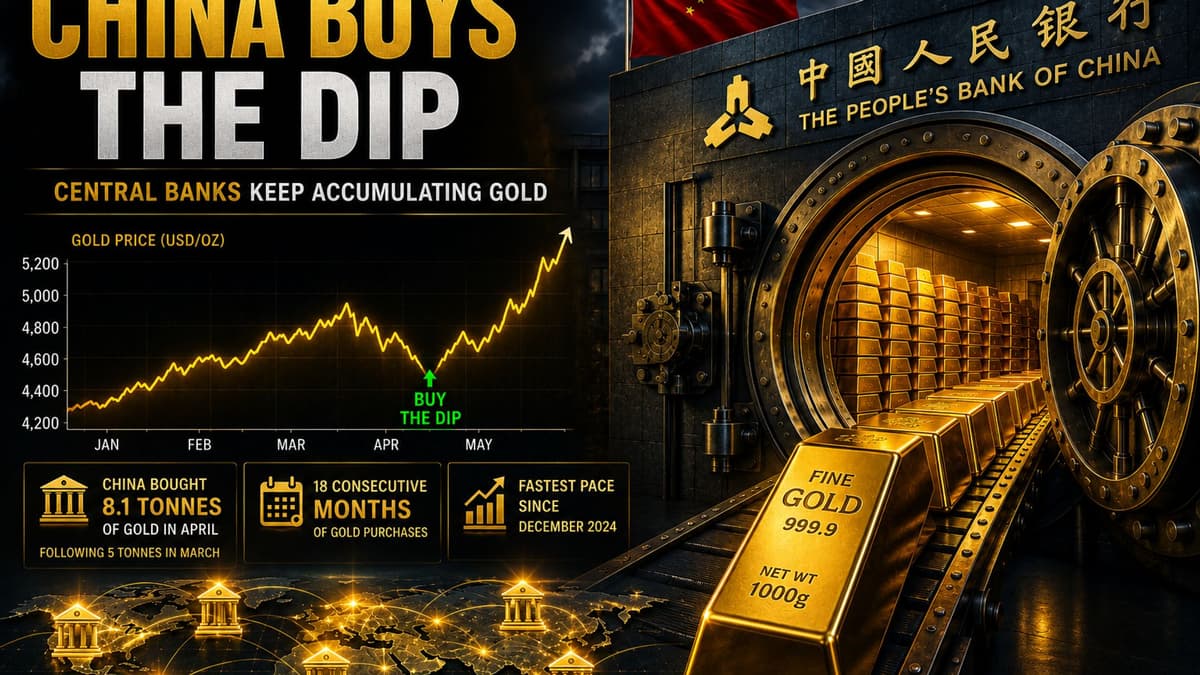
China bought 8 tonnes of gold in March, and that was its largest monthly purchase since December 2024. The People’s Bank of China has now raised its official gold reserves for 18 consecutive months.
China’s role matters because it remains one of the most closely watched central bank buyers in the global bullion market. According to the data, China does not appear to manage reserves based on short-term price signals alone, but it still seems willing to add during periods of weakness.
In March, that opportunistic buying came as gold prices remained roughly 16% below their January 2026 all-time highs. That suggests China viewed the pullback as a suitable point to keep building reserves.
For Indian investors, China’s steady accumulation is worth tracking because it can help support international gold prices in U.S. dollar terms. If XAUUSD finds a structural floor from official buying, domestic gold rates in India may also stay resilient, especially if the Indian rupee weakens against the dollar.
What does gold’s share of global reserves say about future demand?
Gold still has room to gain a larger share of official reserves. According to the World Gold Council, gold currently makes up roughly 15% of total global reserve assets.
That figure is important because it suggests central banks have significant scope to increase allocations over time. If reserve managers continue diversifying away from the U.S. dollar, gold’s share could rise further from current levels.
This is one reason many analysts remain constructive on the long-term gold price outlook. Even at elevated prices per troy ounce, official-sector demand may continue if institutions believe bullion improves reserve stability and reduces currency concentration risk.
Why are smaller central banks entering the gold market?
Smaller central banks are entering the gold market because they also want stronger reserve stability. Kosovo’s decision to purchase gold for the first time in its history shows that demand is broadening beyond the largest reserve holders.
This development matters because it points to an expanding role for precious metals in the global monetary system. When first-time buyers emerge, it signals that gold is not losing relevance at higher price levels.
Instead, participation is widening. That broadening base of buyers can strengthen the long-term demand profile for bullion and make the market less dependent on a few large institutions.
Has central bank gold demand become less price-sensitive?
Yes, recent behaviour suggests central bank gold demand has become less price-sensitive than in earlier cycles. Analysts note that official institutions appear to be focusing less on short-term valuation and more on strategic positioning.
That change has major implications for the gold price outlook. If central banks buy for policy reasons rather than tactical price reasons, their demand can remain steady even when bullion trades near historically elevated levels.
This also helps explain why many market participants now describe official-sector buying as a structural floor under gold prices. It does not eliminate volatility, but it can cushion corrections.
What could still push gold prices lower in the near term?
Gold is not immune to further downside pressure. Rising bond yields, a stronger U.S. dollar, and shifts in geopolitical tensions could still weigh on bullion in the near term.
These macro forces often influence investor appetite for non-yielding assets such as gold. Higher yields increase the opportunity cost of holding bullion, while a stronger dollar can make gold more expensive for non-U.S. buyers.
Still, the current pattern suggests that significant declines may continue to attract renewed sovereign demand. As long as central banks keep treating gold as a core reserve asset, deeper pullbacks could invite fresh official buying.
For Indian investors, that backdrop is particularly relevant. A correction in international gold prices may not fully translate into a sharp drop in domestic rates if the rupee remains under pressure. In practice, INR gold prices can remain firm even when global bullion softens.
What does this mean for the gold price outlook in India?
The gold price outlook remains supported by long-term central bank demand, even if short-term momentum stays muted. The market appears locked in consolidation as investors wait for the next macroeconomic catalyst.
Through the remainder of 2026, central bank accumulation may prove to be one of the most important forces underpinning gold. Indian investors should watch whether official buying continues on dips, along with moves in the U.S. dollar, bond yields, and the rupee, because those factors will shape both global XAUUSD trends and domestic bullion prices.