# Platinum Price Outlook: Supply Crunch Keeps Bullish Case Alive
Platinum prices remain below $2,000 per ounce at the start of London Platinum Week, but the broader bullish case has not disappeared. The World Platinum Investment Council (WPIC) says persistent supply deficits, falling above-ground inventories and renewed investor demand could push platinum higher again, even after recent consolidation.
For Indian investors tracking the wider precious metals market alongside gold price, silver, bullion, and XAUUSD trends, platinum stands out as a tightening physical market with support from industrial demand, automotive use, and investment flows.
Why is platinum still trading below $2,000 an ounce?
Platinum is still trading below $2,000 a troy ounce because the market has lost some momentum after a strong rally earlier this year, even though physical fundamentals remain tight. Prices at the start of London’s historic Platinum Week slipped back under that key level, showing that the market is still moving within a broader trading range.
The source article notes that platinum saw renewed momentum at the start of the month, but that strength has not yet been enough to break the wider consolidation pattern. In other words, price action has paused, while the underlying supply-demand setup remains supportive.
What does London Platinum Week signal for the market?
London Platinum Week matters because it often focuses investor attention on platinum’s supply, demand and pricing trends. This year, the event opened with platinum below $2,000 an ounce, underscoring that sentiment has improved but has not yet translated into a decisive breakout.
What is driving the bullish platinum price outlook?
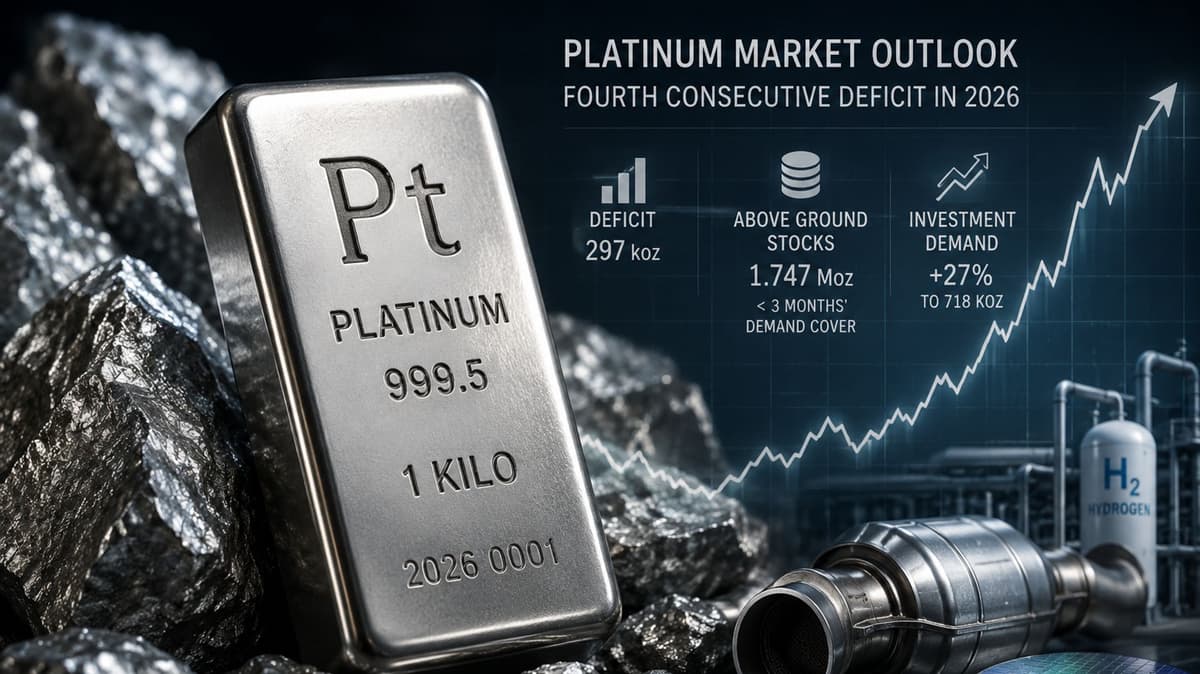
The bullish platinum price outlook is being driven by a market deficit, shrinking above-ground stockpiles, and stronger investor interest in physical assets. According to the WPIC’s first-quarter trends report published Monday, the platinum market is heading for its fourth consecutive annual deficit in 2026.
The WPIC expects supply to fall short of demand by 297,000 ounces in 2026. It also forecasts above-ground stocks will decline to just 1.747 million ounces by year-end, equal to less than three months of global demand coverage.
What did Trevor Raymond say about platinum fundamentals?
Trevor Raymond, CEO of the WPIC, said platinum fundamentals remain attractive. He said the market continues to be undersupplied and added that, despite geopolitical headwinds in the Middle East, platinum demand is well insulated.
That matters for investors because sustained deficits and low inventories usually leave a commodity market vulnerable to sharper price moves if demand improves or supply is disrupted.
Why do low above-ground stocks matter so much?
Low above-ground stocks matter because they limit the market’s buffer against disruption. In an interview with Kitco News, Edward Sterck, WPIC director of research, said one of the key drivers behind last year’s rally was the fact that above-ground stocks had fallen to unsustainably low levels.
Sterck said the market would need several years of significant surpluses to rebuild those inventories. That suggests the current tightness is structural, not temporary.
How tight is the platinum market in 2026?
The platinum market looks tight in 2026 because supply remains constrained while demand stays relatively resilient. Sterck said the core drivers behind the bull market are still intact despite recent price consolidation.
He said platinum still faces very constrained supply, while demand remains largely price inelastic. He pointed to automotive, industrial, and jewelry demand as major pillars that are changing year on year, but not drastically enough to weaken the market’s overall support.
What does the WPIC report say about total demand?
The WPIC expects total platinum demand to fall 9% in 2026 to 7.674 million ounces. The main reason is that last year’s large ETF and exchange stock inflows are unlikely to be repeated.
Even so, the report shows that underlying physical investment demand remains strong. That distinction is important because it suggests platinum is not losing broad appeal; instead, some demand categories are normalizing after an unusually strong prior year.
How strong is bar and coin demand?
Bar and coin demand is expected to be especially strong. The WPIC projects physical investment demand in bars and coins will jump 27% to 718,000 ounces, which would mark a six-year high.
For Indian investors, this is notable because it mirrors a wider trend in precious metals where buyers increasingly prefer tangible assets over financial instruments when debt, inflation, and currency concerns rise.
Why are investors paying more attention to platinum now?
Investors are paying more attention to platinum because it combines precious-metals appeal with tighter physical market dynamics than many peers. Sterck said investor interest is rising as concerns build around global debt, inflation and currency debasement.
He added that the investment case for platinum increasingly overlaps with broader precious metals demand as investors look for alternatives to U.S. dollar-denominated assets.
How does platinum compare with gold as a safe-haven asset?
Platinum is not replacing gold, but it is gaining attention because its supply backdrop is tighter. Sterck said that if investors look across the precious metal complex, platinum has the tighter market dynamics and may offer the greatest leverage to a scenario in which investors seek alternatives to the U.S. dollar.
Gold still dominates traditional safe-haven flows, especially in India, where gold price movements directly shape jewellery demand, investment buying and rupee-based bullion trading. But platinum’s tighter supply profile gives it a different kind of appeal for investors seeking diversification within precious metals.
What market signals show platinum tightness?
The WPIC said platinum’s tightness is visible in elevated lease rates and strong backwardation in over-the-counter forward markets. Those signals typically indicate strong near-term demand for physical material relative to future delivery.
Sterck framed the argument in simple terms: investors may increasingly prefer holding a physical asset with tangible value over paper money that may lose purchasing power.
For Indian investors, the comparison matters because a weaker U.S. dollar or inflation concerns can influence both international bullion prices and the INR cost of imported precious metals.
How is industrial demand supporting platinum prices?
Industrial demand is supporting platinum prices because usage in manufacturing and technology remains strong and is expected to rise this year. The WPIC forecasts industrial demand will increase 9% to 2.238 million ounces, led by a rebound in glass manufacturing capacity expansions.
That is a major pillar of support because it adds real-economy demand to the investment story.
How is artificial intelligence increasing platinum demand?
Artificial intelligence infrastructure is emerging as a long-term platinum demand driver. Sterck said platinum group metals are essential in producing specialty crystals used in semiconductors, optical communications, and data centers.
He said current data center technology cannot function without platinum and the broader PGM complex. He also said China alone may have consumed a quarter-million ounces last year for these crucibles.
Although much of that platinum is recyclable, Sterck said the wider AI buildout is adding another layer of structural demand to an already undersupplied market.
Could hydrogen become a major platinum demand driver?
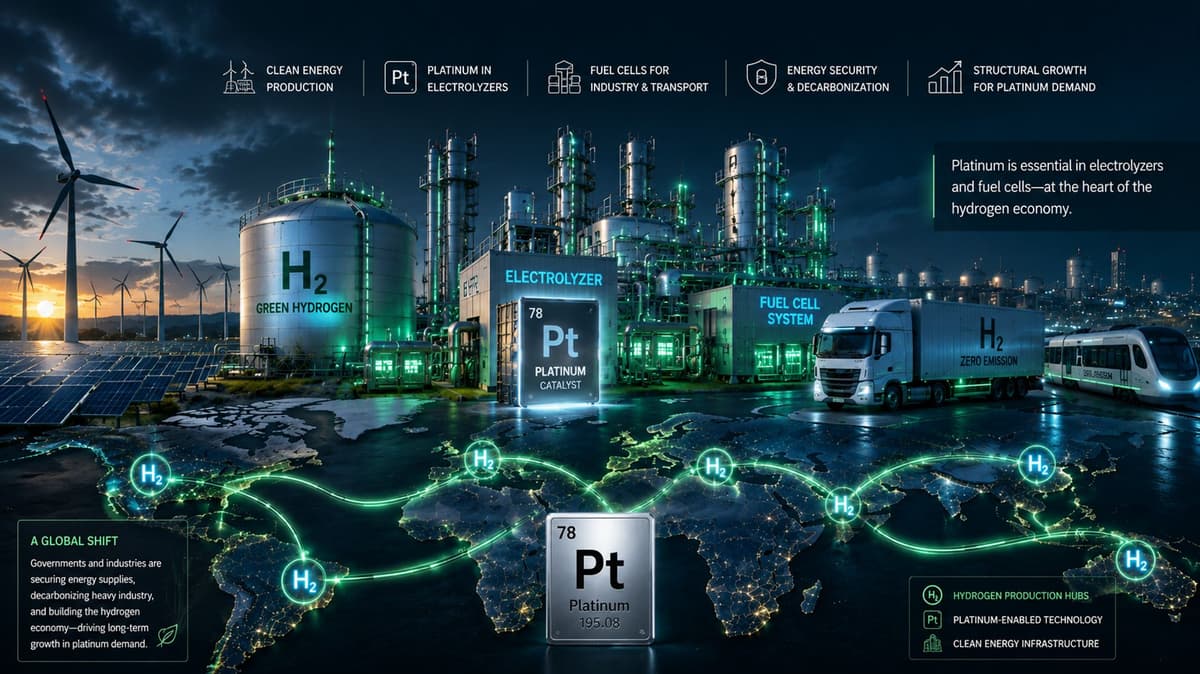
Yes, hydrogen could become an important future demand source for platinum. Sterck said governments are placing greater emphasis on regional energy security because of geopolitical tensions and deglobalization, which could increase interest in hydrogen technologies.
He argued that not everything can be electrified. He said steel cannot be reduced with electricity alone, and fertilizer or ammonia cannot be produced with electricity alone, so hydrogen remains essential.
Sterck added that growing investment in renewable energy infrastructure and green hydrogen production could become a significant platinum demand driver over the next several years, even if it does not materially affect this year’s forecasts.
How resilient is platinum demand during economic uncertainty?
Platinum demand appears relatively resilient even during slower growth and geopolitical stress. Sterck said the platinum demand profile is relatively recession-proof.
He acknowledged risks to automotive production if supply chains are disrupted, but said industrial demand and investment demand would likely counterbalance that weakness.
What is happening to automotive platinum demand?
Automotive demand is expected to remain broadly stable. The WPIC forecasts automotive platinum demand will decline only 2% this year to 2.959 million ounces, despite weaker internal combustion engine production.
Support is coming from hybrid vehicle growth and heavy-duty vehicle demand in the U.S. and India. That India reference is important because it links platinum directly to domestic vehicle trends, making the outlook relevant for Indian investors watching local industrial demand and import patterns.
Why is platinum supply still constrained?
Platinum supply is still constrained because mine output is barely growing and recycling, while improving, still faces limits. The WPIC forecasts mine supply will remain broadly flat in 2026 at 5.551 million ounces.
Modest gains in South Africa are expected to be offset by declines elsewhere, leaving total mined output largely unchanged.
Is recycling enough to solve the shortage?
No, recycling is not enough to fully solve the shortage. The WPIC expects recycling supply to rise 9%, but recyclers continue to face operational and financial constraints.
That means secondary supply may help at the margin, but it is unlikely to eliminate the broader market deficit on its own.
What does this platinum outlook mean for Indian investors?
For Indian investors, the platinum outlook highlights a different opportunity within the precious metals space. Gold remains the dominant safe-haven asset in India, but platinum offers exposure to a market where inventories are tighter, industrial demand is expanding, and supply growth remains limited.
A stronger platinum price can also affect import costs in rupee terms if the INR weakens against the U.S. dollar. Investors comparing gold price, silver, and platinum trends may find platinum attractive as a diversification play, especially if concerns over inflation, debt, currency debasement and physical asset ownership continue to build.
Sterck said investors are not necessarily focused on price levels right now. Instead, they are looking for trends. That makes upcoming data on above-ground inventories, investment demand, automotive use in India, and industrial consumption key watchpoints for the next move in platinum prices.