# Gold Reserves Shift: BRICS+ Buying Powers a Bullish Market
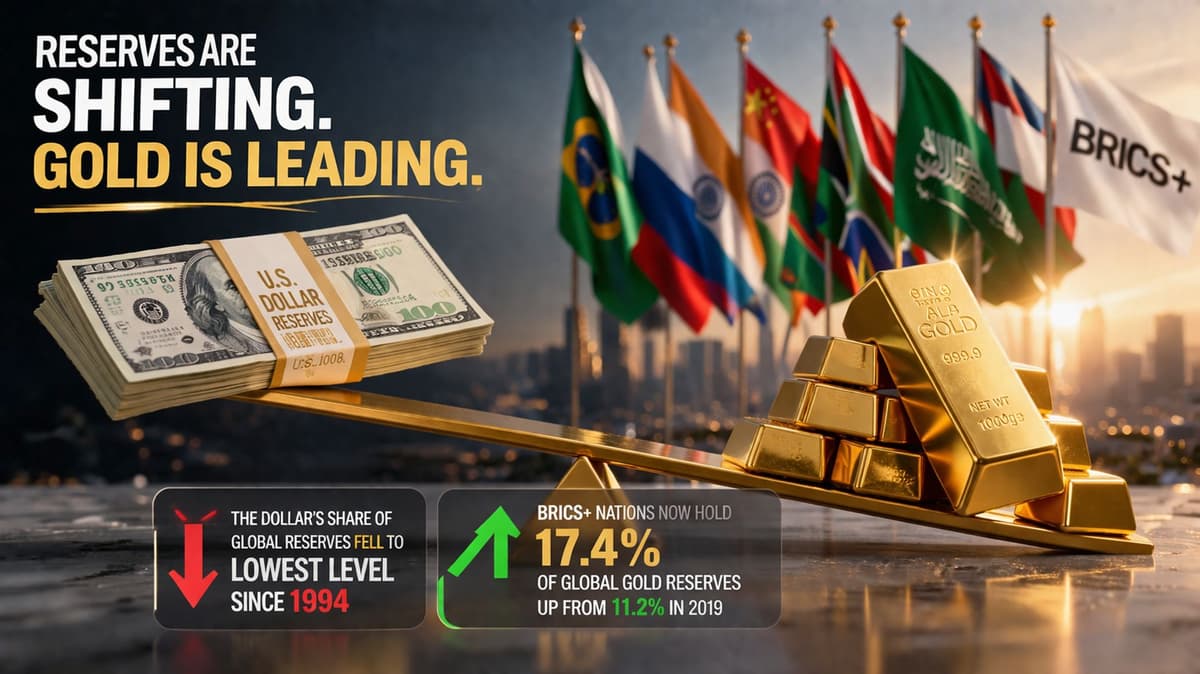
BRICS+ central banks are driving a structural shift in the gold market, and the trend is becoming too large for investors to ignore. According to Michael Harris, technical analyst at EBC Financial Group, BRICS+ nations now hold more than 6,000 tonnes of gold, equal to about 17.4% of total global central bank reserves, up from 11.2% in 2019.
At the same time, the U.S. dollar’s share of global reserves has fallen to roughly 57% by the end of 2025, its lowest level since 1994. For Indian investors, that matters because sustained sovereign demand can keep the global gold price elevated, which in turn supports domestic bullion prices in rupee terms.
Why are BRICS+ nations buying more gold?
BRICS+ nations are buying more gold because central banks increasingly see bullion as a strategic reserve asset that cannot be frozen or confiscated through foreign financial systems. Harris said this is policy-driven demand, not speculation.
In a new analysis published Tuesday, he wrote that central banks bought more gold in the past three years than at any point in modern history. He added that the concentration of bullion among BRICS+ reserves is rising sharply.
“Central banks bought more than total annual mine production of several mid-sized gold-producing countries in 2025,” Harris said. “This is not speculative demand, it is policy.”
He also stressed that the buying has been broad-based. Russia, China, India, Turkey, and Poland led the accumulation, but more than 40 central banks participated in 2025.
Which BRICS+ countries hold the most gold?
Russia and China dominate BRICS+ gold holdings. Harris said BRICS+ countries now hold over 6,000 tonnes of gold.
Russia leads with 2,336 tonnes. China holds 2,298 tonnes, and India follows with 880 tonnes. Together, Russia and China account for roughly 74% of the bloc’s total gold holdings.
The BRICS+ grouping originally included Brazil, Russia, India, China, and South Africa. It later expanded to include Egypt, Ethiopia, Iran, and the UAE.
How much gold have BRICS central banks bought recently?
BRICS central banks represented more than half of all sovereign gold purchases globally between 2020 and 2024. Harris said that in the first nine months of 2025 alone, BRICS nations added 663 tonnes worth about $91 billion.
Brazil also returned to the market. It made its first gold purchase since 2021 by adding 16 tonnes in September 2025.
What triggered the move away from dollar reserves into gold?
The key trigger was the freezing of Russia’s foreign exchange reserves in 2022. Harris said the United States and its allies froze roughly $300 billion in Russian reserves after Russia invaded Ukraine, and that changed how central banks view reserve safety.
“That action sent a clear message to every central bank holding dollar-denominated assets: reserves stored in another country’s financial system can be seized,” Harris wrote.
The response was immediate. Central bank gold purchases jumped from roughly 500 tonnes per year before 2022 to more than 1,000 tonnes annually in each of the three years since.
Gold held in domestic vaults offers a different type of security. Harris said gold stored domestically cannot be frozen or confiscated through the SWIFT system, which helps explain the acceleration in sovereign bullion buying.
How fast is the U.S. dollar losing reserve share?
The U.S. dollar is losing reserve share gradually, not through outright dumping but through faster growth in competing assets. Harris cited IMF COFER data showing the dollar’s share fell from 71% in 1999 to roughly 57% by the end of 2025.
That is the lowest level since 1994. However, Harris noted that foreign central bank holdings of dollar-denominated assets have actually remained steady since 2014.
Is de-dollarisation happening through selling dollars?
No, not primarily. Harris said the decline in the dollar’s share is being driven more by reserve diversification than by active selling.
Reserve growth has been stronger in euros, yen, gold, and a widening basket of non-traditional currencies. That means gold is gaining a bigger role inside official reserves even without a dramatic liquidation of U.S. assets.
What do central banks expect next?
Central banks expect the dollar’s reserve role to weaken further and gold holdings to rise. Harris cited the 2025 World Gold Council survey, which found that 73% of participating central bankers believe the dollar’s reserve share will decline further over the next five years.
The same survey showed that 43% of surveyed central banks plan to increase their gold holdings. Harris said both figures are record highs.
How important is gold now in official reserves?
Gold has become much more important in central bank reserve portfolios. Harris wrote that gold’s share of official reserve assets has more than doubled from below 10% in 2015 to over 23% today.
Part of that increase reflects the sharp rise in the gold price. But Harris said the direction is clear: central banks are allocating a bigger share of reserves to bullion, and the Hormuz crisis has added urgency to that process.
For Indian investors, this matters because policy-driven demand tends to be less price-sensitive than ETF or speculative futures demand. That can create stronger support for XAUUSD and, by extension, domestic gold prices in INR.
Could Saudi Arabia become the biggest gold market wildcard?
Yes, Saudi Arabia could become a major new source of central bank gold demand if it raises its allocation even modestly. Harris called the Kingdom one of the biggest wildcards in the sovereign shift toward gold.
Saudi Arabia currently holds about 323 tonnes of gold, equal to just 2.6% of its total reserves. For a country with more than $500 billion in reserves, Harris said that allocation is remarkably low.
What would happen if Saudi Arabia lifted gold allocation to 5%?
A move to 5% gold allocation would be huge. Harris said that such a step would require purchases equivalent to the entire projected central bank demand for 2026 from a single buyer.
The Kingdom has not publicly announced plans to increase gold holdings. But Harris said its BRICS+ membership, participation in the mBridge platform, and deepening ties with Beijing all suggest a broader strategic repositioning that could logically include more gold.
What does central bank demand mean for gold prices in 2026?
Central bank demand is creating a structural floor under gold prices. Harris said gold was trading near $4,660 per ounce in early April 2026 after surging more than 60% in 2025 alone.
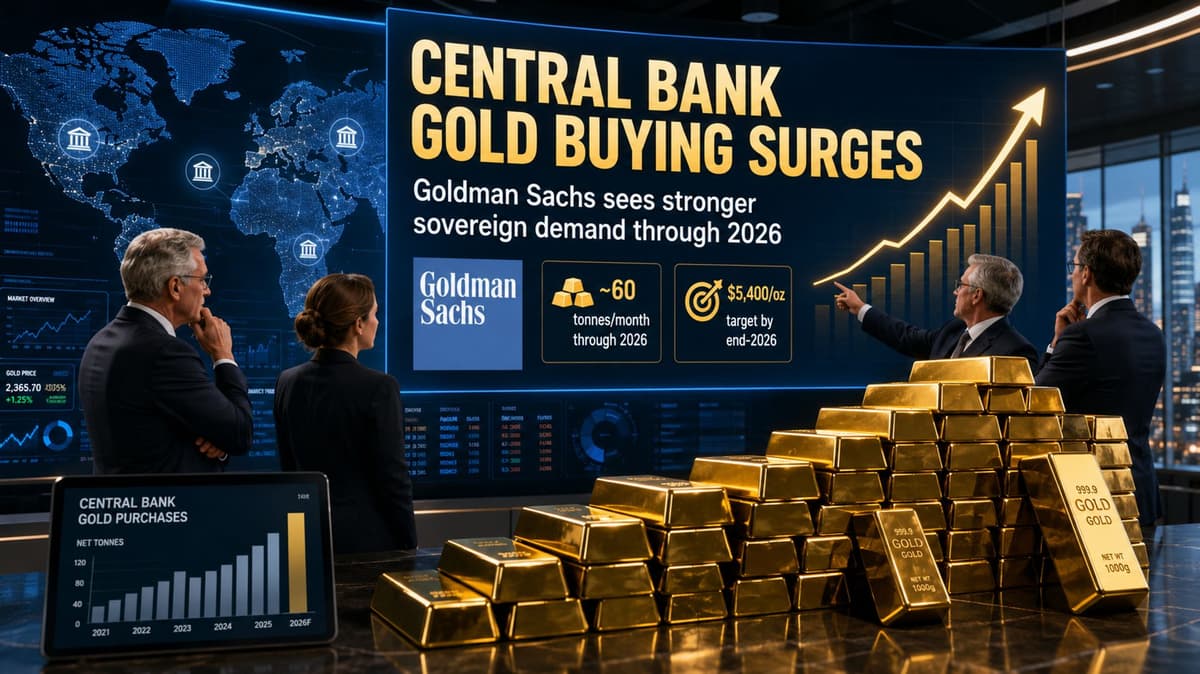
That rally has pushed major bank forecasts sharply higher. Deutsche Bank is targeting $6,000, JPMorgan sees $6,300, Goldman Sachs forecasts $5,400, and Societe Generale calls $6,000 conservative.
The World Gold Council projects 750 to 850 tonnes of central bank purchases in 2026. Harris said that remains far above historical norms.
How much mine supply are central banks absorbing?
Central banks could absorb about 20% of annual global mine supply in 2026. Harris said that volume would be taken out of the market as a one-directional flow regardless of whether gold trades at $4,000 or $5,000 per troy ounce.
That matters for price action. He said this steady sovereign buying has made each correction shallower than the last, reinforcing a long-term bullish structure in bullion.
Are ETF and institutional flows adding to the rally?
Yes, institutional demand is reinforcing central bank buying. Harris said gold ETF inflows accelerated through 2025, while China’s insurance sector received pilot allocations to gold.
“When sovereign, institutional, and retail buyers all move in the same direction simultaneously, the supply-demand picture tightens in ways standard price models fail to capture,” he wrote.
What does this trend mean for Indian gold investors?
For Indian investors, the message is that global central bank demand is becoming a powerful support for gold prices. India is already part of the sovereign buying trend, with 880 tonnes in reserves, and any sustained rise in XAUUSD can feed directly into domestic bullion and jewellery prices.
A weaker dollar share in global reserves does not automatically mean a collapse in the U.S. currency. But it does suggest that gold may keep gaining strategic importance in central bank portfolios, which can support prices even during pullbacks.
That has direct implications for rupee-based investors. If global bullion remains firm while the Indian rupee weakens against the U.S. dollar, local gold prices can rise faster than international prices.
Harris also outlined three possible future catalysts that could speed up the shift away from the dollar and into gold. The first is greater transparency from China. He said that if China reveals larger-than-expected gold holdings, it would act as an immediate catalyst for the market.
For now, that is one of the most important watchpoints for Indian investors tracking the next leg higher in gold.