# Gold Price Warning: Heraeus Sees Bull Market Pause for Months
Gold and silver flashed bearish technical signals in March, and Heraeus says the precious metals bull market may stay on hold for several months. For Indian investors, that means gold price volatility could remain elevated even as central bank buying, inflation risks and shifting Federal Reserve policy expectations continue to support the longer-term case for bullion.
Why does Heraeus think the gold bull market may pause for months?
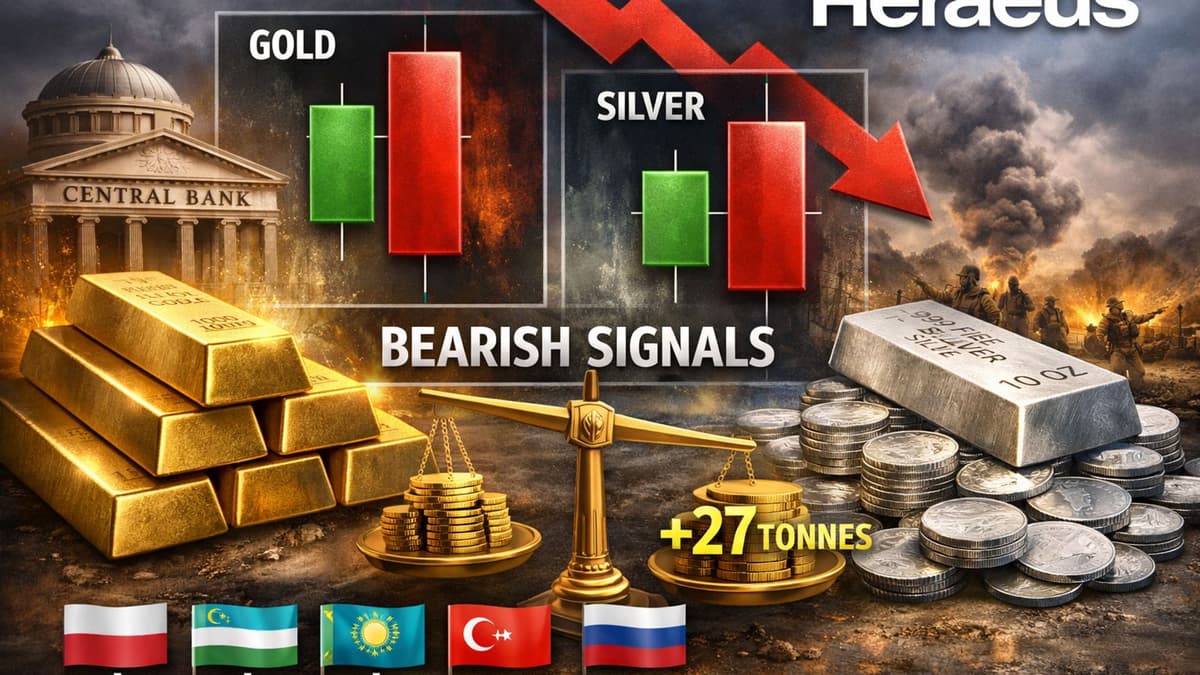
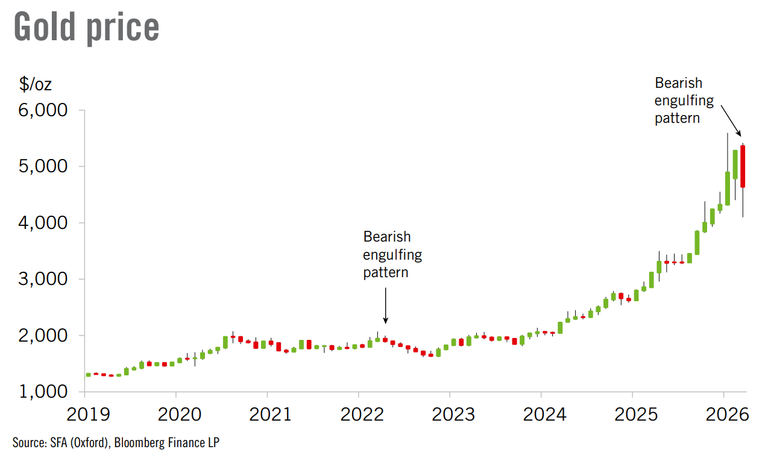
Heraeus says gold and silver both printed bearish engulfing patterns in March, a technical signal that often points to consolidation or further downside before an uptrend resumes. The firm said this could mean the precious metals bull market is still as much as six months away from fully resuming.
According to Heraeus analysts, gold’s monthly chart showed a bearish engulfing pattern because the price in March opened higher and closed lower than the previous month. They said this matched the stalling of the bull market in late January and the start of the U.S.-Israeli military operation in Iran.
Heraeus compared the current setup with April 2022. The last bearish engulfing pattern then was followed by six consecutive months of losses, with gold falling from $2,000 per ounce to $1,600 per ounce.
The analysts did not say the long-term bull market is over. Instead, they said the current correction could still be absorbed within the broader uptrend if inflation stays elevated and real interest rates remain low, both of which support demand for gold as a safe-haven asset.
For Indian investors, this matters because a pause in international gold price momentum can affect domestic bullion rates even if local prices remain supported by rupee weakness, import costs or festival demand. In other words, MCX gold and physical gold prices in India may not move in a straight line from here.
What is the key gold price level traders should watch now?
The key near-term support level Heraeus flagged is around the March lows at $4,100 per ounce. The firm said if the uptrend seen over the last week reverses, gold could move toward that area.
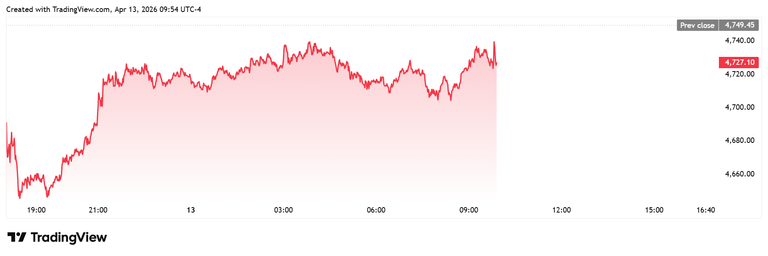
At the same time, spot gold is still trying to push higher. On Monday morning, gold traded near session highs as it challenged resistance near $4,800 per ounce.
Spot gold was last at $4,767.01 per ounce, up 0.47% on the session. That leaves XAUUSD caught between strong resistance near $4,800 and downside support near $4,100, a range Indian traders should closely monitor.
How should Indian investors read these levels?
Indian investors should view $4,800 as a key resistance zone and $4,100 as a major support band in the global market. If the U.S. dollar strengthens or rate-cut hopes fade, global gold price pressure could spill into domestic prices, though INR moves can cushion or amplify that effect.
If the rupee weakens against the U.S. dollar while spot gold corrects, Indian retail prices may not fall as sharply as international bullion prices. That currency pass-through is especially important for jewellery buyers, ETF investors and MCX participants.
How is the Federal Reserve influencing gold prices?
The Federal Reserve is influencing gold because it faces a difficult trade-off between inflation and employment. Heraeus said the Fed is in a tough position on interest rate policy as prices are expected to keep rising while employment remains stagnant.
The analysts wrote that the Fed must balance its dual mandate of maximum employment and stable prices. Even with a ceasefire in the Middle East, they said inflation is likely to stay higher for a period, which suggests the Federal Reserve should hold rates steady or even raise them.
At the same time, labour market signals are mixed. Non-farm payrolls rose by 178,000 in March, beating expectations by 118,000, according to the U.S. Bureau of Labor Statistics.
But Heraeus also noted that revisions have been negative in 11 of the last 12 reported months from January 2025, with the average revision at -51,000. The analysts added that the total number of non-farm employees has remained relatively stagnant since the end of 2024 after the post-Covid recovery.
Why do stagnant jobs and sticky inflation matter for bullion?
Sticky inflation usually supports gold because investors use bullion as a hedge against declining purchasing power. But high interest rates can also limit upside because they raise the opportunity cost of holding non-yielding assets like gold and silver.
Heraeus said if higher costs slow economic growth, that would hurt employment. A weaker job market could then push the Federal Reserve to cut the Federal Funds Rate to support the economy and jobs, which would generally be supportive for gold price sentiment.
What changed after the April 7 ceasefire announcement?
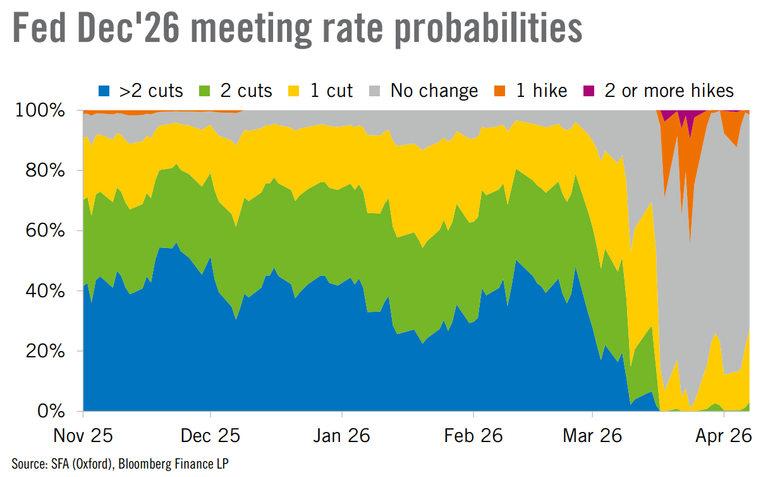
Rate-cut expectations increased after the April 7 ceasefire announcement. Heraeus said the probability of one to two interest rate cuts in 2026 rose to 27.3% on April 9, up from 14.1% before the ceasefire news.
The analysts said the initial market reaction was for previously sold-off assets to rally, while assets that had risen, including energy and the U.S. dollar, fell. That move helped lift precious metals prices on Wednesday and allowed them to end the week higher.
For Indian investors, lower U.S. rate expectations can support gold by weakening the dollar and improving sentiment toward safe-haven assets. However, if the Fed stays hawkish for longer, gold may struggle to break decisively above resistance.
Are central banks still buying gold despite some sovereign selling?
Yes, central banks remained net buyers of gold in February. Heraeus said official sector purchases totaled a net 27 tonnes in February, up sharply from January’s net 5 tonnes.
The National Bank of Poland led the buying by adding 20.2 tonnes of gold to reserves in February. Heraeus said that was Poland’s largest addition since February 2025, when it bought 29 tonnes.
Uzbekistan added 7.8 tonnes and Kazakhstan added 7.7 tonnes. The major sellers were Turkey, which sold 8.1 tonnes, and Russia, which sold 6.2 tonnes.
Heraeus said this fits the broader trend of central bank gold accumulation since the global financial crisis. Last year, central banks added 863 tonnes to their reserves.
Why should Indian investors care about central bank buying?
Central bank demand is one of the strongest structural supports for gold. When official institutions keep adding bullion, they help absorb supply and reinforce gold’s role as a reserve asset during periods of geopolitical stress and inflation uncertainty.
For Indian investors, sustained central bank buying can help limit deeper corrections in international gold price benchmarks over time. That backdrop remains constructive for long-term allocation decisions even if short-term price action stays choppy.
What bearish signals did silver send in March?
Silver also sent a bearish technical signal in March, according to Heraeus. Like gold, silver formed a bearish engulfing candle on the monthly chart, suggesting several months of consolidation and sideways-to-lower price action may follow before the bull market resumes.
The analysts said silver’s March price opened above the end-February close, then fell and ended March below the level where it had started February. Because the pattern appeared on a monthly chart, Heraeus said the implication is more significant and may point to a longer pause in the uptrend.
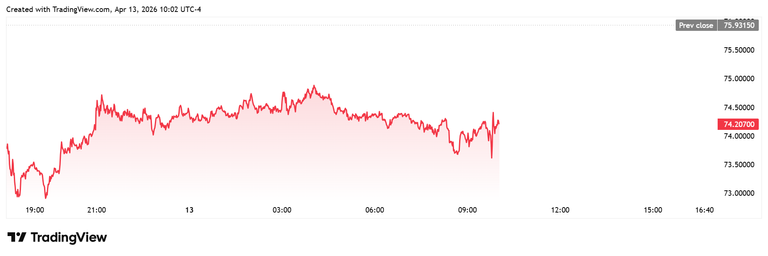
Spot silver traded in a very narrow range after spiking higher early in the Asian session overnight. It was last at $74.212 per ounce, up 2.26% on the daily chart.
How did physical silver demand perform?
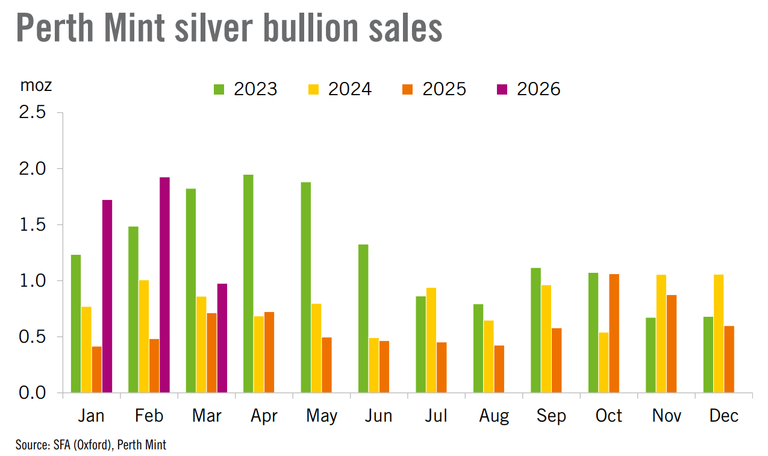
Physical silver demand softened in March from very strong February levels, but 2026 still started much better than 2025. Heraeus said the Perth Mint sold 976,450 ounces of silver bars and coins in March, down sharply from almost 2 million ounces in February, which had been the strongest monthly total in more than two years.
The analysts said investors had used the sharp sell-off that ended in early February to increase exposure. Even after the March slowdown, total Perth Mint silver sales exceeded 4.6 million ounces in the first quarter, showing that 2026 has started far more strongly than 2025.
The U.S. Mint also reported slightly weaker silver American Eagle coin sales. Sales fell from 1.7 million ounces in February to 1.6 million ounces in March, which Heraeus still described as respectable.
For the first three months of the year, U.S. Mint silver American Eagle sales totaled more than 8.1 million ounces, up from 5.3 million ounces in the same period last year. Heraeus added that 2025 posted the lowest annual total since 2007.
What does this outlook mean for Indian gold investors now?
Indian investors should prepare for a period of range-bound or volatile bullion trading rather than assume an uninterrupted rally. Heraeus’ analysis suggests gold and silver may need several months to digest recent gains even though inflation, low real rates and central bank buying continue to offer medium-term support.
That means portfolio strategy matters more than chasing short-term spikes. Investors in India should track three variables closely: whether spot gold clears $4,800 per ounce, whether it slips toward $4,100 support, and whether the Federal Reserve leans toward holding rates, hiking, or cutting in response to inflation and jobs data.
The rupee will also remain crucial. Even if global XAUUSD pauses, INR weakness can keep domestic gold prices elevated, especially ahead of seasonal Indian demand. The next big watchpoint is whether gold can sustain the latest rebound without reversing lower, because that will determine whether this is only a correction within a bull market or the start of a longer consolidation phase.