# Gold Price Volatility Masks Gold’s Rising Store-of-Value Role
Gold is becoming more important as a store of value even though the gold price has turned unusually volatile, according to the Swiss Bankers Association. In a note published on Wednesday, Nina-Alessa Michel, policy advisor for regulation and economics at the Swiss Bankers Association, argued that a more fragmented and politically sensitive global financial system is increasing gold’s strategic role in portfolios, central-bank reserves, and trade.
For Indian investors, that message matters because domestic bullion prices do not move only on local jewellery demand. They also track global XAUUSD swings, safe-haven flows, U.S. monetary-policy expectations, and the rupee’s exchange rate against the U.S. dollar.
Why does the Swiss Bankers Association say gold matters more now?
Gold matters more now because geopolitical tension, economic stress, and rising government debt are lifting demand for safe investments. Michel said recent events once again show how tightly gold prices are linked to global uncertainty.
She wrote that, "Against a backdrop of geopolitical and economic tensions and rising government debt, demand for safe investments is increasing." In her view, that does not automatically mean a straight-line rally in bullion prices, but it does mean gold is gaining relevance as a strategic reserve asset.
Michel said global capital markets are being shaped by fragmentation, conflicts, and shifting balances of power. That backdrop is pushing investors toward safe-haven assets such as gold, even when short-term price action looks unstable.
For Indian investors, this supports gold’s long-term role in diversification. Even if XAUUSD suffers sharp corrections, global stress can still reinforce demand for physical gold, sovereign reserves, and investment allocations over time.
Why has gold price volatility increased despite safe-haven demand?
Gold price volatility has increased because gold is reacting quickly to geopolitical headlines and shifts in monetary-policy expectations. Michel said gold has recently been much more volatile than many investors would normally expect from a classic safe-haven asset.
She pointed to a sharp example: gold fell by 14% in the space of three days when Donald Trump nominated the next Chairman of the U.S. Federal Reserve. That move also put pressure on silver and Bitcoin.
Michel said this kind of swing shows that gold is not always the safest of havens in the short term. Instead, gold can react sensitively to geopolitical developments and monetary-policy shifts, especially when markets rapidly reprice risk, liquidity, and interest-rate expectations.
That distinction is important for Indian investors. Gold can still serve as a strategic hedge in a portfolio, but near-term bullion prices can remain highly volatile in rupee terms when global prices swing and the INR-USD exchange rate moves at the same time.
How do political and policy signals move gold so sharply?
Political signals can move gold sharply because traders often react before policies are fully confirmed. Michel said even rumours can trigger major price moves.
She cited the U.S. tariff episode as an example. Gold rose when the U.S. government appeared to suggest tariffs on gold, and then the price fell back when officials said no such tariffs were planned.
Michel warned that political signals and regulatory decisions will likely keep driving stronger short-term market reactions than underlying fundamentals. She said last year’s debate over international trade and sanctions policies showed that even rumours of fresh barriers can affect the gold market, whether or not those barriers are eventually introduced.
How important is Switzerland in the global gold market?
Switzerland is highly important in the global gold market because it is a major hub for refining, trading, and financing gold flows. Michel said the country’s refineries, trading networks, and international links make the Swiss banking centre especially sensitive to global political news.
She argued that rising demand, potential export restrictions, or international sanctions can have a direct effect on Switzerland’s real economy. That is because Swiss financial and industrial infrastructure sits close to the centre of global bullion flows.
The trade data underline that role. In the first half of 2025 alone, Switzerland exported more than 476 tonnes of gold worth CHF 39 billion to the United States.
Michel said U.S. demand was being driven by uncertainty, inflation, and concerns about a further rise in government debt. For Indian readers, that is a reminder that the global gold market is shaped not just by jewellery consumption, but by cross-border trade, reserve management, and financial stress in major economies.
What role do central banks and stablecoins play in gold demand?
Central banks and stablecoins are both becoming more important buyers of gold. Michel said many central banks are increasing gold’s role as they diversify reserves and reduce dependence on traditional hard currencies.
She also highlighted stablecoins, especially Tether. According to Michel, Tether bought around 70 tonnes of gold in 2025, more than most central banks.
That is a notable signal for the bullion market because it broadens the buyer base beyond jewellery consumers, ETF investors, and official-sector institutions. For Indian investors, it means gold demand is increasingly being shaped by non-traditional financial players as well as central banks.
What happened to gold prices in 2026?
Gold started 2026 with an explosive rally before correcting sharply. Michel said that after an exceptionally strong performance in 2025, the uptrend continued into 2026 even faster and more forcefully than many market participants had expected.
At the start of the year, gold was trading around USD 4,330 per troy ounce. It then surged in the opening weeks on sustained demand and a market environment still filled with uncertainty.
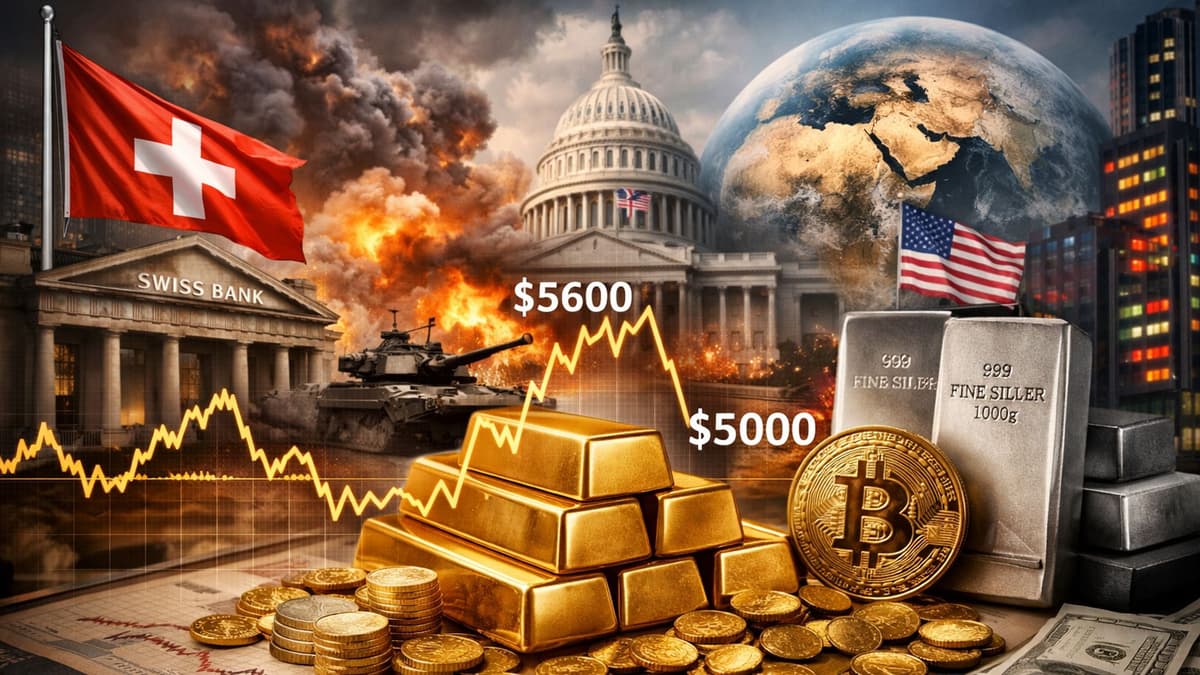
Michel said gold was breaking records almost daily in mid-January. It peaked at an all-time high of almost USD 5,600 on 28 January, with a record intraday high of USD 5,597.23 per ounce.
That move also carried gold decisively above the psychologically important USD 5,000 mark within just a few weeks. But Michel said the outsized upward momentum did not prove sustainable over the longer term.
Why did gold fall after hitting record highs?
Gold fell after its January peak because investors took profits and markets began speculating about the future direction of U.S. monetary policy. Michel said those factors triggered a marked correction at the end of January and the start of February.
Over a few days, the gold price dipped below USD 5,000 at times before slowly stabilising. Michel added that since the outbreak of the Iran War on 28 February, there has been a renewed drop.
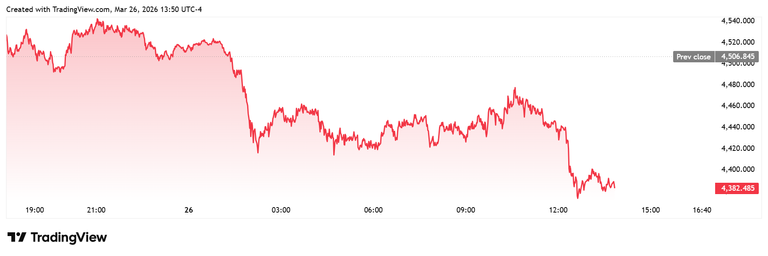
The source text also notes that gold later broke below USD 4,400 per ounce, reinforcing the scale of the correction and the elevated volatility. For Indian bullion buyers, such fast moves can create both risk and opportunity, especially when rupee weakness cushions local prices or rupee strength limits imported gains.
What could drive gold prices next?
Gold prices will likely be driven by structural trends rather than one-off events alone. Michel said the Swiss Bankers Association expects the next phase in gold to reflect geopolitics, reserve diversification, inflation, liquidity, and risk perception.
She said geopolitical uncertainty will play a central role. In her words, the larger the shifts in global balances of power, the more attractive gold will become as a strategic reserve.
Michel also said gold’s importance for central banks will continue to increase as more of them try to diversify currency reserves and reduce dependence on traditional hard currencies. That trend matters for India because central-bank buying can help support long-term bullion demand even when speculative flows fade.
How does monetary policy affect gold now?
Monetary policy still matters, but Michel said its effect now runs more through risk perception and liquidity conditions than through any single rate decision. In other words, gold responds not just to whether the Federal Reserve hikes or cuts, but to how policy shapes confidence, inflation expectations, and the availability of market liquidity.
She added that fluctuating inflation and changing interest-rate expectations continue to support demand for investments that tend to be stable. For Indian investors, that means tracking the Federal Reserve, U.S. real yields, and the dollar remains essential when evaluating gold price risk.
What does this outlook mean for Indian gold investors?
Indian investors should view gold as a strategic anchor, not as a guaranteed one-way trade. Michel said gold can be a central component of diversification, but only as part of an overall investment strategy.
She concluded that stability today comes less from any single asset class and more from forward-looking risk management that accounts for geopolitical and regulatory developments. That framework is highly relevant in India, where gold demand spans jewellery, coins, bars, ETFs, and portfolio hedging.
The core takeaway is that gold’s role is expanding even if price action stays violent. If geopolitical fragmentation deepens, reserve diversification accelerates, and policy uncertainty remains high, Indian investors should watch not only the next XAUUSD move, but also central-bank buying, trade restrictions, sanctions risk, U.S. debt concerns, and rupee moves that shape domestic bullion prices.