# Gold Price Tumbles to 6-Week Low as Inflation Fears Roil Markets
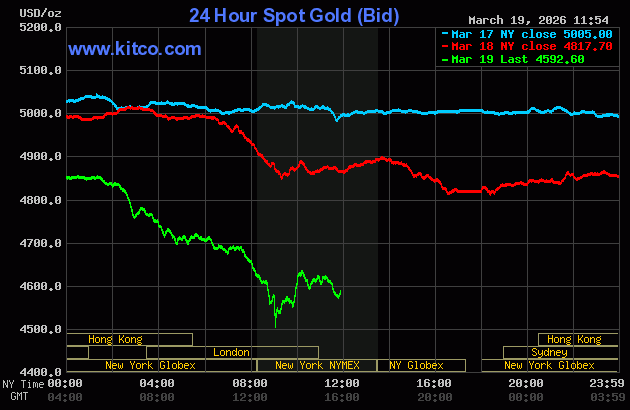
Gold and silver prices fell sharply to six-week lows in midday U.S. trading on Thursday as traders reacted to stubborn inflation risks, tighter-for-longer central bank policy expectations, and fresh geopolitical stress from the Middle East.
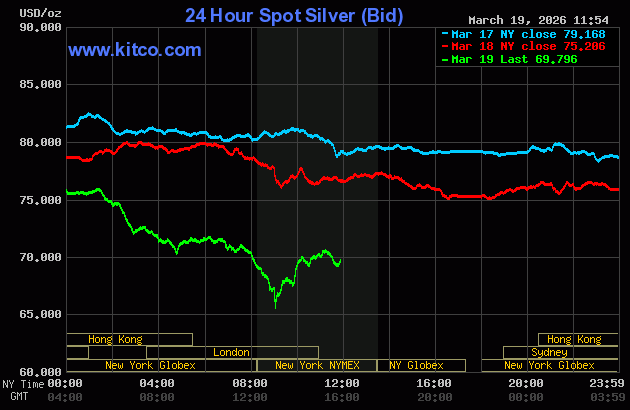
According to Kitco News, April gold was last down $319.20 at $4,576.20, while May silver fell $8.152 to $69.50. The selloff extended a steep correction from late January highs, with gold futures now down more than $900 per ounce from their record high and silver down more than $50 per ounce from its own late-January peak.
For Indian investors, the global gold price slide matters because international bullion moves feed directly into domestic landed costs, MCX gold trends, jewellery pricing, and sentiment toward safe-haven assets. However, any relief in rupee gold prices may be uneven if energy costs remain high and pressure India's import bill.
Why did gold prices fall sharply on Thursday?
Gold prices fell because traders feared that problematic inflation will keep monetary policy tight for longer. That outlook reduces enthusiasm for non-yielding assets such as gold and silver and can also curb consumer and commercial demand for precious metals.
Kitco News said the market was being hammered by worries that persistent inflation would keep central banks from easing quickly. In that environment, investors expect tighter financial conditions to stay in place, which is typically negative for bullion in the short term.
April gold was last down $319.20 at $4,576.20 in midday U.S. trading. May silver was down $8.152 at $69.50, underscoring that the pressure was broad across precious metals, not limited to XAUUSD alone.
How big has the correction been from January highs?
The decline has been severe. Gold futures prices are now down more than $900 an ounce from the late-January record high.
Silver has also suffered a deep retreat. Silver prices are down more than $50 an ounce from the record high they reached in late January.
That scale of decline shows how quickly sentiment has shifted from momentum buying to inflation-driven liquidation. For Indian bullion buyers, such sharp moves can create opportunities, but they also increase short-term volatility in local gold price discovery.
How did the Federal Reserve influence gold and silver?
The Federal Reserve pressured gold by signaling that inflation remains a problem and that rate cuts will be limited. Higher-for-longer U.S. interest rates reduce the appeal of holding non-yielding precious metals such as gold and silver.
Federal Reserve officials left U.S. interest rates unchanged on Wednesday, which the market had fully expected. The Federal Open Market Committee, or FOMC, said it expects just one interest rate cut this year because uncertainty has increased due to the war in the Middle East.
Fed Chair Jerome Powell reinforced the message. Powell said progress in reducing inflation is still needed before the Federal Reserve can resume lowering rates.
The Federal Reserve also raised its outlook for inflation in 2026 to 2.7% annually. That higher inflation projection added to market concern that policy will stay restrictive for longer than many traders had hoped.
What else did Jerome Powell say?
Jerome Powell also said he has no intention of resigning from the Federal Reserve Board of Governors until an investigation of the Federal Reserve by the U.S. Department of Justice has concluded. While that comment was not the main market driver, it added to the broader policy backdrop investors were already parsing.
For Indian investors, the key message is straightforward: when the Federal Reserve signals fewer cuts and higher inflation, global bullion often faces pressure even when long-term safe-haven demand remains intact.
How is the Middle East war affecting metals markets?
The worsening war in the Middle East is lifting energy prices and raising risks to the global economy, which is hitting industrial metals and complicating the outlook for precious metals. Higher oil prices can worsen inflation fears, which in turn hurts gold if traders believe central banks will stay hawkish.
According to the source article, copper erased its gains for the year as the conflict intensified. There were broad declines on the London Metal Exchange after Iran and Israel traded strikes on energy facilities in the Middle East.
Copper had started the year strongly and reached an all-time high in late January. It has now shed more than 9% this month.
Why do higher energy prices matter for gold?
Higher energy prices matter because they can feed inflation across the global economy. If crude oil rises, transport, manufacturing, and input costs often rise too, making it harder for central banks to cut interest rates.
On Thursday, Nymex crude oil was firmer and trading around $97.75 a barrel. For India, that matters because higher crude can widen the import bill, pressure the rupee, and affect how much of the international gold price decline is passed through into INR gold rates.
What were the key outside markets telling traders?
The outside market mix was mixed but still broadly difficult for gold. The U.S. dollar index was weaker, yet rising energy prices and firm bond yields kept the macro backdrop unfriendly for bullion.
The key outside markets showed the U.S. dollar index weaker on Thursday. Normally, a weaker dollar can help gold because it makes dollar-denominated bullion cheaper for holders of other currencies.
But that support was offset by other forces. Nymex crude oil was firmer around $97.75 a barrel, and the yield on the benchmark 10-year U.S. Treasury note was around 4.25%.
Why do Treasury yields matter for XAUUSD?
Treasury yields matter because they raise the opportunity cost of holding gold, which does not pay interest. When the 10-year U.S. Treasury yield holds near 4.25%, some investors prefer income-bearing assets over bullion.
That is especially important in a market already worried about inflation and delayed rate cuts. For Indian investors tracking global gold price action, U.S. yields remain one of the most important external signals for near-term XAUUSD direction.
What are the key technical levels for gold prices now?
Gold remains technically weak, with bears targeting a break below $4,423.20 and bulls needing a close above $5,000.00 to regain control. The market's technical damage deepened as prices fell to a six-week low.
According to Wyckoff analysis cited in the source article, April gold futures bulls' next upside price objective is a close above solid resistance at $5,000.00. Bears' next near-term downside price objective is pushing futures prices below solid technical support at the February low of $4,423.20.
First resistance is seen at $4,750.00 and then at $4,800.00. First support is seen at Thursday's low of $4,505.00 and then at $4,450.00.
Wyckoff's Market Rating for April gold futures stands at 4.0. That rating indicates bears hold the near-term technical advantage.
What do these gold levels mean for Indian investors?
These levels matter because global support and resistance often influence MCX gold sentiment and physical bullion pricing in India. If gold breaks below $4,423.20, traders may expect another leg lower in international prices.
If gold rebounds above $4,750.00 and then $4,800.00, selling pressure could start to ease. A move above $5,000.00 would be a much stronger bullish technical signal.
What are the technical levels for silver prices?
Silver is also under heavy technical pressure, with bears targeting a break below $64.66 and bulls needing a close above $90.00 to shift momentum. The drop in silver has been even more dramatic in percentage terms than the decline in gold.
For May silver futures, bulls' next upside price objective is closing prices above solid technical resistance at $90.00. The next downside price objective for bears is a close below solid support at the February low of $64.66.
First resistance is seen at $72.50 and then at $75.00. Next support is seen at Thursday's low of $65.55 and then at $64.66.
Wyckoff's Market Rating for May silver futures is also 4.0. That suggests sellers remain in control unless silver can reclaim resistance levels quickly.
Why should Indian investors watch silver too?
Indian investors should watch silver because the domestic market has strong retail and industrial interest in the metal. Large swings in global silver prices can affect jewellery demand, investment bars and coins, and broader sentiment across the precious metals complex.
A sustained break below $64.66 would signal further weakness. A recovery through $72.50 and $75.00 would be the first sign that downside momentum is fading.
For now, the most important watchpoints are inflation data, Federal Reserve guidance, crude oil near $97.75 a barrel, the 10-year U.S. Treasury yield around 4.25%, and whether gold can hold above $4,505.00 and $4,450.00. Indian investors should also track whether any rupee weakness offsets the latest drop in international bullion prices.