# Gold Price Today: Sharp Selloff Eases After Iran Shock
Gold and silver prices fell sharply on the day, but both metals recovered significantly from their overnight lows after a fresh twist in the Iran conflict triggered violent moves across commodities, currencies and equities. For Indian investors, the pullback in global bullion, the stronger U.S. dollar, and renewed energy-market stress all matter because they can quickly feed into domestic gold rates through both international prices and the rupee.
What happened to gold and silver prices today?
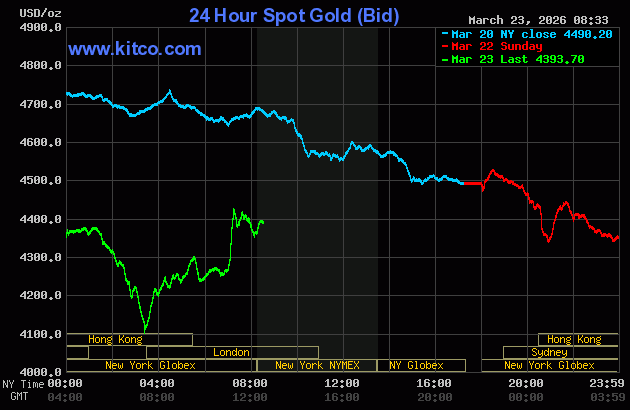
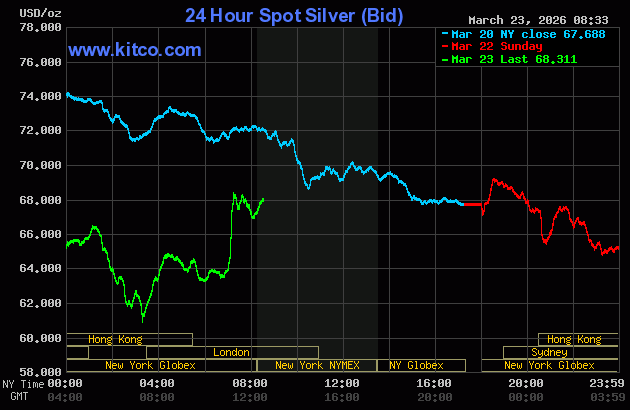
Gold and silver stayed sharply lower, even after rebounding from deep overnight losses. April gold was last down $205.40 at $4,369.10, while May silver was down $2.009 at $67.63.
Earlier in the session, gold hit a four-month low and silver touched a 3.5-month low. The recovery from those lows shows bargain hunting and short covering emerged, but the broader tone remained negative.
Kitco said the metals markets were still facing underlying selling pressure from global inflation worries and a strong U.S. dollar. That combination kept bullion under stress despite the intraday rebound.
For Indian investors, moves in global gold prices do not translate one-for-one into domestic rates. A stronger U.S. dollar can pressure the rupee and partly cushion the fall in local gold prices even when XAUUSD weakens.
Why did Iran war headlines jolt gold prices today?
The immediate trigger was a new signal that the Iran war may be de-escalating, which reduced safe-haven demand for gold and silver and caused large price swings across markets. President Donald Trump said the Pentagon would postpone military strikes against Iranian power plants and energy infrastructure for five days, according to a Truth Social post.
Trump also said the U.S. and Iran had held very good and productive conversations over the past two days. But the Iran news agency reportedly denied Trump’s claims of progress, keeping uncertainty high and volatility elevated.
Other conflict developments added to the whiplash. Israel hit Tehran again, Iran launched fresh strikes across the Gulf, and the International Energy Agency said more than 40 energy assets across the Middle East had been damaged since the conflict began.
Global stock markets rebounded and bond prices rallied after Trump’s social media post, although prices stayed volatile. That shift toward risk assets helped pull money out of precious metals, at least temporarily.
India also appeared directly in the geopolitical fallout. The report said Prime Minister Narendra Modi was seeking to calm India as the Iran war caused an acute gas shortage, underlining why Indian investors should watch the Middle East conflict not just for gold price direction but also for inflation and currency risks.
How are oil prices and the U.S. dollar affecting gold?
Oil and the U.S. dollar are now two of the biggest cross-market drivers for gold. Crude oil prices dropped by more than 10% on apparent de-escalation in potential U.S. military action, though prices later retreated from their daily highs.
At the same time, the U.S. dollar advanced as traders judged the American economy to be better insulated from the war-driven energy shock than many peers. Bloomberg reported that surging energy prices support the oil-exporting U.S. economy and that investors were rushing to safe-haven assets.
According to Bloomberg, the greenback was just shy of a fresh year-to-date high, and options traders saw more gains ahead. One-month dollar sentiment was described as the most bullish since 2022.
The dollar strengthened against its Group-of-10 peers after Trump gave Iran an ultimatum to reopen the Strait of Hormuz or face strikes on its power plants. Tehran responded that it would close the Strait of Hormuz "completely," and higher oil prices again supported the dollar.
Jens Naervig Pedersen, senior analyst at Danske Bank, told Bloomberg that "in real terms, the U.S. economy is still looking better insulated against the energy shock, which we expect to support the dollar over coming weeks." The report also said hedge funds that bought the dollar on Friday were coming back for more, according to currency traders familiar with the transactions.
A firm U.S. dollar usually weighs on gold because it makes bullion more expensive for non-dollar buyers. For Indian buyers, however, a stronger dollar can also weaken the rupee, which may keep domestic gold prices elevated even when international bullion retreats.
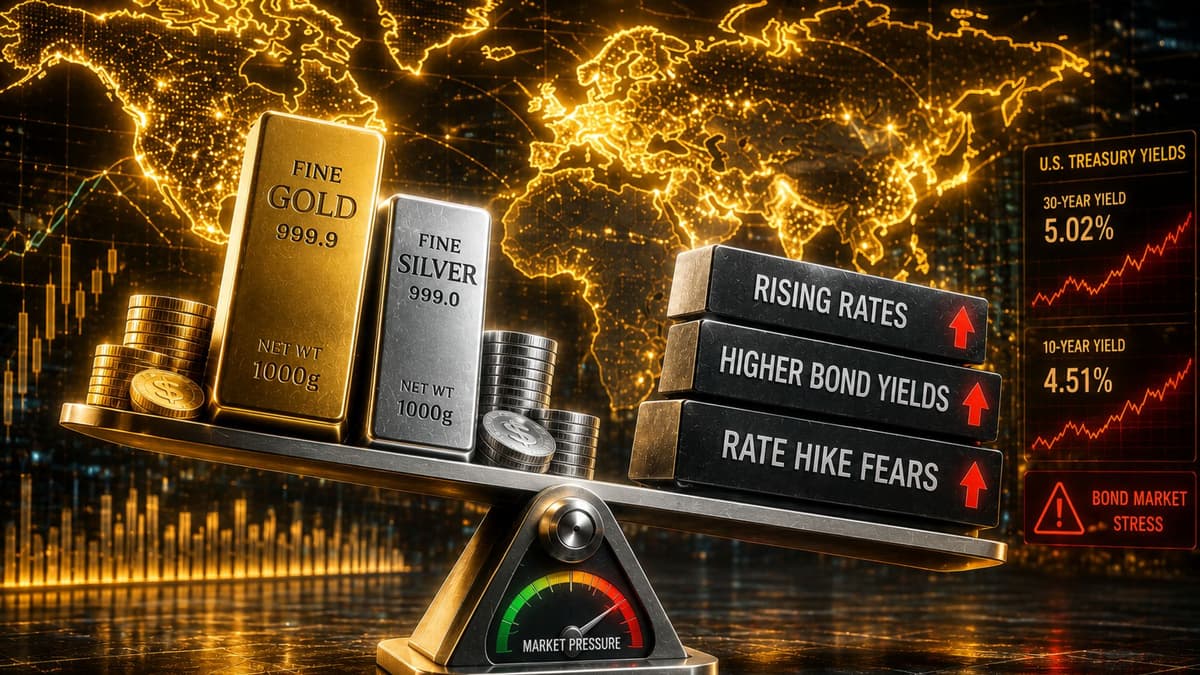
The article also noted that the U.S. dollar index was slightly lower later in the session, showing how fast intraday positioning was changing. Meanwhile, the yield on the benchmark 10-year U.S. Treasury note was around 4.4%, another key level because higher yields can reduce the appeal of non-yielding gold.
What is Goldman Sachs forecasting for crude oil, and why does it matter for bullion?
Goldman Sachs raised its 2026 crude oil forecasts because it expects prolonged disruption through the Strait of Hormuz, and that matters for gold because energy shocks can reshape inflation expectations, dollar strength and safe-haven flows. The bank now expects Brent crude to average $85.00 a barrel in 2026 and West Texas Intermediate to average $79.00.
Those new forecasts are up from earlier estimates of $77.00 for Brent and $72.00 for WTI. Goldman said the revision assumes oil flows through Hormuz stay at just 5% of normal levels for six weeks, followed by a one-month recovery.
Under that scenario, cumulative losses would total just over 800 million barrels. A disruption of that scale would keep investors focused on inflation, growth and geopolitical risk, all of which can alter the outlook for gold price, silver, and broader precious metals trading.
For India, the Hormuz assumption is especially important. India is highly sensitive to imported energy costs, so any prolonged disruption could pressure inflation, the current account and the rupee, which in turn could lift local bullion prices even if COMEX gold futures remain volatile.
How does the gold market pricing system work right now?

Gold trades through both the spot market and the futures market, and that distinction matters when investors read intraday price headlines. The spot market quotes prices for immediate purchase and delivery, while the futures market sets prices for delivery at a later date.
The article noted that, because of year-end positioning and market liquidity, the December gold futures contract is currently the most actively traded contract on the CME. Even so, the session’s quoted benchmark in the report was April gold futures.
That is important for Indian investors comparing international futures quotes with local jewellery, coin or ETF pricing. Domestic rates can reflect a mix of global spot prices, futures expectations, import duties, GST, dealer premiums and INR moves.
What technical levels should gold traders watch now?
Gold remains technically weak, and the next major levels are clearly defined. April gold futures bulls need a close above strong resistance at $4,750.00 to regain control.
Bears, meanwhile, are targeting a break below solid technical support at today’s low of $4,100.00. Near-term resistance stands first at $4,500.00 and then at the overnight high of $4,537.10.
On the downside, first support is seen at $4,300.00 and then at $4,250.00. Wyckoff's Market Rating for April gold futures is 3.5, signaling that bears still hold the near-term technical advantage.
What technical levels should silver traders watch now?
Silver is also under technical pressure, though it too has bounced from the session low. May silver futures bulls need closing prices above solid technical resistance at $80.00 to improve the chart outlook.
The bearish objective is a close below major support at $60.00. First resistance comes in at the overnight high of $69.72 and then at $70.00.
Next support is seen at $65.00 and then at the overnight low of $61.21. Wyckoff's Market Rating for May silver futures is also 3.5.
For Indian investors tracking silver alongside gold, the message is similar: volatility remains high, macro headlines are driving intraday swings, and currency moves may shape domestic prices as much as global precious metals charts. The next key watchpoint is whether Middle East de-escalation holds, because that will influence oil, the U.S. dollar, Treasury yields and safe-haven demand for bullion in the sessions ahead.