
# Gold Price Today: Key Intraday Trading Levels for April 16
Gold traders looking for short-term opportunities on April 16 should focus on key intraday support and resistance levels in Comex gold futures. The source analysis from Kitco News highlights a 5-minute bar chart as a practical tool for active traders who want clearer buy and sell entry points during the trading day.
For Indian investors, this matters because global Comex gold futures often shape sentiment in bullion markets, including MCX gold and domestic gold rates in INR. When international gold price momentum shifts sharply, Indian traders typically see the impact through futures pricing, import-cost expectations, and rupee-linked volatility.
What Are the Key Intraday Gold Trading Levels for April 16?
The main focus for April 16 is the use of short-term technical support and resistance in Comex gold futures to identify possible trade entries. According to Kitco News, the trading framework is built around a 5-minute bar chart designed for active intraday gold futures traders and market watchers.
This chart-based approach helps traders spot areas where gold price may attract buying support or face selling pressure. In practical terms, support levels can act as potential zones for fresh long entries, while resistance levels can help define possible short entries or profit-booking areas.
Because the original source frames the setup as an intraday analytical tool, the emphasis is not on long-term gold price forecasting. Instead, it is aimed at short-duration price action in Comex gold futures during the April 16 session.
Why does a 5-minute chart matter?
A 5-minute chart matters because it captures short-term gold price movement without becoming as noisy as a 1-minute chart. For active traders, that balance can make it easier to identify momentum shifts, breakout attempts, and reversals in XAUUSD-linked futures trading.
Short-duration charts are especially useful when traders want to react quickly to changes in bullion sentiment, U.S. dollar moves, Treasury yield fluctuations, or sudden order-flow changes. For gold futures traders, timing often matters as much as direction.
How Does the Kitco Intraday Tool Help Gold Traders?
The Kitco tool helps gold traders by showing possible buy and sell entry points based on technical support and resistance. According to Kitco News, the chart is intended as a valuable analytical and trading tool for the active intraday gold futures trader or market watcher.
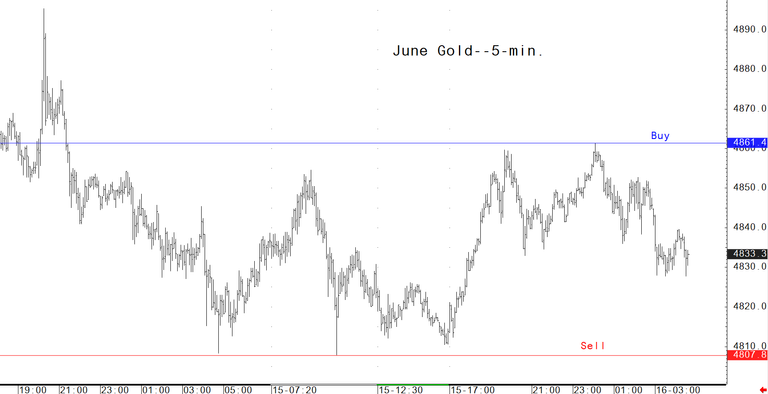
The article specifically says the setup shows potential buy and sell price entry points. That means traders can use the marked levels to build a more disciplined plan rather than chasing every move in gold.
How are buy and sell entries identified?
Buy and sell entries are identified through price behavior around short-term technical levels. If gold price shows early strength near or above a support-related trigger, traders may treat that as a possible long entry.
If gold price shows weakness near resistance or breaks lower through a near-term level, traders may view that as a signal to sell, short, or reduce exposure. This kind of framework is common in high-frequency and intraday bullion trading.
What trading principle does the article emphasize?
The article emphasizes a simple but important rule: most successful traders buy on early price strength and sell on early price weakness. That guidance reflects momentum-based trading rather than emotional or reactive decision-making.
For intraday gold traders, this approach can reduce the risk of buying into weakness too early or selling into strength too soon. It also aligns with how many professional futures traders manage entries in volatile precious metals markets.
Why Is Intraday Gold Price Analysis Important for Active Traders?
Intraday gold price analysis is important because gold can move quickly within a single session, creating both opportunity and risk. Active traders in Comex gold futures often rely on short-term technical levels to manage entries, exits, and stop-loss placement.
Gold price action can react to macro headlines, currency swings, and technical breakouts in real time. A structured 5-minute chart gives traders a way to track those moves with more discipline.
What does this mean for risk management?
It means traders can define risk more clearly before entering a position. When support and resistance levels are mapped in advance, a trader can estimate potential upside, downside, and invalidation points with greater precision.

This is particularly relevant in gold futures, where leverage can amplify gains but also magnify losses. For Indian market participants who track both Comex and MCX gold, disciplined intraday planning becomes even more important when INR volatility adds another layer of price movement.
How Can Indian Gold Traders Use Global Intraday Signals?
Indian gold traders can use global intraday signals by watching how Comex gold futures behave around support and resistance, then comparing that with MCX gold and local bullion trends. International price direction often influences the opening tone and trading bias in India.
If Comex gold shows early strength on April 16, Indian traders may see firmer sentiment in domestic futures and wholesale bullion markets. If Comex gold trades weakly, that softness can spill over into Indian pricing, although USD/INR moves may either cushion or magnify the effect.
Why does the INR angle matter?
The INR angle matters because Indian gold prices do not move only with international bullion prices. They also respond to the rupee-dollar exchange rate, import costs, and local demand conditions.
So even when global gold price in dollar terms holds steady, domestic gold rates in India can still change if the rupee weakens or strengthens. For Indian investors, that makes global chart signals useful but not sufficient on their own.
Who benefits most from this type of chart setup?
This setup benefits active traders most, especially those who monitor gold price action throughout the day. Scalpers, short-term futures traders, and market watchers who follow technical levels closely are the core audience.
Long-term investors can still benefit indirectly. Even if they do not trade every intraday move, these levels can help them understand whether short-term sentiment in gold is turning stronger or weaker.
What Should Gold Traders Watch Next?
Gold traders should next watch how price behaves around early-session support and resistance on April 16. The key insight from the Kitco News analysis is that disciplined entries matter most when traders align with early strength for buys and early weakness for sells.
For Indian investors, the next watchpoint is whether global futures momentum feeds into MCX gold and local bullion pricing in INR. If international gold breaks key intraday levels decisively, domestic traders may see faster follow-through in precious metals trading through the session.