# Gold Price Today: Iran Headlines Drive Wild Weekly Swings
Gold prices posted a second straight weekly gain, but the move came with extreme volatility as shifting headlines on Iran whipsawed bullion markets. For Indian investors, the sharp moves in global spot gold can quickly spill into domestic rates through both international pricing and any INR reaction to geopolitical risk.
What happened to gold prices this week?
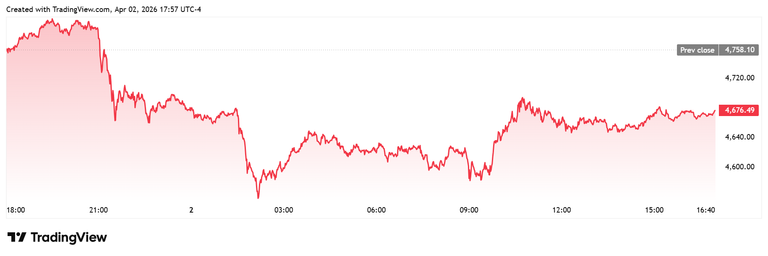
Gold rose overall this week, even after a late sell-off erased more than half of its gains. Spot gold started the week at exactly $4,400 per ounce, dipped briefly to $4,375, then climbed in stages before topping out at $4,800 per ounce on Wednesday ahead of U.S. President Donald Trump's comments on Iran.
After the president's address turned more belligerent, gold fell more than $100 in 20 minutes and dropped back below $4,600 by 2:00 a.m. Eastern. Gold then recovered modestly, approached $4,700 by 10:30 a.m. Eastern, and ended the shortened trading week roughly $20 below that level, near $4,680 per ounce.
How the weekly price action unfolded
Spot gold opened the week at $4,400 per ounce. After a quick decline to $4,375, bullion rebounded steadily.
Half an hour after the North American equity open, spot gold traded at $4,460 per ounce. Shortly before noon, it moved above $4,530.
Early in the Asian session, gold retested support near $4,420 per ounce. By 2:30 a.m. Tuesday, it had set a fresh weekly high of $4,540 per ounce, and by 8:30 a.m. it had risen further to $4,573 per ounce.
The next Asian session again started quietly, but gold then surged $100 in an hour, peaking at $4,624 per ounce just after 9:30 p.m. After a European-session pullback, North American trading resumed strongly, with gold breaking above $4,620 and advancing toward $4,685 around the equity close.
Asian traders extended the move, pushing spot gold above $4,700 per ounce by 8:15 p.m. Tuesday evening. Momentum built through Wednesday as markets circulated rumors that President Trump could announce a positive development on the Iran war.
That optimism drove spot gold to $4,800 per ounce ahead of the speech. But once Trump's remarks included threats against Iran's civilian and oil infrastructure, the market reversed violently.
Why did Iran headlines move gold so sharply?
Iran-related headlines drove gold because geopolitical risk changes safe-haven demand almost instantly. In this case, traders first bought gold on hopes of a breakthrough, then sold hard when rhetoric suggested a more aggressive conflict path.
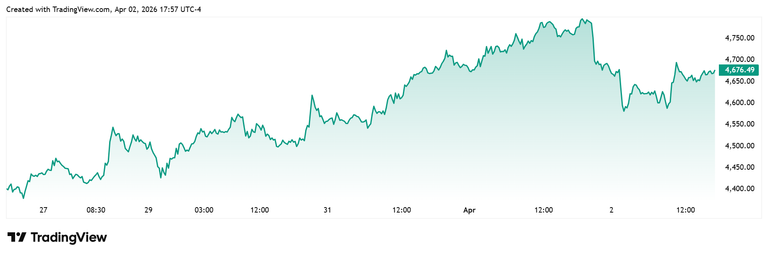
Kitco described the week as one in which optimism for an Iran breakthrough built steadily before being dashed by a belligerent Wednesday evening presidential address. That speech erased more than half of gold's gains, even though the metal still closed the week higher.
Why the market reaction was so fast
According to Kevin Grady, president of Phoenix Futures and Options, gold's overnight highs and lows were driven entirely by market perceptions of the Iran war. He said the move was “100% in response to the market’s perception of where the Iran war is headed.”
Grady said he watched markets in real time during Trump's remarks. In his words, “As soon as he said we would go in and bomb, and we could even bomb their oil fields, everything just reversed. Everything. Equities dumped, energy shot up, crude shot up, gold dumped.”
That reaction matters for Indian investors because geopolitical shocks can hit several channels at once. Gold may gain as a safe-haven in some moments, but if traders unwind risk aggressively or reposition rapidly across oil, equities, and currency markets, bullion can also see abrupt intraday drops.
What are Wall Street analysts saying about gold next week?
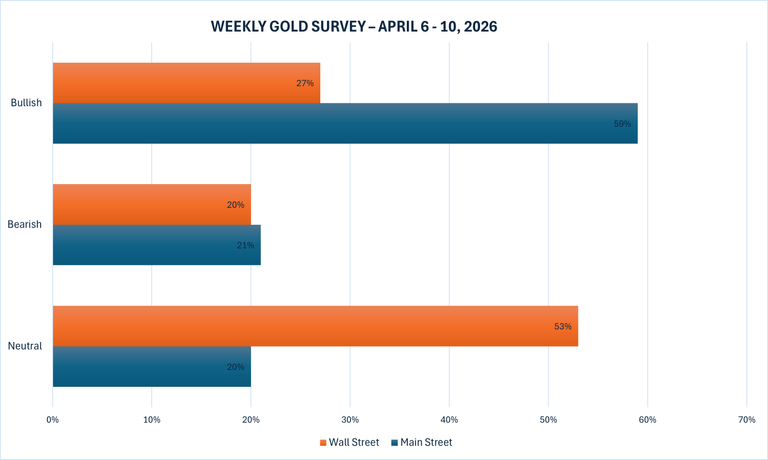
Wall Street turned cautious, while Main Street grew slightly more bullish after gold's gains. The latest Kitco News Weekly Gold Survey showed professional analysts stepping back amid mixed Iran signals from the U.S. administration.
Darin Newsom: Sideways in a huge range
Darin Newsom, senior market analyst at Barchart.com, said gold was “Sideways.” He pointed to an enormous trading range between a high of $5,666.60 and a low of $4,128.50.
Newsom added, “Does a $1,500 range mean I have no idea? Absolutely. It all depends on what the US President posts to social media next.” His comment captures how event risk, not conventional fundamentals, is dominating short-term XAUUSD trading.
James Stanley: Bigger-picture trend still bullish
James Stanley, senior market strategist at Forex.com, said “Up.” He argued that gold remains aligned with broader risk trends and that he does not want to bet against the bigger-picture bullish trend.
Stanley said, “There’s been a clear alignment with larger risk trends and while I think there’s good chance of stocks setting fresh lows, I still don’t want to bet against the bigger-picture bullish trend in gold. Instead, I’ll be looking to pullbacks for long setups.”
Rich Checkan: Investors may buy into the weekend
Rich Checkan, president and COO of Asset Strategies International, also said “Up.” He said he would watch the trade-shortened Good Friday session to judge whether traders wanted exposure over the long weekend.
Checkan said, “My suspicion, given the overblown sell-off and the recent attempts to move higher, is that investors will go long gold this weekend and into next week.”
Colin Cieszynski: Neutral but volatile
Colin Cieszynski, chief market strategist at SIA Wealth Management, took a more balanced view. He said, “I am neutral on Gold for the coming week, but I think it may continue to be volatile.”
He added that with markets closed for three days, plus a bank holiday Monday, trading would likely be thinner than usual. Cieszynski also warned, “As we have seen over the past 24 hours, there can be huge swings and reversals in both directions from hour to hour, rumor to rumor or even tweet to tweet.”
Adrian Day: Gold depends on war, then monetary policy
Adrian Day, president of Adrian Day Asset Management, said “Up, but the degree of appreciation is very dependent on the war.” He also highlighted an important earlier factor behind gold's March weakness.
Day said, “Now we know that Turkey sold almost 60 tons and was clearly one cause of gold falling so much earlier in March. The revelation is positive since it removes uncertainly about gold’s decline.”
He added that once the war ends, monetary factors should regain importance: “Once the war ends, monetary factors will come to the fore, and however much central banks around the world express concern for stubborn inflation, most will pivot when the economies start to falter.”
How does thin holiday trading affect gold volatility?
Thin holiday trading can amplify price swings because fewer participants are active and liquidity is lower. That means headlines can move gold faster and farther than usual, especially when open interest is already relatively low.
Kevin Grady's positioning warning
Grady said he would prefer to be flat going into the long weekend. His reasoning was straightforward: with major geopolitical announcements possible and liquidity thinner during a holiday period, directional trades become harder to control.
He said, “There's no upside. At some point, this isn't trading – when you're just going to be having position on and hope the news that comes out goes your way.”
What the open interest data shows
Grady pointed to relatively low open interest in gold futures. He said overall open interest stood at 357,000 contracts, which he described as “pretty low.”
For comparison, he noted that on March 23 open interest was above 406,000 contracts. In January, around the 23rd, it was approximately 520,000 contracts.
He also said the active June contract had open interest of 265,000. Lower open interest can make markets more sensitive to sudden order imbalances, which helps explain why gold and other precious metals can gap sharply on geopolitical headlines.
Passive commodity index flows matter too
Grady also highlighted the role of passive commodity index investors. He pointed to major indexes such as Goldman and Bloomberg commodity benchmarks, saying these funds are generally persistent longs in futures across energy and metals.
In his words, “All the big indexes, the Goldman and the Bloomberg, all these big commodity indexes, those are passive longs, they never get out. They're just long futures, they're long energies, they're long metals, they're just long.” That means the amount of truly active discretionary positioning may be smaller than headline open interest suggests.
What does this mean for Indian gold investors?
Indian gold investors should watch both global spot prices and the rupee because domestic bullion rates respond to both. A rise in international gold prices, a weaker INR, or both can lift local gold prices even when global trading is highly unstable.
Why global gold swings matter in India
India imports most of its gold, so local prices track international bullion benchmarks such as spot gold and XAUUSD, adjusted for the USD/INR exchange rate, import duties, and taxes. When geopolitical tensions push crude oil higher, they can also pressure India's trade balance and the rupee, which may further influence domestic gold prices.
That makes the Iran story especially relevant for Indian households, jewellers, and investors. Even if global gold retreats from intraday highs like $4,800 per ounce, rupee weakness can cushion the fall in domestic terms.
What Indian investors should watch next
For now, the key watchpoint is whether the Iran conflict escalates or de-escalates after the long weekend. Traders should also monitor whether gold can hold above the $4,600-$4,700 per ounce zone after the sharp reversal from $4,800.
If geopolitical tension fades, monetary policy and central bank expectations could again become the main drivers, as Adrian Day suggested. But if new military headlines emerge during thin trading, Indian investors should be prepared for another bout of outsized moves in bullion, crude oil, currencies, and local gold prices.