# Gold Price Today: Iran Deadline, China Buying Keep Bulls Alert
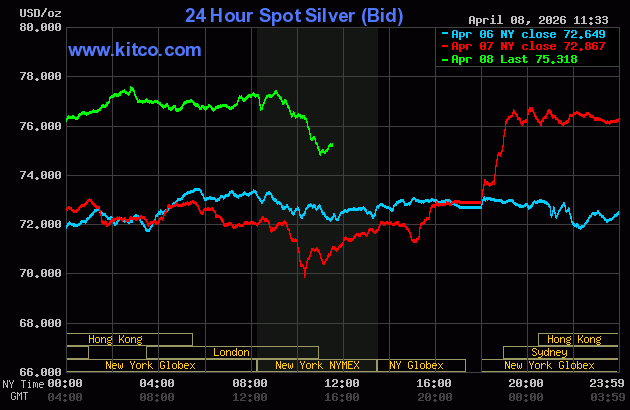
Gold prices eased in early U.S. trading, but the market stayed highly sensitive to geopolitics and central-bank buying. June gold futures were last down $11.20 at $4,673.00 per troy ounce, while May silver futures fell $0.792 to $72.07, as traders watched a U.S. deadline for Iran to reopen the Strait of Hormuz by Tuesday 8 p.m. ET.
For Indian investors, this mix matters because global bullion prices, the U.S. dollar, and crude oil all feed into domestic gold rates. If gold holds elevated levels while oil trades near $114 a barrel and the dollar stays firm, imported gold could remain expensive in rupee terms.
Why is gold price slipping today despite ongoing geopolitical risk?
Gold price is slipping because traders are balancing safe-haven demand against a stronger U.S. dollar, firm Treasury yields, and uncertainty around the Iran crisis. In early trade, those conflicting fundamentals kept bullion under pressure even as geopolitical tensions remained high.
The immediate trigger was a U.S.-imposed deadline for Iran to reopen the Strait of Hormuz, or face consequences. That deadline was set for Tuesday at 8 p.m. ET, which kept markets cautious rather than decisively bullish.
June gold futures were last quoted at $4,673.00, down $11.20 on the session. May silver futures were also weaker, down $0.792 at $72.07.
How are outside markets influencing XAUUSD and bullion?
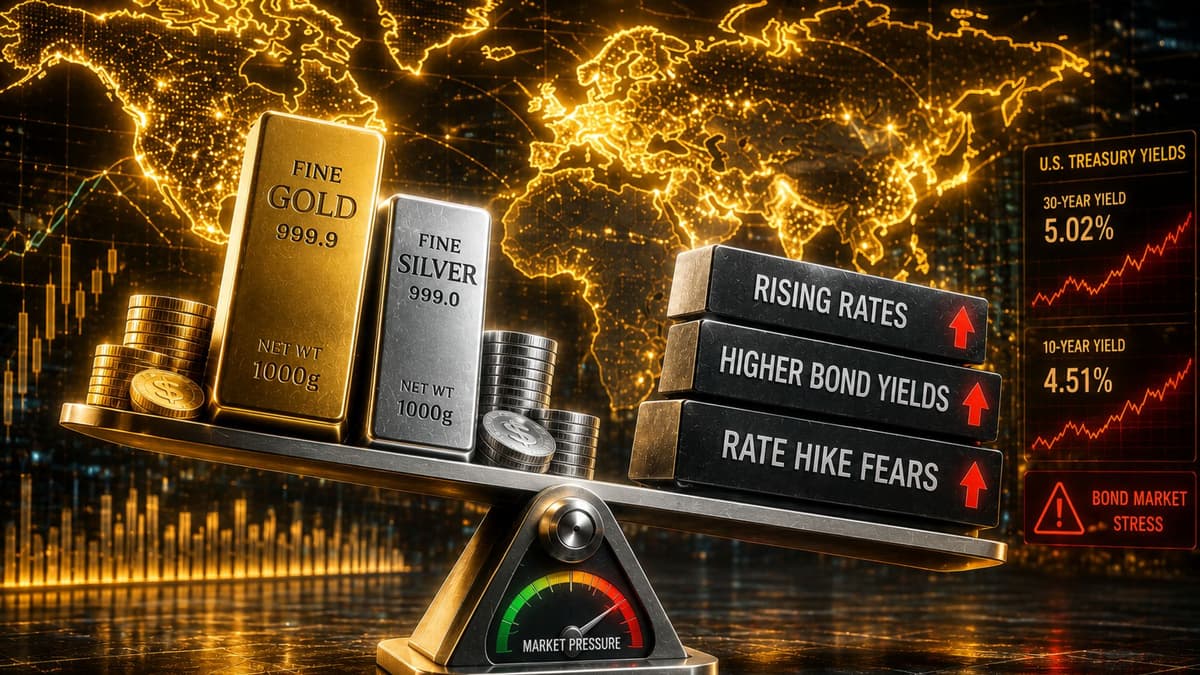
Outside markets are adding pressure to precious metals through higher oil, a firmer U.S. dollar, and elevated bond yields. Those factors can support inflation fears but also reduce expectations for near-term Federal Reserve rate cuts.
Nymex WTI crude oil was trading around $114.00 a barrel. The U.S. dollar index was slightly higher early in the session, and the yield on the benchmark 10-year U.S. Treasury note stood at 4.34%.
For XAUUSD and broader bullion trade, that is a classic push-pull setup. Geopolitical stress supports safe-haven buying, but higher yields and a stronger dollar can cap upside momentum.
How is China supporting gold prices right now?
China is supporting gold prices through continued central-bank buying. The People’s Bank of China added 160,000 troy ounces, or about 5 tons, in March, showing that official-sector demand remains a major pillar for bullion.
According to a Bloomberg report cited in the source article, China’s central bank bought the most gold in more than a year in March. Data from the World Gold Council showed bullion held by the People’s Bank of China rose by 160,000 troy ounces last month.
The PBOC has now added to its gold holdings for 17 straight months. That steady accumulation is important because it signals that one of the world’s largest official buyers continues to back gold even during sharp price corrections.
Why does central-bank demand matter for Indian investors?
Central-bank demand matters because it can put a floor under global gold prices during volatile periods. When official buyers continue to accumulate bullion, private investors often view that as a sign that long-term confidence in gold remains intact.
For Indian investors, that is especially relevant when domestic prices are already sensitive to global spot moves, futures pricing, and rupee-dollar exchange rates. Sustained central-bank demand can limit deeper corrections in local gold prices even if international markets turn volatile.
What happened to gold in March, and why was the drop so severe?
Gold sank sharply in March because the Middle East conflict boosted the U.S. dollar and increased expectations that the Federal Reserve would struggle to cut interest rates if inflation accelerated. The result was a 12% drop in March, the worst monthly performance for gold since 2008.
That decline showed how gold can weaken even during geopolitical turmoil if macro forces turn against it. In this case, the war-related shock lifted the dollar and reinforced concern that inflation pressures would keep U.S. monetary policy tighter for longer.
Bloomberg said China’s renewed buying helps support investor confidence at a time when gold prices have come under pressure amid the Iran war. That matters because sharp corrections can unsettle traders unless official-sector demand remains visible.
What are other central banks doing?
Other central banks are not moving in one direction, which is why China’s buying stands out. Some central banks bought more gold, while others sold reserves or swapped bullion for currency support.
In March, Turkey’s central bank sold and swapped about 60 tons to defend the lira, according to the report. In the first two months of the year, central banks bought a net 25 tons, based on a World Gold Council estimate released last week.
The National Bank of Poland accounted for much of that support by buying 20 tons in February. That split in official-sector behavior suggests global central-bank demand remains positive overall, but not uniform.
What are the key technical levels for gold and silver now?
Gold and silver are trading in technically important ranges, with both bulls and bears lacking a clear near-term advantage. That neutral setup is reflected in a Wyckoff Market Rating of 5.0 for both June gold futures and May silver futures.
What levels should traders watch in June gold futures?
June gold futures need a close above $5,000.00 to give bulls a major technical win. Bears, meanwhile, need to push prices below strong support at $4,300.00.

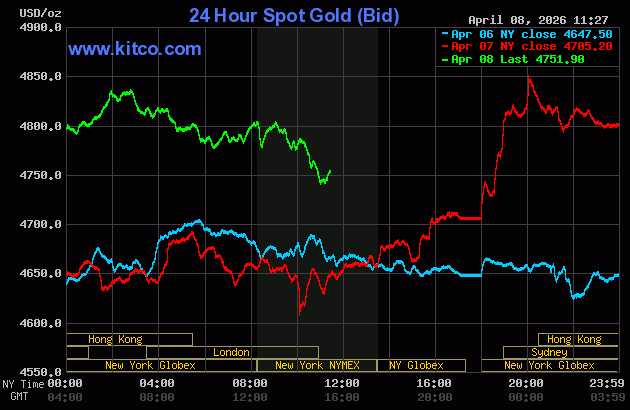
The first resistance level stands at $4,750.00. The next resistance is last week’s high at $4,825.90.
On the downside, first support is seen at this week’s low of $4,626.20. The next support level comes in at $4,580.40.
What levels should traders watch in May silver futures?
May silver futures need a close above $80.00 to strengthen the bullish case. Bears are targeting a move below the March low of $61.21.
The first resistance level in silver is $75.00. After that, traders are watching last week’s high of $76.265.
On the downside, first support is at $70.00. The next support level is last week’s low of $67.70.
How do spot and futures gold prices differ?
Spot and futures gold prices differ because they reflect two different pricing mechanisms. Spot gold represents immediate purchase and delivery, while futures prices reflect delivery at a specified later date.
The source article notes that the gold market operates through these two primary systems. It also adds that, due to year-end positioning and market liquidity, the December gold futures contract is currently the most actively traded contract on the CME.
This distinction matters for Indian investors following global gold price moves. Local bullion dealers, jewellers, ETF investors, and futures traders may all react to different reference prices depending on whether they track spot, international futures, or MCX-linked pricing.
For now, the key watchpoint is clear: if the Iran-Strait of Hormuz deadline escalates into a broader supply and geopolitical shock, gold could quickly retest resistance near $4,750 and $4,825.90. If the U.S. dollar and Treasury yields keep rising instead, bullion may stay under pressure despite strong central-bank buying from China.