# Gold Price Tests $4,500 as Silver Crashes Below $76
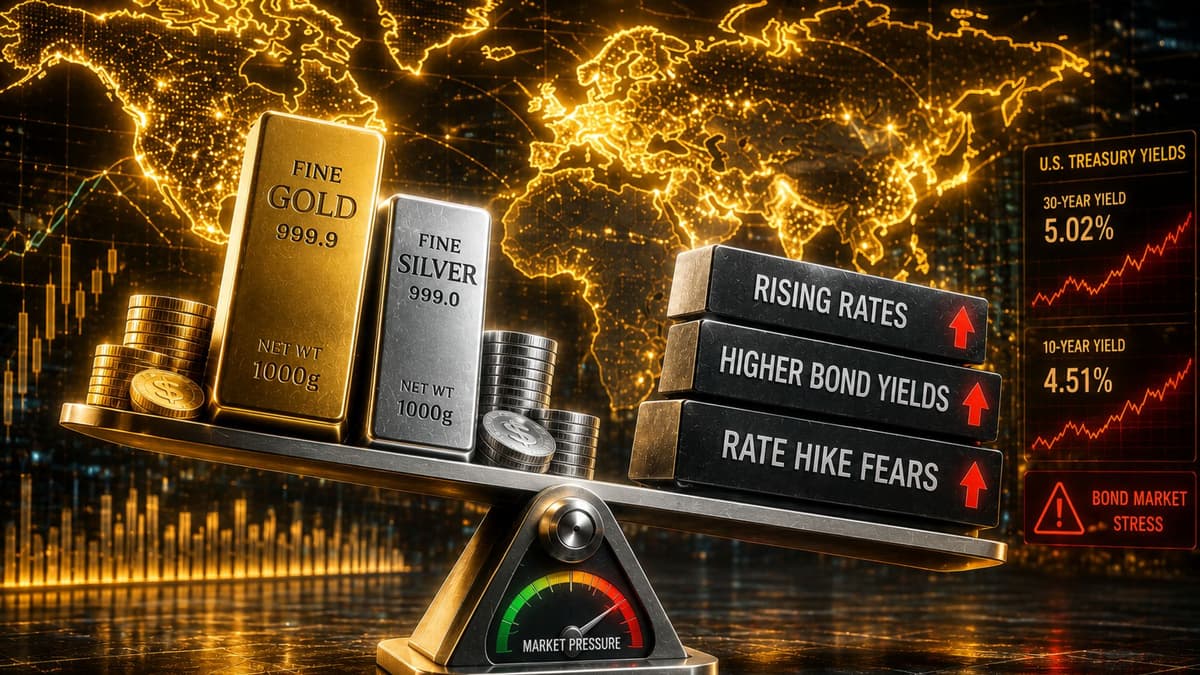
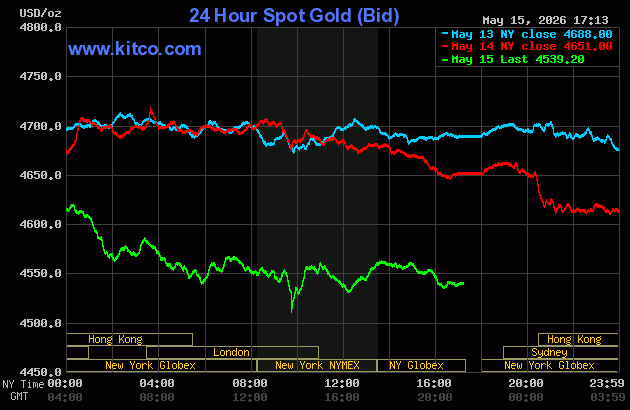
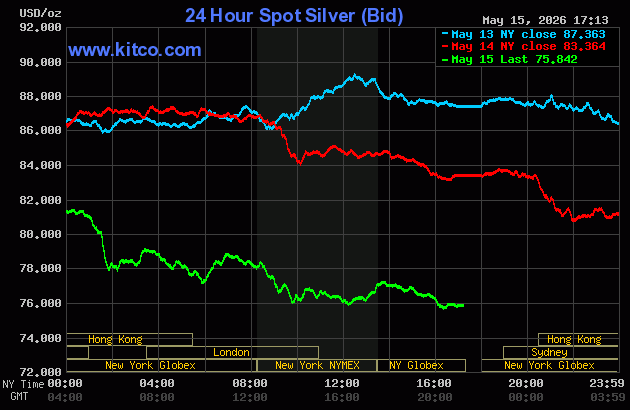
Spot gold fell sharply on Friday as rising U.S. Treasury yields, a firmer U.S. dollar and oil-driven inflation fears outweighed safe-haven demand from the Iran crisis. Spot gold traded near $4,539.40 per troy ounce, down 2.40%, while spot silver dropped to $75.910, down 8.94% in late U.S. trading.
For Indian investors, the move matters because weaker global bullion prices can be partly offset by rupee weakness if the U.S. dollar index remains strong. At the same time, elevated crude oil prices can worsen India’s import bill, lift inflation expectations and complicate the outlook for gold prices in INR terms.
Why Did Gold Price Fall Even as Iran Risk Stayed High?
Gold prices fell because the market focused more on inflation, yields and the U.S. dollar than on safe-haven buying. The Iran-related risk supported bullion demand, but it did not outweigh the pressure from higher rate expectations.
The Strait of Hormuz remains the key geopolitical trigger for both precious metals and energy markets. The waterway is still effectively constrained after the U.S.-Iran conflict, and traffic remains far below pre-war levels.
U.S.-Iran negotiations have shown no visible progress after the Trump-Xi meeting. Tehran has said vessels can pass unless they belong to countries at war with Iran, but the physical market continues to treat the Strait of Hormuz as effectively blocked.
That creates a two-way effect for gold. On one side, geopolitical stress boosts safe-haven demand for gold and other precious metals. On the other, WTI crude above $105 and Brent near $110 lift inflation expectations, push bond yields higher and reduce the appeal of non-yielding assets such as XAUUSD.
What Economic Data Added Pressure on Bullion?
Stronger U.S. industrial data added fresh pressure on gold and silver by reinforcing the market’s rate repricing. The data followed a week of hotter inflation readings, which left bullion exposed.
Industrial production increased 0.7% in April after a 0.3% decline in March. The report also showed manufacturing output rose 0.6%, utilities output increased 1.9%, mining output slipped 0.1% and capacity utilization rose to 76.1%.
That stronger-than-expected production print added to concerns that inflation could stay sticky. As a result, markets priced in higher-for-longer interest rates, pressuring gold, silver, equities, bonds and industrial metals at the same time.
For Indian investors, this matters because U.S. rate repricing often strengthens the dollar and influences imported gold costs in India. Even if global gold prices pull back, INR depreciation can cushion the fall in domestic bullion rates.
How Did Oil, Treasury Yields and the Dollar Hit Gold and Silver?
Oil, yields and the dollar combined to create a powerful headwind for precious metals. Gold and silver usually struggle when Treasury yields rise and the U.S. dollar firms, especially when inflation fears reduce expectations for rate cuts.
The key outside markets showed Nymex WTI crude oil around $105.30 a barrel, while Brent crude traded near the $110 area. At the same time, the U.S. dollar index was firmer and the 10-year U.S. Treasury yield traded near 4.6%.
This macro mix is especially negative for silver because silver has both precious-metal and industrial-metal characteristics. That helps explain why silver underperformed gold so sharply, with spot silver down 8.94% versus gold’s 2.40% decline.
The sharper cross-asset reaction appeared in oil, long-end bond yields, the U.S. dollar, energy equities and rate-sensitive technology shares. In contrast, precious metals came under direct pressure from the jump in real-world inflation fears.
What Happened in U.S. Equities and Why Does It Matter for Precious Metals?
U.S. equities weakened as the bond-market selloff spread across risk assets. That broader liquidation signaled that markets were adjusting to tighter financial conditions rather than moving purely into defensive safe havens.
Late in the session, the S&P 500 tested the 7,425 to 7,435 support zone. The Nasdaq pulled back near historic highs, while the Dow attempted to settle below 49,500.
Energy stocks were the relative winners because higher crude prices supported the sector. Basic-materials shares weakened alongside gold and silver, while utilities also came under pressure from rising Treasury yields.
For Indian market participants, this cross-asset pattern is important because it shows that gold is not moving only on geopolitical headlines. Gold is also reacting to global bond markets, oil shocks and dollar strength, all of which can influence MCX gold and local jewellers’ pricing.
What Are the Key Gold Price Levels to Watch Now?
Gold is testing a major support zone near $4,500, and that level is the key near-term pivot for traders. A break below it would strengthen the bearish technical outlook.
Gold resistance levels
Spot gold bulls’ next upside objective is to push prices back above the $4,530 to $4,550 resistance zone. If gold sustains a move above that area, the next upside targets are $4,605.15 and then $4,637.31.
First resistance is seen at $4,550 and then at $4,605.15.
Gold support levels
Bears’ next near-term downside objective is a break below $4,500. If that support fails, deeper downside targets come in at $4,495.33 and then $4,481.78.

First support is seen at $4,511.20 and then at $4,500.
For Indian investors tracking XAUUSD and domestic bullion, the $4,500 zone is the most important immediate marker. If the dollar stays firm and crude remains elevated, any bounce in gold could remain capped unless safe-haven demand accelerates sharply.
What Are the Key Silver Price Levels After the Drop Below $76?
Silver has entered a more fragile technical position after falling below $76, and traders now need to watch whether support near $75.19 holds. Because silver is more volatile than gold, the next move could be sharp in either direction.
Silver resistance levels
Spot silver bulls’ next upside objective is to reclaim the $76.99 to $78.00 area. If silver clears that zone, the next upside targets are $79.00 and then $83.61.
First resistance is seen at $76.99 and then at $78.00.
Silver support levels
The bears’ next downside objective is a break below $75.19. If that level gives way, deeper downside targets are $74.63 and then $71.84.
Next support is seen at $75.19 and then at $74.63.
Silver’s deeper slide also matters for Indian investors because it can affect sentiment across the wider precious-metals complex. The next watchpoint is whether gold can defend $4,500 and whether oil remains above $105, as both will shape the near-term outlook for bullion and precious metals in global and Indian markets.