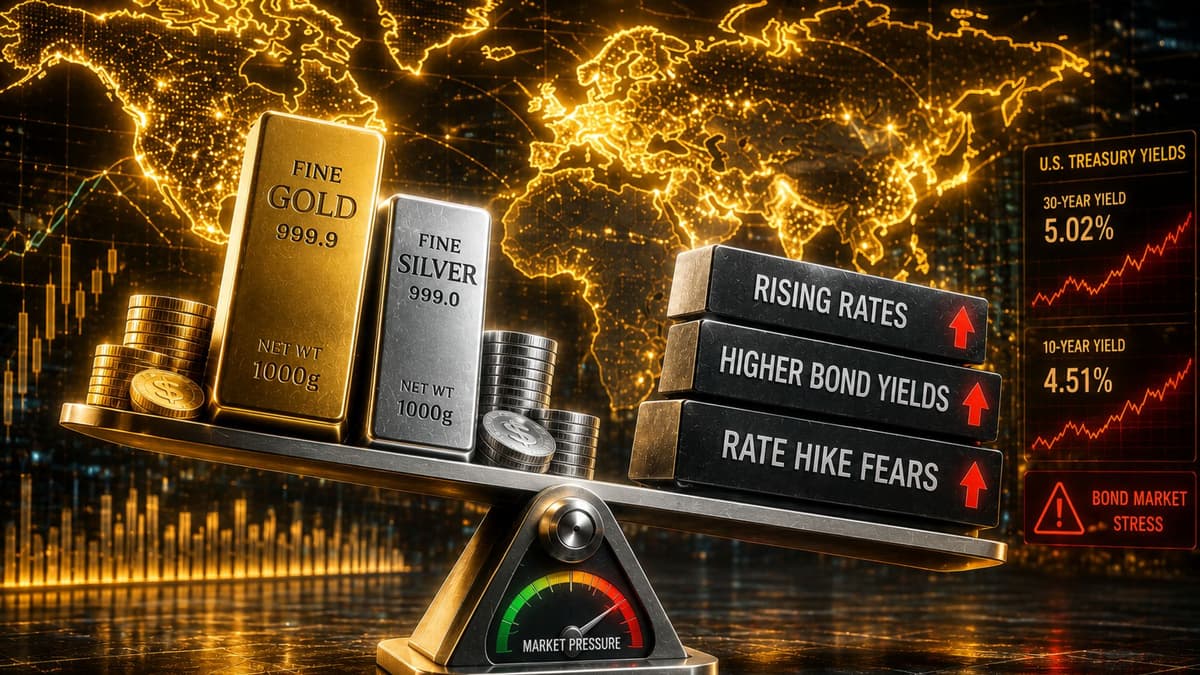
# Gold Price Surges as US Dollar Index Slides, Bulls Eye $5,000
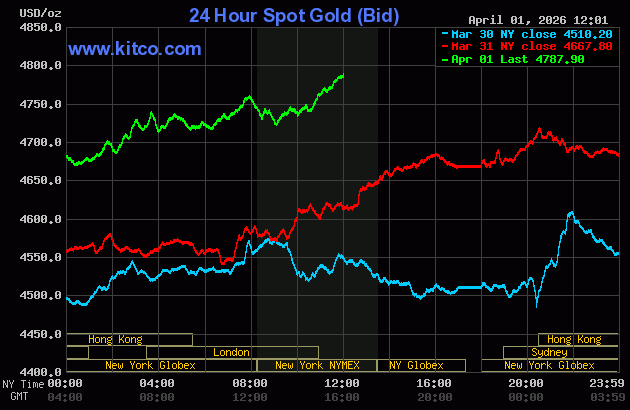
Gold prices jumped sharply in midday U.S. trading as a weaker U.S. dollar index and lower bond yields improved the outlook for bullion. For Indian investors, the move matters because a stronger global gold price can support domestic rates even when the rupee remains relatively stable.
Why did gold prices rise today?
Gold prices rose because the U.S. dollar index fell sharply and global bond market sentiment turned more supportive for precious metals. Those two outside-market drivers lifted safe-haven demand and improved the appeal of non-yielding assets such as gold and silver.
June gold futures were last up $130.50 at $4,808.70 near midday U.S. trading. May silver futures climbed $0.936 to $75.86.
A weaker U.S. dollar usually makes dollar-priced bullion cheaper for buyers using other currencies. That often boosts international demand for gold and silver and supports XAUUSD prices.
What is happening in the bond market, and why does it matter for bullion?
Bond market expectations have swung sharply, and that shift has helped gold. After several weeks of rising yields, traders this week pushed bond prices higher and yields lower, which reduced pressure on precious metals.
Why had global bond prices sold off earlier?
Global government bond prices had been falling in recent weeks because traders feared a spike in energy prices from the war in Iran would fuel inflation. That inflation risk led markets to think central banks might keep interest rates steady for longer or even tighten monetary policy.
Higher yields usually hurt gold because bullion does not pay interest. When government bonds offer better returns, some investors shift away from precious metals.
Why did bond traders reverse course this week?
Bond traders have recently changed their view because they now see a prolonged war in Iran and higher energy costs as a drag on global growth. That weaker-growth outlook has encouraged the idea that central banks may eventually cut interest rates.
Lower yields tend to support gold prices because they reduce the opportunity cost of holding a non-yielding asset. The article notes that, for now, no one knows which macro theory will ultimately prove correct.
How did oil, the U.S. dollar, and Treasury yields affect gold today?
Gold gained as the U.S. dollar index moved solidly lower, while crude oil and Treasury yields offered a mixed but overall supportive backdrop. The combination kept investor focus on safe-haven assets and macro uncertainty.
The key outside markets showed Nymex WTI crude oil weaker and trading around $100.00 a barrel. The 10-year U.S. Treasury yield was around 4.3%.
For Indian investors, the dollar move is especially important. A softer U.S. dollar can lift international bullion prices, but the final effect on Indian gold rates also depends on the USD/INR exchange rate, import costs, and local jewellery demand.
What are the key technical levels for gold price now?
Gold futures remain in an uptrend on the daily chart, with bulls targeting the psychologically important $5,000 level. The near-term setup remains constructive as long as prices stay above key support zones.
June gold futures technical levels
According to the technical outlook in the source report, June gold futures are trending higher on the daily bar chart.
- Last price: $4,808.70
- Bulls’ next upside objective: close above $5,000.00
- Bears’ next downside objective: push prices below $4,300.00
- First resistance: $4,850.00
- Second resistance: $4,900.00
- First support: $4,700.00
- Second support: $4,600.00
- Wyckoff Market Rating: 6.0
What are the latest technical levels for silver price?

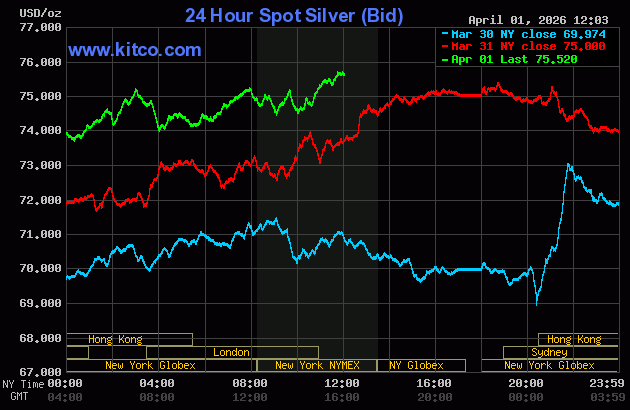
Silver also advanced, though less sharply than gold, and bulls are now focused on a break above $80.00. The metal still faces notable resistance overhead, but momentum has improved.
May silver futures technical levels
The source report says May silver futures bulls want a close above solid technical resistance at $80.00.
- Last price: $75.86
- Bulls’ next upside objective: close above $80.00
- Bears’ next downside objective: close below $61.21, the March low
- First resistance: $77.50
- Second resistance: $80.00
- First support: $72.00
- Second support: $70.00
- Wyckoff Market Rating: 5.5
How do spot and futures gold prices differ?
Gold trades through both the spot market and the futures market, and the difference matters when investors compare headline prices. Spot gold reflects immediate purchase and delivery, while futures prices represent delivery at a later date.
The source article notes that the gold market operates through two primary pricing mechanisms:
1. Spot market: quotes prices for on-the-spot purchase and immediate delivery.
2. Futures market: sets prices for delivery at a future date.
The report also notes that, due to year-end positioning market liquidity, the December gold futures contract is currently the most actively traded on the CME. Investors should keep this distinction in mind when comparing international gold price headlines with live market quotes.
For Indian buyers, domestic gold prices are influenced by global spot and futures benchmarks, but also by the rupee, import duty, GST, and local premiums. That means MCX and retail jewellery prices may not move point-for-point with COMEX futures.
Gold now sits just below near-term resistance at $4,850 and within striking distance of the bigger $5,000 target. The next key watchpoint for Indian investors is whether the U.S. dollar stays weak and Treasury yields remain near or below 4.3%, because that combination could keep bullion and broader precious metals supported in the sessions ahead.