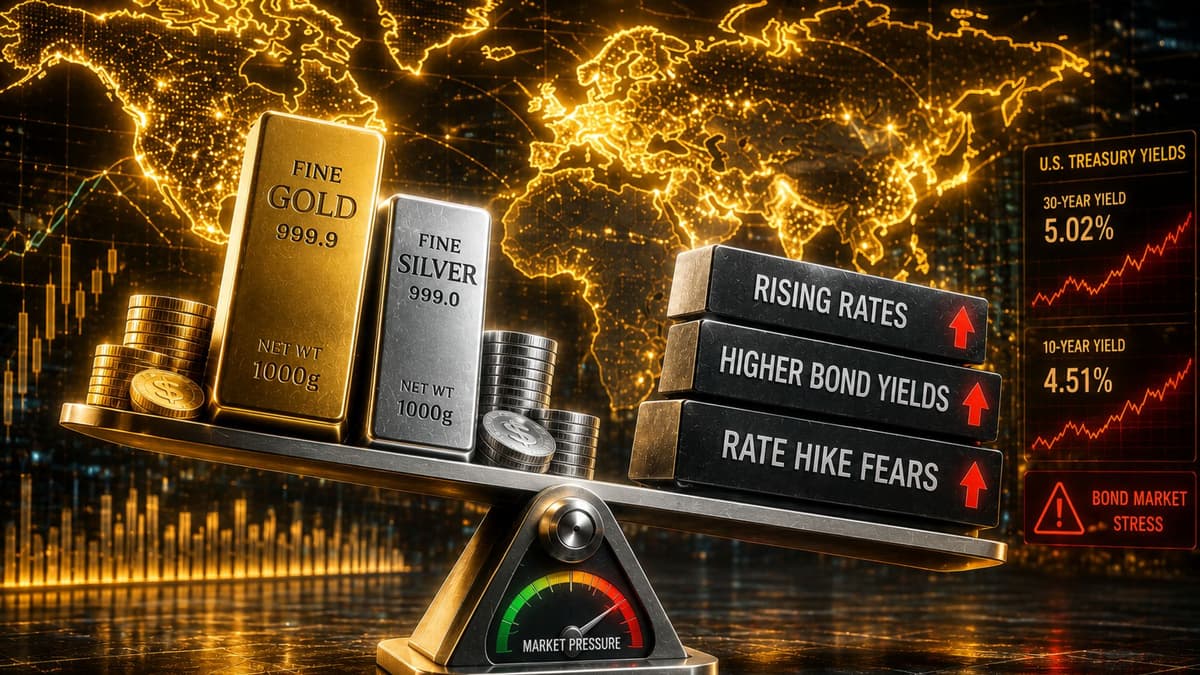
# Gold Price Struggles Near $4,500 as Bond Crisis Fears Build
The gold price remains under pressure as rising U.S. bond yields and oil-driven inflation keep investors cautious, even as analysts warn that a deeper bond market crisis could quickly revive bullish sentiment in bullion. Spot gold last traded at $4,993.60 per troy ounce, up 0.28% on the day, but the market is still struggling to reclaim the $4,500 an ounce level in a convincing way.
For Indian investors, the setup is critical. Global gold prices, U.S. Treasury yields, crude oil, and the U.S. dollar all influence domestic bullion rates in INR. If energy inflation and bond stress intensify together, volatility in XAUUSD could spill over into India’s physical and paper gold markets.
Why is gold price struggling despite safe-haven demand?
Gold is struggling because rising long-term bond yields have increased the opportunity cost of holding non-yielding assets such as bullion. At the same time, a stronger U.S. dollar is reducing demand from non-dollar buyers, making the usual safe-haven bid less effective.
According to Ole Hansen, Head of Commodity Strategy at Saxo Bank, gold’s long-term fundamentals remain strong, but investors are focused on near-term macro risks. That has prevented bullion from fully benefiting from geopolitical stress.
Hansen said markets remain dominated by turmoil in the Middle East as the war in Iran keeps the Strait of Hormuz closed. The resulting global supply-chain disruption has pushed key commodity prices sharply higher, with oil drawing the most market attention.
How are oil prices affecting gold?
Oil is affecting gold by fueling inflation fears and pushing bond yields higher. The conflict-driven energy shock has lifted oil above $100 a barrel, which has changed the market narrative from pure safe-haven demand to inflation and yield pressure.
Hansen said, “Higher energy prices feed directly into inflation and, by extension, government bond yields, while also lending support to the US dollar.” He added that this combination has created a difficult environment for precious metals.
He explained that rising yields raise the cost of holding a non-yielding asset like gold, while a stronger dollar tends to weigh on demand from overseas investors. As a result, the normal safe-haven response in gold has become less straightforward.
What are bond yields signaling for gold right now?
Bond yields are signaling near-term pressure on gold, but they may also be laying the groundwork for a stronger rally later if investors begin to distrust sovereign debt markets. Right now, yields are high enough to hurt bullion, but a further rise could eventually trigger safe-haven buying in gold.
The article notes that 10-year bond yields are at their highest level since mid-January 2015, while 30-year bond yields have climbed above 5%, their highest level in two decades. These are critical levels because they tighten financial conditions across the economy.
In a note to Kitco News, Hansen said gold could perform well if investors start losing faith in bond markets. However, he also said traders are currently focused on only one major theme at a time.
He said, “The market is struggling to cope with more than one theme at a time. Right now, it’s the higher oil price linked to inflation and yields that’s in the driving seat, but a continued rise in yields may well end up being positive for gold given the fiscal debt worries it raises.”
What does gold need to regain upside momentum?
Gold needs either easing oil-driven inflation fears or fresh evidence that economic growth risks are becoming more serious than inflation risks. Until then, rising yields are likely to cap upside in XAUUSD.
In a social media post on Wednesday, Hansen said, “For gold to regain upside momentum, the market needs to see some easing in oil-driven inflation concerns, or renewed evidence that growth risks are beginning to outweigh inflation fears.”
How could a bond market crisis turn bullish for gold?
A bond market crisis could turn bullish for gold if investors begin to see rising yields not as a sign of economic strength, but as evidence of fiscal stress and market instability. That shift would likely restore gold’s role as a safe-haven asset.
So far, the bond selloff has remained orderly, and analysts say that has helped keep gold prices in check. But with yields already at key levels, sentiment could change quickly.
Doug Casey, founder of InternationalMan.com, highlighted how rapidly rising yields can worsen U.S. government finances. In a social media post, he said that for every one basis point rise in 10-year yields, the government’s average borrowing cost adds roughly $3.9 billion in annual interest payments.
He noted that since the start of the war, the 10-year yield has increased by 63 basis points. That rise has major fiscal implications.
Casey said, “So a 63 bps rise is not trivial — it translates to nearly $250 billion in additional yearly interest costs, materially widening a 2025 budget deficit that was already around $1.8 trillion.”
Why do fiscal debt worries matter for bullion?
Fiscal debt worries matter for bullion because investors often buy gold when they lose confidence in governments’ ability to finance deficits without inflation, currency weakness, or market disruption. If debt-servicing costs surge, gold can benefit as an alternative store of value.
For Indian investors, this matters because a worsening U.S. fiscal backdrop can move the U.S. dollar, Treasury yields, and global risk appetite at the same time. Those shifts often feed directly into imported gold prices in India, especially when the rupee is also under pressure from higher crude oil costs.
Why are analysts warning about a possible breaking point in bonds?
Analysts are warning about a possible breaking point because persistent inflation, rising Treasury issuance, and higher investor compensation demands are making the bond market harder to stabilize. If that stress worsens, it could hit equities, growth, and eventually support precious metals.
Fawad Razaqzada, market analyst at FOREX.com, said in a note on Wednesday that bond markets could be approaching a breaking point. He added that surging yields also raise the risk of a deeper correction in equity markets.
Razaqzada said, “When inflation becomes more persistent, lenders demand higher long-term yields to compensate for the erosion of purchasing power. This should mean even higher bond yields, which is bad news for risk assets and good news for the dollar.”
He said the U.S. fiscal backdrop continues to deteriorate because Treasury issuance is increasing rapidly just as investors are demanding more compensation to hold longer-dated debt. In his view, that combination is difficult for bond markets to absorb smoothly.
What broader economic effects could higher yields create?
Higher yields could raise mortgage rates, increase government debt-servicing costs, and force tougher policy trade-offs. These pressures can slow economic activity and eventually change how investors price safe-haven assets like gold.
Razaqzada said, “Not only will mortgage rates rise for consumers, but debt-servicing costs will also increase sharply for the government, which would need to be financed by issuing even more debt at even higher yields, or by reducing budgets in other sectors of the economy.”
What does this mean for Indian gold investors?
Indian gold investors should watch U.S. yields, crude oil, the U.S. dollar, and the rupee together because these factors are now driving the global gold price more than headline safe-haven demand alone. A sustained rise in yields can pressure bullion in the short term, but signs of bond-market stress could reverse that quickly.
If oil stays above $100 a barrel, India’s import bill and inflation risks could rise, potentially affecting the INR and local bullion prices. That means domestic gold rates may remain volatile even if international spot prices struggle to build momentum.
For now, the key watchpoint is whether bond yields continue rising in an orderly way or begin to undermine confidence in the broader financial system. If investors start treating sovereign debt itself as a source of risk, gold could move from being yield-sensitive to crisis-sensitive again.