Why is gold price still stuck below $5,000 after the Federal Reserve meeting?
Gold price remains under pressure because the Federal Reserve left interest rates unchanged and did not deliver a strong enough dovish signal to spark fresh bullion buying. Even though the U.S. central bank still projects lower rates through 2026, traders focused on steady policy, resilient growth forecasts, and inflation that remains above target.Spot gold was last at $4,887.90 per troy ounce, down more than 2% on the day, after Wednesday's monetary policy decision. That left XAUUSD unable to reclaim the psychologically important $5,000 level.
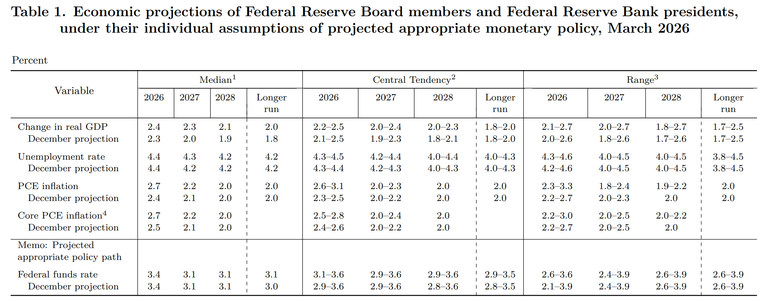
The Federal Reserve kept its policy rate unchanged in a range of 3.50% to 3.75%, as widely expected. Its updated projections showed rates falling to 3.4% by the end of the year, implying at least one rate cut this year.
The rate path was unchanged from December's forecast. Some economists still viewed the new projections as slightly more dovish than expected because markets had positioned for a more hawkish message amid persistent inflation.
For Indian investors, this matters because global gold price moves feed directly into domestic bullion rates, although rupee-dollar moves can soften or amplify that impact. If the U.S. dollar stays firm while gold struggles below $5,000, Indian gold prices in INR may not fall as sharply as international prices suggest.
What did the Federal Reserve say about interest rates and the economy?
The Federal Reserve said the U.S. economy is still expanding at a solid pace and gave little forward guidance beyond acknowledging uncertainty. That message reduced the urgency for safe-haven buying in gold, even as the Fed kept the door open to easier policy later.In its statement, the Federal Reserve said: "Available indicators suggest that economic activity has been expanding at a solid pace." The central bank also said: "The implications of developments in the Middle East for the U.S. economy are uncertain. The Committee is attentive to the risks to both sides of its dual mandate."
That language showed cautious optimism rather than alarm. For gold, that is important because bullion usually gains more traction when the Federal Reserve signals growth stress, recession risk, or a faster easing cycle.
How did analysts interpret the Fed's tone?
Analysts said the Fed appeared willing to look past near-term geopolitical risks and supply-driven inflation pressures. That stance limited support for precious metals, which often rally when policymakers sound more defensive.Jamie Cox, Managing Partner at Harris Financial Group, said the central bank was deliberately staying steady. In his words, "The Fed is choosing to look through the fog of conflict, for now. A dual mandate Federal Reserve is not going to rock the interest rate boat during a supply shock."
That view helps explain why gold did not react strongly to the Fed's lower-rate outlook through 2026. The market heard a patient Federal Reserve, not an urgent one.
What do the Fed's new forecasts say about growth, jobs, and inflation?
The Fed's updated projections show stronger growth, a stable labor market, and inflation that rises this year before easing later. That combination is not ideal for gold because it lowers immediate expectations for aggressive rate cuts while keeping real yields relatively firm.How much growth does the Fed expect?
The Federal Reserve now expects the U.S. economy to grow 2.4% this year, up from 2.3% in December. It projects growth of 2.3% next year, compared with the previous estimate of 2.3%, effectively unchanged.For 2028, the Fed expects GDP to expand by 2.1%, up from the prior forecast of 1.0%. That is a notable upward revision and signals confidence that the economy can keep expanding.
What is the Fed expecting for unemployment?
The Federal Reserve expects a relatively stable labor market. It projects the unemployment rate at 4.4% this year, unchanged from December.The unemployment rate is expected to ease to 4.3% next year, up slightly from the previous forecast of 4.2%. By 2028, the Fed sees unemployment at 4.2%, unchanged from December.
A stable labor market usually reduces the need for the Federal Reserve to cut rates quickly. That tends to cap upside in gold price, especially when investors are weighing returns from bonds against non-yielding assets like bullion.
What is the Fed projecting for inflation?
The Federal Reserve expects inflation to move higher this year, but it does not see that increase as lasting. The committee projects U.S. headline PCE inflation at 2.7% this year, up sharply from 2.4% in December.For next year, headline PCE is expected at 2.2%, up from 2.1% in December. The central bank still sees broad inflation returning to its 2% target by 2028.
Core inflation tells a similar story. Core PCE, which strips out food and energy, is projected at 2.7% this year, up from 2.5% in December.
Core PCE is expected at 2.2% next year, up from 2.1% in December. The Fed again expects core inflation to reach 2% in 2028.
For gold investors, that forecast matters because sticky inflation can support safe-haven demand, but if the Federal Reserve still believes inflation will cool without major economic damage, the bullish case for XAUUSD becomes less immediate.
Why did gold fail to rally even though the Fed still sees lower rates through 2026?
Gold failed to rally because the market wanted a clearer dovish shift, not just a long-term projection of lower rates. Traders saw unchanged policy, a still-healthy economy, and inflation that remains elevated, so bullion did not get the immediate catalyst it needed.The Fed's path still points to lower rates through 2026, but the updated rate projections were already largely expected. Since the central bank's interest-rate outlook was unchanged from December, investors had limited reason to reprice gold sharply higher.
Markets were also looking for a more hawkish tilt because inflation has stayed persistent. When the Fed instead delivered a nuanced message rather than a clear pivot, gold ended up in a middle ground: not weak enough to collapse on policy shock, but not strong enough to break back above $5,000.
That helps explain why spot bullion stayed near $4,887.90 per ounce even after the meeting. For traders in precious metals, a modestly dovish message is not always enough if it arrives alongside stronger growth and stable employment projections.
How do economists see the risks ahead for gold and the broader economy?
Economists say the Federal Reserve is in a holding pattern because the U.S. economy faces mixed signals. That creates a complicated backdrop for gold, with support from future rate-cut expectations but resistance from resilient growth and a still-stable jobs market.Jeffrey Roach, Chief Economist at LPL Financial, said the Federal Reserve is navigating uncertain conditions. He warned that the growth picture looks weaker when examined in context, even if the longer-term forecasts appear stronger.
Roach said, "The upward revision to 2026 growth is misleading if not presented in context. The weaker growth in Q4 2025 showed the economy is on feeble footing than originally estimated. The likely productivity boost from AI could not come at a better time, if it can be the antidote to slower population growth, shrinking labor force, and persistent services inflation."
That assessment matters for gold because any evidence that growth is weaker than headline projections suggest could revive safe-haven demand. If labor conditions soften or inflation stays sticky for longer, investors may return to bullion as a hedge.
What does this mean for Indian gold investors right now?
Indian gold investors should watch both the Federal Reserve's rate path and the rupee's reaction to the U.S. dollar. Global gold price weakness can create buying opportunities in India, but INR depreciation can keep domestic bullion prices elevated.If U.S. rates stay in the 3.50% to 3.75% range for longer, the dollar could remain supported, which would matter for landed gold costs in India. At the same time, if the Fed follows through with rates moving to 3.4% by year-end, lower U.S. yields could eventually support gold and improve sentiment toward precious metals.
The next key watchpoint for Indian investors is whether gold can regain momentum above $5,000 per troy ounce as markets reassess U.S. growth, inflation, and rate-cut timing. A softer dollar or clearer evidence of slowing U.S. activity could shift the balance back in favor of bullion.