Spot gold stabilized on Tuesday as bargain hunting emerged after Monday’s sharp selloff, even as easing oil prices and record-high U.S. equities capped stronger upside. For Indian investors, the move shows that bullion is still drawing safe-haven and value buying, but elevated U.S. yields, sticky inflation signals, and a firmer dollar continue to limit momentum in global gold price trends.
Why did gold price stabilize today?
Gold price stabilized because buyers stepped in after Monday’s steep decline, while mixed U.S. economic data kept bullion trading in a two-way range. Late in North American trading on Tuesday, spot gold was near $4,557.68 per troy ounce, while spot silver traded at $73.680.The rebound was modest rather than aggressive. Easing crude oil prices reduced some geopolitical stress, and record highs in U.S. equities improved overall risk sentiment, which prevented a sharper safe-haven rally in XAUUSD.
For Indian investors, that matters because global bullion prices often feed directly into domestic gold rates, alongside the rupee-dollar exchange rate and import-related costs. If the Indian rupee weakens against the U.S. dollar, even a stable international gold price can keep local prices elevated.
What did the latest U.S. data signal for gold and silver?
The latest U.S. data sent mixed signals, which is why gold and silver remained supported but lacked a clear breakout. The ISM services PMI fell to 53.6 in April from 54.0 in March, missing the 53.7 consensus, but it still stayed above the 50 expansion line.That means the U.S. services sector is still growing, just at a slightly slower pace. At the same time, the ISM prices index held at 70.7, its highest level since October 2022, showing that inflation pressure in services remains elevated.
Labor-market data also produced a nuanced picture. March JOLTS job openings were little changed at 6.87 million, down from 6.92 million in February, while hiring rose to 5.55 million, the strongest level since February 2024.
For gold, this mix is important. Slower activity can support safe-haven demand, but still-firm hiring and sticky inflation reduce the chances of quick Federal Reserve rate cuts, which can weigh on non-yielding assets such as gold.
Why are Treasury yields and Federal Reserve expectations still a problem for bullion bulls?
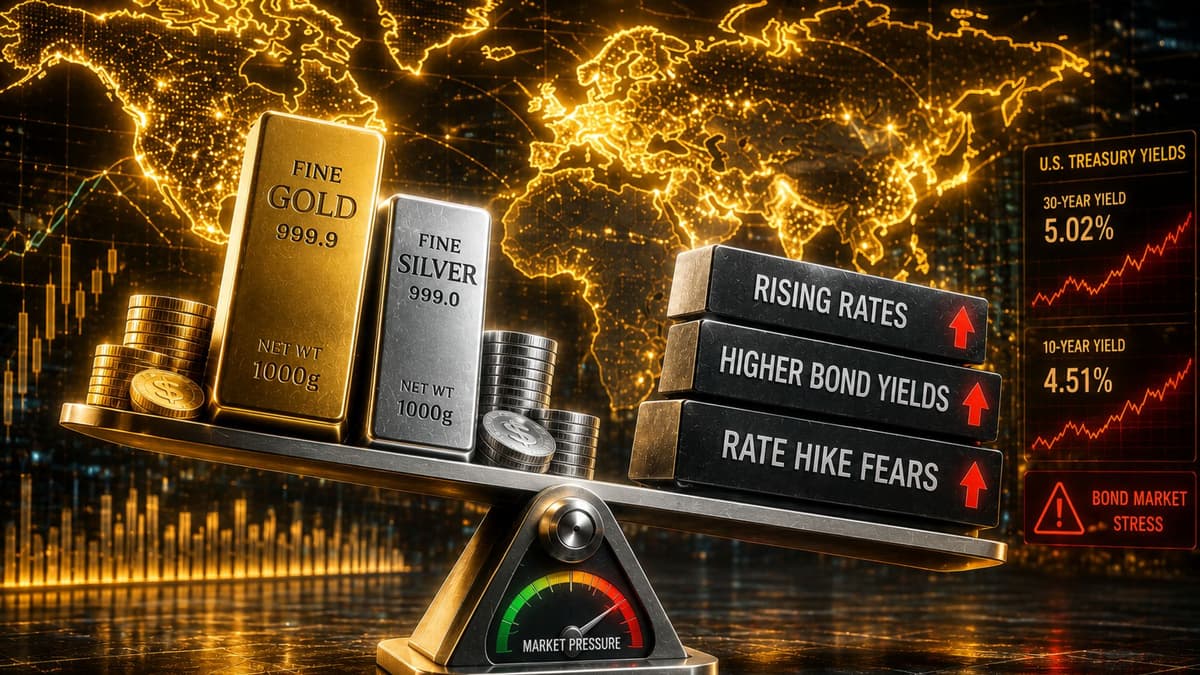
Treasury yields remain a headwind for bullion because they are still far above pre-war levels, even after easing from recent pressure. The benchmark 10-year U.S. Treasury yield slipped to around 4.42% to 4.43%, and was trading near the 4.4% area, but that is still well above the 3.97% level seen before the Iran war began.This policy backdrop remains uncomfortable for bullion bulls. U.S. services are still expanding, labor demand is cooling only gradually, and inflation in the ISM report remains elevated.
That combination suggests the Federal Reserve may keep interest rates higher for longer. Higher yields increase the opportunity cost of holding gold, which does not pay interest, and that tends to limit upside in precious metals.
For Indian gold buyers, delayed U.S. rate cuts can also support the dollar. A firmer U.S. dollar often pressures emerging-market currencies, including the rupee, adding another layer of volatility to domestic bullion pricing.
How did oil prices and record U.S. stocks affect gold?
Oil prices eased and U.S. equities rallied, which reduced some immediate safe-haven demand for gold. In outside markets, Nymex WTI crude oil traded around $102.52 a barrel, while Brent crude was near $110.13.
Brent fell about 4% after U.S. officials said the Iran ceasefire remained in effect. That removed some geopolitical premium from crude and helped equities recover.
U.S. stock indexes closed strongly. The S&P 500 rose 58.47 points to 7,259.22, the Dow Jones Industrial Average added 356.35 points to 49,298.25, and the Nasdaq Composite climbed 238.32 points to 25,326.13.
The S&P 500 and Nasdaq both set record highs, while the Dow gained 0.7%. Stronger equities can pull capital away from defensive assets like gold, especially when falling oil prices reduce near-term inflation panic and geopolitical fear.
What are the key gold price levels traders are watching now?
Technically, spot gold is trying to stabilize after Monday’s steep decline, but bulls still need a breakout above resistance to regain control. The next upside objective for gold bulls is a push above the $4,568.89 to $4,629.39 resistance zone.If spot gold clears that area, the next upside targets are $4,670 to $4,720. Those levels are critical for traders watching whether this recovery is only bargain hunting or the start of a broader rebound in the gold price.
On the downside, bears want a break below $4,503.72. If gold falls through that support, deeper downside targets come in at $4,485 and then $4,450.
In the near term, first resistance stands at $4,568.89 and then $4,629.39. First support is seen at $4,503.72 and then at $4,485.
For Indian investors tracking MCX gold and imported bullion costs, these global XAUUSD levels matter because a decisive break in either direction can quickly ripple into local price discovery.
What silver price levels matter alongside gold?
Spot silver also moved higher, but it faces a similarly important technical test. Silver bulls’ next upside objective is to push prices above the $73.80 to $75.00 resistance zone.A break above that zone would target $76.12. That would signal stronger momentum across precious metals, not just in gold.
On the downside, silver bears are targeting a move below $72.88. If that level breaks, deeper downside targets are $71.85 and then $70.90.
In the immediate term, first resistance is at $73.80 and then $75.00, while next support is at $72.88 and then $71.85. Indian investors often watch silver alongside gold because sharp moves in both metals can indicate whether safe-haven demand is broadening or fading.
What should gold investors watch next?
The next key trigger for gold is U.S. labor-market data, which could reshape expectations for Federal Reserve policy and Treasury yields. Traders are now watching Wednesday’s ADP employment data and Friday’s nonfarm payrolls report for the next reading on labor demand.The metals market is still balancing two competing forces: safe-haven demand on one side, and the risk that higher oil prices keep inflation sticky and delay rate cuts on the other. For Indian investors, that means the near-term outlook for gold will likely depend not just on geopolitics, but also on U.S. jobs data, bond yields, the dollar, and how the rupee responds to those global shifts.