# Gold Price Slips From 3-Week High as Profit-Taking Hits Bullion
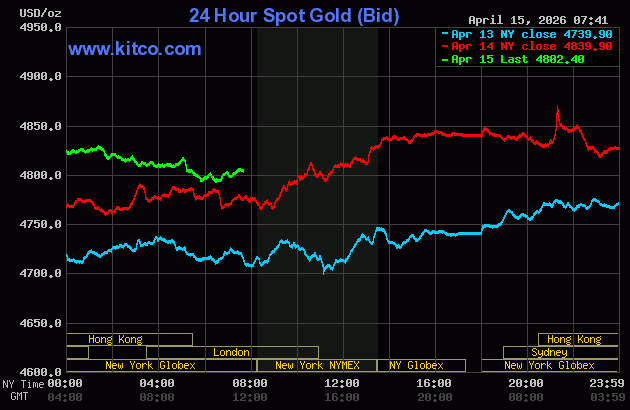
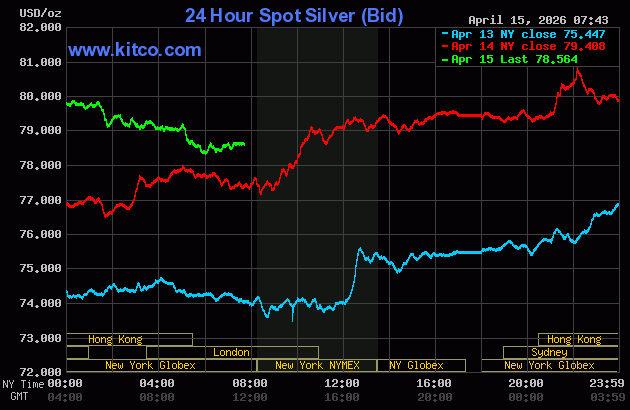
Gold prices eased in early U.S. trading on Wednesday as short-term futures traders booked profits after bullion touched a three-week high overnight. June gold futures were last down $23.30 at $4,826.80 per troy ounce, while May silver futures fell $0.723 to $78.81.
For Indian investors, the move signals a pause rather than a breakdown. A softer or firmer U.S. dollar, elevated crude oil prices, and swings in global risk sentiment can quickly feed into domestic gold rates in rupees, especially when imported bullion costs and INR volatility move together.
Why did gold prices fall today?
Gold prices fell mainly because traders took profits after the market rallied to a three-week high overnight. The decline appeared to be driven by short-term futures positioning rather than a major shift in the broader bullish structure.
June gold futures dropped $23.30 to $4,826.80, while May silver futures lost $0.723 to $78.81 in early Wednesday trading. The pullback came after overnight strength in both precious metals.
Was this a fundamental reversal or simple profit-taking?
It looked like profit-taking, not a clear trend reversal. The broader macro backdrop still includes geopolitical risk, elevated fuel prices, tariff uncertainty, and persistent currency-market shifts that can keep safe-haven demand alive.
For XAUUSD traders and bullion investors, this matters because short-term weakness after a sharp advance often reflects tactical selling. Indian gold buyers should watch whether support near key futures levels holds before assuming a deeper correction is underway.
What is happening in the Middle East and why does it matter for gold?
Middle East developments remain important for gold because any easing in the Iran conflict can reduce immediate safe-haven demand, while renewed escalation can quickly lift bullion again. On Wednesday, markets leaned toward cautious optimism after U.S. President Donald Trump suggested a truce deal with Iran may be close.
According to Bloomberg, Trump said in an ABC News interview on Tuesday that extending a ceasefire expiring next week may not be necessary, signaling possible near-term progress toward ending the nearly seven-week conflict. In a Fox Business interview, Trump said the war is “close to over.”
What is the status of the Iran talks?
The first round of peace talks ended in Pakistan on Sunday without a deal. A second meeting had not yet been agreed, although work continued this week to secure a new time and place, according to people familiar with the matter cited by Bloomberg.
Trump also told the New York Post that talks might restart “over the next two days,” which would mean by Thursday. Even so, uncertainty remains around Tehran’s nuclear program and access to the Strait of Hormuz, which the source article said remains virtually closed.
Why do these headlines affect bullion prices so quickly?
Gold reacts quickly because it is a classic safe-haven asset. If investors believe war risks are easing, they often rotate into equities and away from defensive assets such as gold and silver.
That dynamic was visible as U.S. stocks held near all-time highs on peace hopes. At the same time, lingering uncertainty around Iran, shipping routes, and regional diplomacy limited the downside in precious metals.
For India, the Strait of Hormuz is a key energy route. Any disruption that keeps crude oil elevated can worsen imported inflation and pressure the rupee, both of which can support domestic gold prices even if international gold pauses.
How are fuel prices and crude oil influencing the gold market?
High fuel prices support inflation concerns, and inflation concerns can support gold over time. Even though oil markets eased slightly on hopes of a U.S.-Iran deal, U.S. retail fuel prices remained at their highest seasonal levels on record.
Gasoline averaged $4.12 a gallon on Monday, according to the American Automobile Association as cited by Bloomberg. That topped the prior record for the same date of $4.07 set in 2022 after Russia’s invasion of Ukraine.
National average diesel prices stood at $5.65 a gallon, more than 60 cents above the previous high-water mark for this time of year, also set in 2022. In outside markets, Nymex WTI crude oil traded around $93.00 a barrel.
Why do Indian investors need to watch oil alongside gold?
Indian investors should watch oil because higher crude prices can weaken India’s macro balance by lifting import costs and inflation. That often raises the appeal of gold as a hedge, particularly when INR-denominated gold prices climb due to both global bullion strength and rupee weakness.
If oil stays high while the rupee softens, local gold prices can remain firm even when COMEX gold dips. That is why global gold corrections do not always translate into equal declines in Indian bullion markets.
What do U.S. tariffs and dollar weakness mean for gold prices?
Tariff uncertainty and a weaker dollar can both support gold, although the immediate market reaction can be uneven. On Wednesday, the U.S. dollar index was described as a bit firmer, but the broader narrative around the greenback remained bearish.
Treasury Secretary Scott Bessent said U.S. tariffs could be restored by July to levels that existed before the Supreme Court struck down many of the levies. Speaking on Tuesday at a Wall Street Journal event in Washington, Bessent said the administration would conduct Section 301 studies and that tariffs could be back at the previous level by the beginning of July.
Why do tariffs matter for bullion?
Tariffs matter because they can lift inflation risks, distort trade flows, and increase demand for defensive assets. Trump is trying to restore his tariff wall using different legal authorities after the high court ruled his earlier use of emergency powers was unconstitutional.
For gold, any policy that raises uncertainty around growth, inflation, or global trade can improve safe-haven appeal. Indian investors should also note that tariff-driven volatility can affect the U.S. dollar, global yields, and commodity imports.
Are hedge funds turning bearish on the U.S. dollar?
Yes, hedge funds are increasingly bearish on the U.S. dollar, according to Bloomberg. The report said the greenback had unwound almost all of its war-driven strength as prospects for renewed U.S.-Iran talks improved.
Bloomberg’s dollar index fell 1.9% in April after rising 2.4% in March as the U.S. and Iran began discussing a resolution to the conflict. The report added that analysts expect medium-term dollar weakness to be more pronounced against major peers such as the euro, yen, and Swiss franc.
Harvard University professor Kenneth Rogoff said the dollar is probably still at least 20% overvalued. He said every previous period in which the dollar, or any major currency, had become so overvalued tended to reverse over a five- or six-year period.
A weaker U.S. dollar typically supports gold because bullion becomes cheaper in other currencies. For Indian investors, however, the final impact depends on both the dollar’s path and the rupee’s reaction.
What are the key outside market signals for gold and silver?
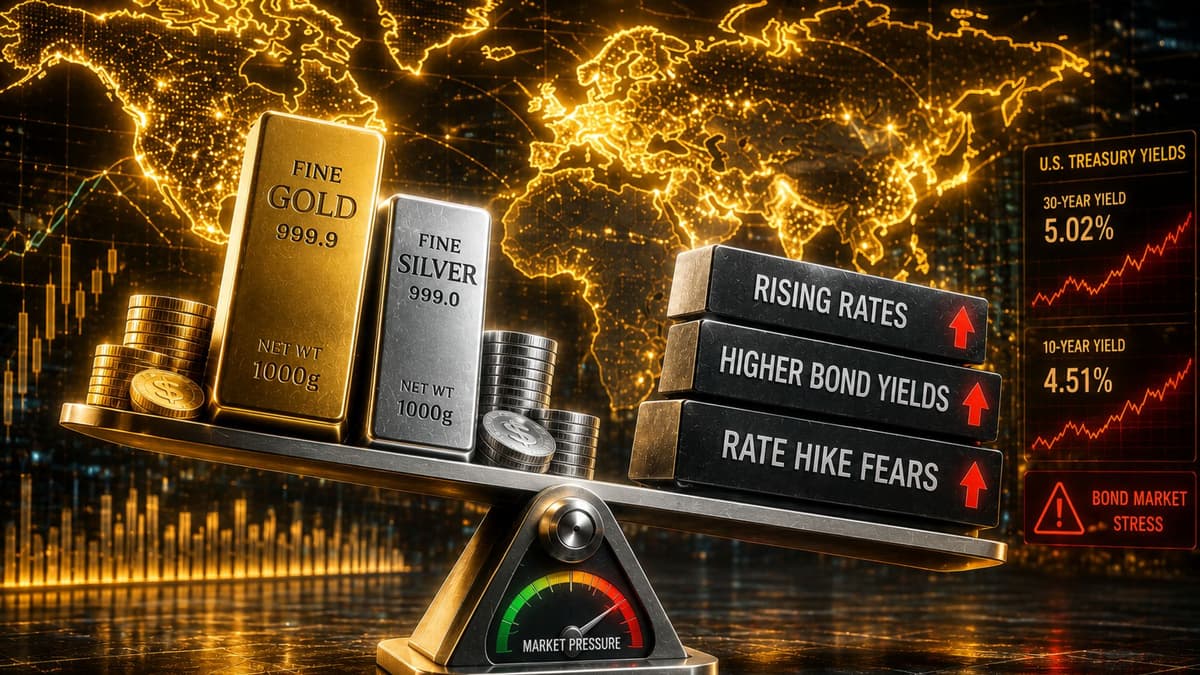
The main outside market signals were mixed on Wednesday. Crude oil was higher, the U.S. dollar index was slightly firmer, and the benchmark 10-year U.S. Treasury yield stood at 4.25%.
Higher Treasury yields can pressure non-yielding assets such as gold in the short term. But elevated oil, geopolitical uncertainty, and a broader bearish view on the dollar can offset that pressure.
Why does the spot-versus-futures distinction matter?
It matters because gold trades through two key pricing mechanisms: the spot market for immediate purchase and delivery, and the futures market for delivery at a later date. The source article also notes that, due to year-end positioning market liquidity, the December gold futures contract is currently the most actively traded on the CME.

For Indian readers, this distinction matters because local jewellers, bullion dealers, and ETFs often respond differently to spot moves, futures positioning, and currency swings. Futures-led volatility can exaggerate intraday price action without necessarily changing physical demand trends.
What technical levels should gold and silver investors watch now?
Gold and silver remain technically constructive, but both markets have pulled back from recent highs. The next major levels now matter for traders looking at momentum, support, and resistance.
Gold technical levels
For June gold futures, bulls’ next upside objective is a close above solid resistance at $5,000.00. Bears’ next near-term downside objective is to push prices below solid technical support at $4,500.00.
First resistance is seen at $4,895.40, which was Wednesday’s high, and then at $4,950.00. First support is seen at $4,800.00 and then at $4,750.00.
Wyckoff's Market Rating: 6.5.
Silver technical levels
For May silver futures, bulls’ next upside objective is a close above solid technical resistance at $85.00. Bears’ next downside objective is a close below solid support at $70.00.
First resistance is seen at $80.00 and then at the day’s high of $81.155. Next support is seen at $77.00 and then at $75.00.
Wyckoff's Market Rating: 6.5.
What do these levels mean for Indian investors?
Indian investors should treat $4,800 in gold and $77.00 in silver as important near-term support markers in the global market. If those levels hold while the rupee remains soft, domestic bullion prices may stay resilient.
If gold pushes back toward $4,895.40 and $4,950.00, traders may start targeting the psychological $5,000.00 barrier again. The next key watchpoint is whether Iran ceasefire headlines, U.S. tariff developments, the dollar trend, and crude oil near $93 a barrel reinforce the recent correction or revive safe-haven demand in bullion.