# Gold Price Slips as Iran War, Fed Meetings Cloud Outlook
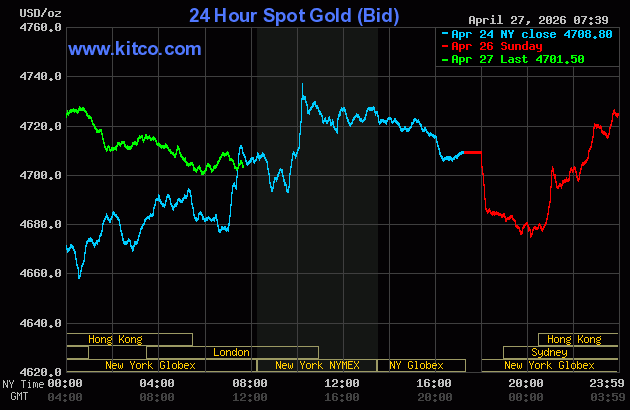
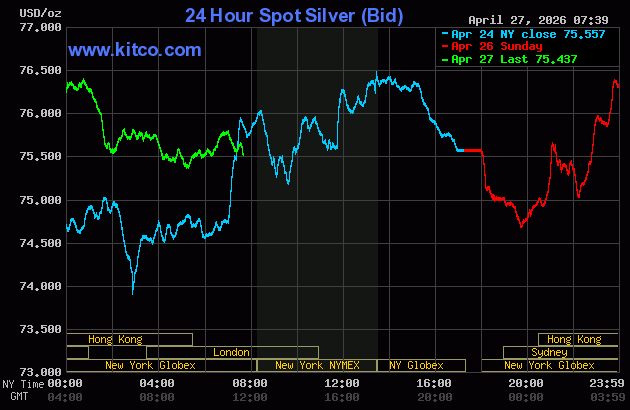
Gold and silver prices eased in early U.S. trading on Monday as traders weighed fresh developments in the U.S.-Iran war and prepared for a heavy week of major central bank decisions. June gold futures were last down $24.00 at $4,717.00, while May silver futures fell $0.804 to $75.60.
For Indian investors, the pullback in global bullion matters because any move in XAUUSD, crude oil and the U.S. dollar can quickly feed into domestic gold rates in rupees. Higher oil prices can pressure inflation and the Indian rupee, which may cushion or even amplify local gold price moves despite softer international futures.
Why did gold prices fall today?
Gold prices fell modestly because traders shifted into a wait-and-watch mode around Middle East war headlines and this week’s central bank meetings. The market is balancing safe-haven demand against uncertainty over interest rates, inflation and energy prices.
June gold futures were last down $24.00 at $4,717.00 in early U.S. trading Monday. May silver futures were down $0.804 at $75.60.
How are outside markets influencing bullion?
Outside markets gave mixed signals for precious metals. The U.S. dollar index was lower, which can support gold, but Nymex WTI crude oil was higher at around $95.50 a barrel and the yield on the benchmark 10-year U.S. Treasury note stood at 4.32%.
Higher Treasury yields typically reduce the appeal of non-yielding bullion. At the same time, rising crude oil prices increase inflation risks, which keeps safe-haven interest in gold alive.
What is happening in the U.S.-Iran war and the Strait of Hormuz?
The latest Middle East developments remain the biggest geopolitical driver for gold because they directly affect energy supply and global risk sentiment. Traders are closely watching whether the Strait of Hormuz can reopen and whether the U.S. and Iran move closer to a ceasefire framework.
What proposal did Iran make?
Iran gave the United States a new proposal to reopen the Strait of Hormuz and end the war. The proposal includes postponing nuclear negotiations and extending the ceasefire so both sides can work toward a more permanent end to the fighting.
Under the proposal, nuclear talks would take place later, after a U.S. blockade of the Strait of Hormuz is lifted. Pakistani mediators delivered the proposal to the White House, but it remains unclear whether the United States is willing to pursue it.
According to a report from Axios, the White House said the U.S. will only make a deal that puts the American people first.
What are the latest war-related developments?
Several developments shaped market sentiment on Monday:
- Iran told Pakistan the war could end if the Americans lift a naval blockade.
- Traffic in the Strait of Hormuz remains halted with blockades firmly in place.
- The U.S. said the Navy intercepted an Iran-linked vessel in the Arabian Sea.
- Germany is readying naval units for a possible Hormuz mission.
What happened at the Washington event attended by Donald Trump and J.D. Vance?
A security incident in Washington added another layer of political tension to the market backdrop. An armed man carrying guns and knives stormed the lobby outside a high-profile journalists’ dinner at the Washington Hilton on Saturday night.
President Trump, Vice President Vance and other senior U.S. leaders were attending the event. Secret Service agents quickly took the man into custody, and both Trump and Vance were uninjured.
One law enforcement official said a gunman had opened fire. According to several sources cited by The Associated Press, a law enforcement officer was shot in a bullet-resistant vest and is expected to be OK.
Why are central bank meetings so important for gold this week?
Central bank meetings matter because interest-rate expectations directly influence gold price direction. If policymakers keep rates high or sound hawkish, yields can remain elevated and cap bullion gains; if they signal caution over growth risks, gold can regain support.
Which central banks are meeting?
Major monetary policy meetings are scheduled across the Group of Seven this week. Bloomberg reported that policymakers in the U.S. and other G7 economies will probably keep interest rates steady while monitoring whether higher energy costs from the Iran war fuel inflation.
The sequence of decisions is as follows:
- Bank of Japan on Tuesday
- Bank of Canada on Wednesday
- Federal Reserve on Wednesday
- Bank of England on Thursday
- European Central Bank on Thursday
Bloomberg said: “Three days of decisions in Washington, Ottawa, London, Frankfurt and Tokyo are widely anticipated to result in unchanged borrowing costs across the club of rich nations, with each central bank seen keeping a hawkish eye on fallout from the Iran war.”
The same Bloomberg report added: “While domestic conditions are key for all of them, events at the Strait of Hormuz, the Middle East pinch point of global energy supply, could well partly dictate the path of their monetary policy too.”
For Indian investors, this matters because a steady or hawkish Federal Reserve can support U.S. yields and shape the dollar-rupee trend. That, in turn, can influence imported gold prices in India even if international bullion trades sideways.
Is Jerome Powell about to leave the Federal Reserve, and why does Kevin Warsh matter?
Federal Reserve leadership is now another key variable for gold traders. A change at the top of the U.S. central bank could shift future policy expectations, which would affect the U.S. dollar, bond yields and bullion.
What changed for Kevin Warsh’s nomination?
A major political hurdle cleared for Kevin Warsh to become the next Fed chair. U.S. Senator Thom Tillis said on Friday that he is dropping his blockade of Warsh’s nomination to lead the Federal Reserve.
The Justice Department’s decision on Friday to end its criminal probe targeting Fed Chair Jerome Powell removed a threat to the central bank’s independence, according to Tillis. Tillis said he looks forward to supporting Warsh’s confirmation and called him an “outstanding nominee” who can help the Federal Reserve move beyond distraction and return full attention to its mission.
When does Jerome Powell’s term end?
Jerome Powell’s term ends on May 15. The article noted that this week’s Federal Open Market Committee meeting may well be Powell’s last as head of the U.S. central bank.
That political transition matters for gold because any change in Fed leadership can alter the market’s expectations for rates, inflation control and the future path of the U.S. dollar. Indian bullion traders should watch this closely, especially if it affects XAUUSD volatility and rupee pricing.

What are the key technical levels for gold and silver now?
Gold and silver remain in technically important trading ranges. Traders are watching whether futures can break resistance and resume the uptrend or fall through support and trigger a deeper correction.
Gold futures technical levels
June gold futures bulls’ next upside price objective is a close above solid resistance at $5,000.00. Bears’ next near-term downside price objective is pushing futures below solid technical support at $4,500.00.
Key near-term levels are:
- First resistance: $4,750.00
- Second resistance: $4,800.00
- First support: $4,672.20 (last week’s low)
- Second support: $4,626.00
- Wyckoff's Market Rating: 5.5
Silver futures technical levels
For May silver futures, the bulls’ next upside price objective is a close above solid technical resistance at the April high of $83.245. The bears’ next downside objective is a close below solid support at $70.00.
Key near-term silver levels are:
- First resistance: $77.50
- Second resistance: $80.00
- First support: $73.845 (last week’s low)
- Second support: $72.00
- Wyckoff's Market Rating: 5.0
Why does the futures contract note matter?
The gold market operates through two primary pricing mechanisms: the spot market and the futures market. The spot market quotes prices for immediate purchase and delivery, while the futures market sets prices for delivery at a later date.
Due to year-end positioning market liquidity, the December gold futures contract is currently the most actively traded on the CME. That detail matters for traders because liquidity often shapes price discovery, volatility and execution quality.
Indian investors tracking MCX gold and global bullion should now watch three things closely: whether the Strait of Hormuz reopens, whether the Federal Reserve and other G7 central banks keep a hawkish tone, and whether June gold can hold above $4,672.20 or retest resistance at $4,750.00 and $4,800.00. With crude oil near $95.50 a barrel and the 10-year U.S. Treasury yield at 4.32%, global macro signals could quickly spill into domestic gold prices in rupees.