# Gold Price Slips as Dollar Hits 2-Week High, Yields Rise
Gold prices moved lower in early U.S. trading on Thursday as a stronger U.S. dollar and higher Treasury yields pressured bullion. Silver fell more sharply, while Middle East tensions, rising oil prices, and weak Eurozone business activity added to the risk-off backdrop.
For Indian investors, the move matters because global gold price weakness can be partly offset if the U.S. dollar stays strong against major currencies and keeps the rupee under pressure. That means domestic gold rates in INR may not fall as much as international XAUUSD-linked prices.
Why did gold prices fall today?
Gold prices fell because the U.S. dollar index climbed to a two-week high overnight and U.S. Treasury yields moved up. Those two outside-market forces reduced support for non-yielding bullion and weighed on both gold and silver.
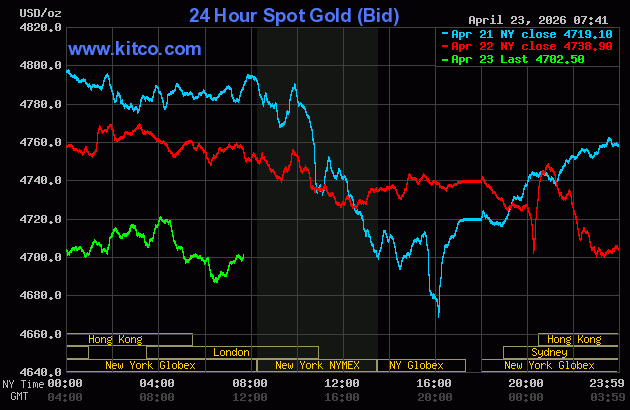
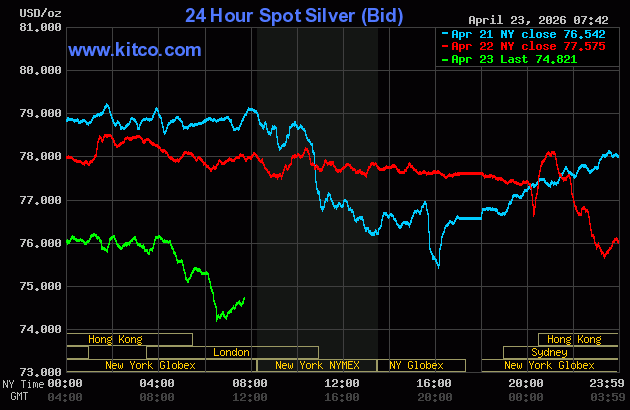
In early U.S. trading Thursday, June gold was last down $35.20 at $4,717.30 per troy ounce. May silver was down $3.186 at $74.77.
A firmer dollar typically makes gold more expensive for buyers using other currencies. Higher Treasury yields also raise the opportunity cost of holding precious metals, which do not pay interest.
What were the key outside markets doing?
The key outside markets were broadly bearish for precious metals. Nymex WTI crude oil was trading higher at around $94.50 a barrel, the U.S. dollar index was firmer, and the yield on the benchmark 10-year U.S. Treasury note stood at 4.32%.
Higher oil prices can support inflation concerns, which is usually constructive for gold over time. But on Thursday, the immediate pressure from the stronger dollar and rising yields dominated price action.
How is the Middle East conflict affecting gold and silver?
The Middle East conflict is supporting the U.S. dollar more than gold in the current session. That shift in safe-haven flows hurt bullion even as geopolitical risks remained elevated.
According to Bloomberg, the U.S. military said it intercepted two Iranian oil supertankers that tried to evade Washington’s blockade. The very large crude carriers Hedy and Hero II were anchored at Chabahar, an Iranian port on the Gulf of Oman, after being intercepted earlier in the week, according to U.S. Central Command, which posted the update on Wednesday on X.
Bloomberg reported that the enforcement action suggested only a tiny amount of petroleum was reaching global markets through the Strait of Hormuz, one of the world’s most important oil channels. The report also said Tehran attacked at least three vessels and diverted two of them into its waters, reminding global markets of the risk to commercial shipping in the strait.
Why didn’t safe-haven demand lift gold more strongly?
Gold did not benefit fully because the U.S. dollar captured the stronger safe-haven bid. In periods of acute geopolitical stress, investors often buy both gold and dollars, but Thursday’s market showed the dollar winning that competition.
That dynamic is important for Indian bullion buyers. If geopolitical tensions keep energy prices elevated and support the dollar, imported gold can remain expensive in rupee terms even when international gold prices soften.
Why is the U.S. dollar staying strong?
The U.S. dollar is staying strong because global trade and financial flows continue to favor it during periods of stress. New Swift transaction data showed the dollar’s role in international payments increased sharply.
Bloomberg reported that the U.S. currency’s share of international transactions rose to a record 51.1% in March, up from 49.2% a month earlier. That is the highest share since 2023, when Swift revised how it collects transaction data.
Large global banks use the Belgium-headquartered Society for Worldwide Interbank Financial Telecommunication, or Swift, to communicate and facilitate interbank currency deals. After the U.S. dollar, the ranking of transaction share was the euro at about 21%, followed by the pound, yen, Chinese yuan, and Canadian dollar.
What did JPMorgan say about dollar dominance?
JPMorgan said last year’s dollar weakness has not changed the currency’s structural dominance. A JPMorgan research team led by Joyce Chang said, “Dollar weakness seen last year has not translated into any clear decline in the dollar’s role as a reserve or base currency for capital markets.”
That matters for XAUUSD because a structurally strong dollar can cap rallies in bullion, especially when bond yields are also rising. For Indian investors, it also matters because dollar strength can keep landed gold costs firm even if futures prices pause.
What does Eurozone PMI data mean for gold markets?
The Eurozone data showed a clear slowdown in overall business activity, which reinforced concerns about global growth. But the details were mixed because manufacturing improved even as services weakened sharply.
The Eurozone Composite PMI fell to 48.6 in April, below expectations of 50.2, marking the sharpest contraction since November 2024. Services contracted sharply as the energy-cost surge linked to the U.S.-Iran war squeezed demand.
At the same time, the Eurozone Manufacturing PMI rose to 52.2 in April 2026 from 51.6 in March, beating expectations of 50.8. That was the strongest improvement in business conditions since May 2022.
What improved inside Eurozone manufacturing?
Production growth accelerated to its fastest pace since August 2025. New orders expanded at the quickest rate in four years, helped by the first rise in export demand since February 2022.
For gold, that mix creates crosscurrents. Slower services activity and war-driven energy pressure support defensive positioning, but stronger manufacturing and a resilient dollar can limit immediate upside in bullion.
What are the key technical levels for gold price now?
Gold futures remain in a technically neutral-to-slightly-bullish setup, but the market has pulled back from recent highs. Traders are now watching whether June gold can hold support above the mid-$4,600 area.
According to the technical outlook, June gold futures bulls’ next upside price objective is a close above solid resistance at $5,000.00. The bears’ next near-term downside price objective is pushing futures below solid technical support at $4,500.00.
Where is gold resistance and support?
First resistance is seen at the overnight high of $4,771.30 and then at $4,800.00. First support is seen at this week’s low of $4,685.80 and then at $4,626.00.

Gold’s Wyckoff Market Rating is 5.5, suggesting neither bulls nor bears hold a decisive near-term technical edge.
Why does the futures contract note matter?
The source notes that the gold market operates through two main pricing mechanisms: the spot market, which covers immediate purchase and delivery, and the futures market, which sets prices for delivery at a later date. Due to year-end positioning market liquidity, the December gold futures contract is currently the most actively traded on the CME.
That distinction matters for investors comparing spot gold, MCX gold, and COMEX futures. Short-term price moves can vary depending on liquidity and contract positioning.
What are the technical levels for silver price?
Silver is under heavier pressure than gold, with May silver futures posting a sharper decline. The chart setup still shows a balanced market, but downside risks are more visible if support breaks.
The next upside price objective for silver bulls is a close above solid technical resistance at the April high of $83.245. The next downside price objective for silver bears is a close below solid support at $70.00.
Where is silver resistance and support?
First resistance is seen at $76.00 and then at today’s high of $78.405. Next support is seen at $72.00 and then at $70.00.
Silver’s Wyckoff Market Rating is also 5.5.
For Indian investors, silver’s sharper volatility can create larger swings in domestic prices, especially when combined with rupee moves and changing industrial-demand expectations.
Indian traders should now watch three variables closely: the U.S. dollar index, the 10-year Treasury yield at 4.32%, and developments in the Strait of Hormuz. If the dollar stays firm and yields rise further, gold price dips could extend globally even as INR weakness cushions domestic declines.