# Gold Price Slips Ahead of Key U.S. Inflation Data
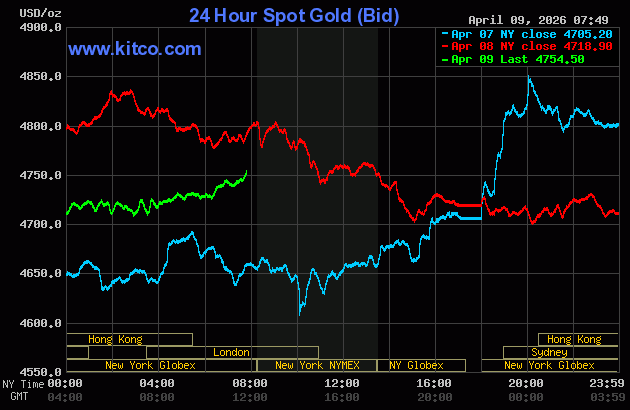
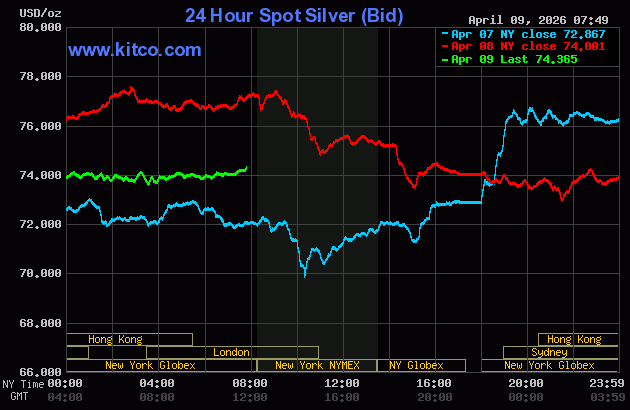
Gold prices eased in early U.S. trading on Thursday as traders turned cautious before closely watched U.S. inflation readings. June gold futures were last down $5.40 at $4,772.10 per troy ounce, while May silver futures fell $1.005 to $74.38.
For Indian investors, the pullback in bullion matters because global XAUUSD price moves often feed into domestic gold rates after adjusting for the rupee, import duty and local premiums. Even a mild decline in U.S. futures can be offset if the Indian rupee weakens against the U.S. dollar.
Why is gold price lower today?
Gold price is lower today because traders are trimming positions before major U.S. inflation data and reassessing geopolitical risks tied to the Middle East war. The move is modest rather than aggressive, which suggests the market is waiting for fresh macro signals.
June gold futures slipped $5.40 to $4,772.10, and May silver futures dropped $1.005 to $74.38 in early Thursday trading. The weakness came just before the U.S. personal income and outlays report and ahead of the March U.S. consumer price index report due Friday morning.
What inflation data is the market watching?
The market is watching the U.S. PCE price index because it is the Federal Reserve’s preferred inflation gauge. Expectations suggest inflation remained sticky in February 2026.
The headline PCE price index is expected to rise 0.4% month over month in February 2026, slightly above January’s 0.3% increase. The core PCE index, which excludes food and energy, is also projected to rise 0.4%, matching January’s pace.
On a year-over-year basis, headline PCE inflation is expected to remain at 2.8%. Core PCE inflation is seen easing slightly to 3.0% from 3.1%, but that would still leave inflation above the Federal Reserve’s 2% target.
The report is expected to show that price pressures stayed elevated in February, before the war with Iran began to reshape the inflation outlook. That is why traders in gold, silver and broader precious metals markets are treating the release as a key short-term catalyst.
How are the Federal Reserve and inflation expectations affecting gold?
Federal Reserve expectations are affecting gold because policymakers are increasingly worried that the Middle East war could reignite inflation, even as some officials still see economic risks that could justify lower rates. That tension is creating uncertainty for bullion.
According to the minutes of the mid-March Federal Open Market Committee meeting released Wednesday afternoon, a growing number of Federal Reserve officials are worried that the war could further stoke inflation and may eventually force the U.S. central bank to consider raising interest rates.
Most Federal Reserve officials were concerned that a prolonged war could hurt the labor market and warrant lower interest rates. At the same time, many policymakers highlighted inflation risks that might ultimately justify rate increases.
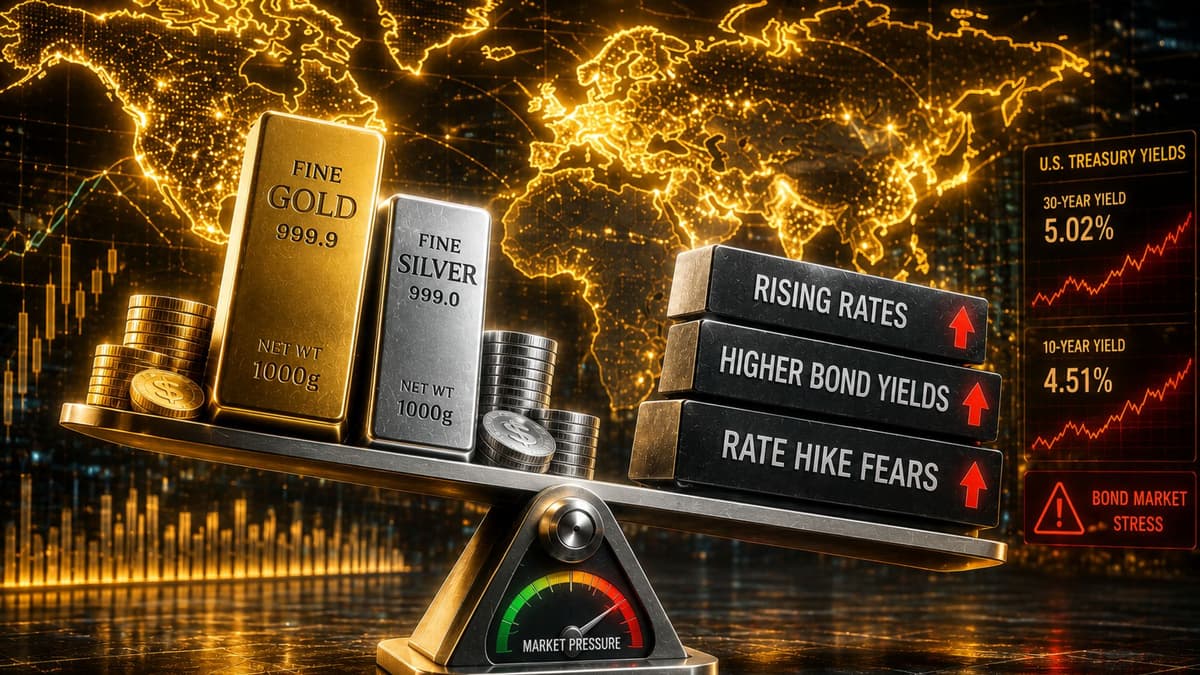
Some Federal Reserve officials who were more worried about inflation even urged colleagues to consider adding language to the post-meeting statement that would raise the possibility of hiking rates under certain conditions. For gold price, that matters because higher rate expectations typically lift bond yields and reduce the appeal of non-yielding safe-haven assets like bullion.
What is happening in the Middle East and why does it matter for bullion?
The Middle East war still matters for bullion because it is driving energy market stress, inflation concerns and safe-haven demand, even though Thursday’s gold price action was slightly weaker. Traders are balancing geopolitical support for gold against the risk of tighter U.S. monetary policy.
The latest developments show a fragile and highly uncertain backdrop:
- The White House said the U.S. will hold direct talks with Iran, despite mistrust on both sides.
- U.S. Vice President Vance is set to lead U.S. negotiations with Iran in Pakistan on Saturday.
- There were no reports of strikes from Arab Gulf nations for much of Wednesday.
- President Donald Trump said the U.S. military will remain in place around Iran until a ceasefire is reached.
- Lebanon remains a stumbling block to negotiations after a barrage of attacks from Israel.
- The Strait of Hormuz remained largely closed as of Thursday.
- Some tankers in the Persian Gulf are sailing east to be nearer to the Strait of Hormuz.
- The U.S. has asked allies for quick plans to secure Hormuz after a ceasefire.
- Crude oil rose after its biggest drop since 2020 as the Strait of Hormuz stayed blocked.
- U.S. and European stocks moved back into the red as ceasefire optimism faded.
Why does the Strait of Hormuz matter for gold and Indian investors?
The Strait of Hormuz matters because it is a critical oil chokepoint, and any disruption can push crude oil prices higher, worsen inflation and reshape expectations for interest rates. That mix can create two-way volatility for gold price.
For India, the impact is even more important. India imports most of its crude oil, so any rise in oil prices can pressure the rupee, widen external balances and raise imported inflation. A weaker rupee can support domestic gold prices in INR terms even if international bullion prices soften.
What are the key outside markets signalling now?
The outside markets are sending a mixed message for precious metals. Oil is supportive for inflation-sensitive assets, while the U.S. dollar and Treasury yields are not showing an extreme move.
Nymex WTI crude oil is trading higher at around $99.00 a barrel. The U.S. dollar index is slightly down, while the yield on the benchmark 10-year U.S. Treasury note stands at 4.29%.
A softer U.S. dollar can help gold by making bullion cheaper for non-dollar buyers. However, a 10-year Treasury yield near 4.29% keeps competition alive for gold because higher yields improve returns on fixed-income assets.
What are the important technical levels for gold price?
Gold price remains in a technically resilient but range-bound structure, with bulls still holding a near-term advantage. Traders are now focused on whether June gold futures can retest $4,800 and eventually challenge $5,000.
Gold futures support and resistance levels
June gold futures bulls’ next upside objective is a close above solid resistance at $5,000.00. Bears’ next near-term downside objective is to push prices below solid technical support at $4,500.00.
First resistance stands at $4,800.00, followed by this week’s high of $4,888.00. First support is seen at $4,700.00, followed by this week’s low of $4,626.20.
Wyckoff's Market Rating for June gold futures is 6.0. That rating suggests bulls still retain a modest technical edge, although not full control.

Why do futures levels matter for Indian gold buyers?
Futures levels matter because global benchmark prices heavily influence landed bullion costs in India. If gold breaks above $4,800 or even $5,000 per troy ounce, Indian retail and investment demand could face higher entry levels unless the rupee strengthens materially.
On the downside, support near $4,700 and $4,626.20 will be watched closely by traders looking for buying opportunities in both international gold and domestic MCX-linked pricing trends.
What are the important technical levels for silver price?
Silver price is under more visible short-term pressure than gold, but it still has a defined technical trading range. May silver futures need to regain momentum above $77.80 to improve the near-term chart picture.
May silver futures bulls’ next upside objective is a close above solid technical resistance at $80.00. Bears’ next downside objective is a close below solid support at the March low of $61.21.
First resistance is seen at this week’s high of $77.80 and then at $80.00. Next support is located at $72.50 and then at this week’s low of $69.78.
Wyckoff's Market Rating for May silver futures is 5.5. That points to a more neutral technical backdrop than gold, with neither side holding a decisive advantage.
What should Indian investors watch next in gold and silver?
Indian investors should watch U.S. inflation data, Federal Reserve rate expectations, crude oil near $99 a barrel, and developments around Iran and the Strait of Hormuz. These factors will likely determine whether gold price resumes its safe-haven rise or extends its current pause.
The immediate watchpoints are the February 2026 PCE inflation report and Friday morning’s U.S. consumer price index report for March. If inflation surprises on the upside, markets may price in a more hawkish Federal Reserve, which could pressure XAUUSD in the short term.
But if geopolitical risks intensify further, especially around the Strait of Hormuz, safe-haven demand and energy-led inflation fears could quickly put gold back on the offensive. For Indian buyers, the added variable is the rupee: any INR weakness could keep local gold prices firm even when global bullion trades slightly lower.