# Gold Price Slips Ahead of Fed, PPI as Iran War Clouds Outlook
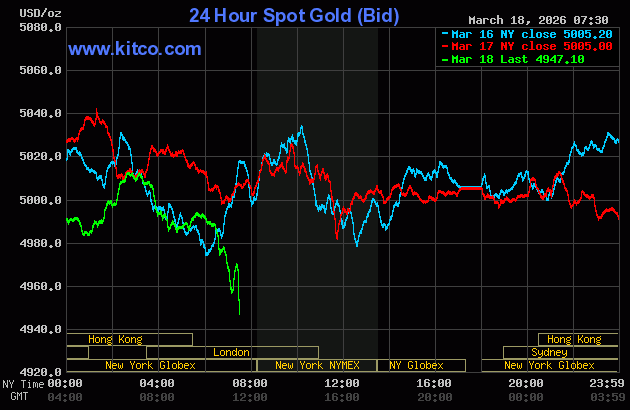
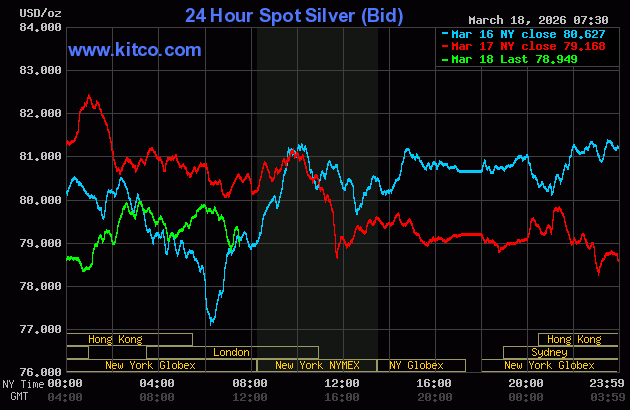
Gold and silver prices moved lower in early U.S. trading on Tuesday as traders waited for two major catalysts: the U.S. producer price index (PPI) and the Federal Reserve's policy decision. April gold futures were last down $38.10 at $4,970.10, while May silver futures fell $0.351 to $79.57.
For Indian investors, the near-term gold price outlook now hinges on three global drivers at once: Federal Reserve guidance, U.S. inflation data, and the widening Middle East conflict. A firmer U.S. dollar and elevated energy risks can also feed into the rupee-denominated gold price in India by raising imported bullion costs.
Why did gold price and silver price edge lower on Tuesday?
Gold price and silver price eased because traders turned cautious before fresh U.S. inflation data and the Federal Open Market Committee decision. The market was not seeing aggressive liquidation, but it was pulling back as participants waited for direction from macro data and Federal Reserve Chair Jerome Powell.
April gold futures were down $38.10 at $4,970.10 in early U.S. trading. May silver futures were down $0.351 at $79.57, showing similar pressure across precious metals.
The broader backdrop also limited safe-haven buying. Even with war risks in the Middle East, traders appeared more focused on how inflation, interest rates, Treasury yields, and the U.S. dollar could affect bullion and XAUUSD in the short term.
What is the Federal Reserve expected to do, and why does it matter for gold?
The Federal Reserve is widely expected to leave U.S. monetary policy unchanged at the end of its meeting today. That matters for gold because interest-rate expectations shape the opportunity cost of holding non-yielding bullion.
Traders and investors are now focused on Jerome Powell's press conference early this afternoon. Powell is expected to explain how Federal Reserve officials are balancing economic risks as war in the Middle East threatens growth, inflation, and energy markets.
According to the source report, Powell will likely stress that Federal Reserve officials need more time. He is expected to assess how long the U.S. conflict with Iran may last and how that conflict could affect economic growth and inflation.
A Bloomberg report added that bond traders are scaling back aggressive bets that had pushed markets to price out Federal Reserve rate cuts this year. The market has shifted back to pricing at least one quarter-point cut by the end of 2026 after a sell-off in short-end U.S. Treasuries accelerated on inflation worries tied to oil moving above $100 a barrel.
For gold, that mix is crucial. Fewer or later rate cuts can weigh on bullion, but persistent geopolitical stress and inflation fears can still support safe-haven demand.
What does the latest U.S. PPI report mean for gold price?
The U.S. producer price index matters because hotter inflation can keep the Federal Reserve cautious, which can pressure gold. Softer inflation, by contrast, can revive hopes for easier policy and support precious metals.
The market expects U.S. producer prices to rise 0.3% month over month in February. That would be lower than January's 0.5% increase and the smallest rise in three months.
Core PPI, which excludes food and energy, is also forecast to rise 0.3%. That compares with a much stronger 0.8% increase in the previous month.
On an annual basis, headline producer inflation is expected to remain at 2.9%, unchanged from January. Core producer inflation is projected to edge up to 3.7% from 3.6% in January, which would mark the highest reading since March of last year.
That split matters for gold investors. A stable headline number may calm markets, but a rise in core producer inflation to 3.7% could reinforce concerns that inflation remains sticky, keeping Treasury yields and the U.S. dollar supported.
How is the Iran war affecting gold, oil, and safe-haven demand?
The Iran war is keeping geopolitical risk elevated, but its impact on gold is being filtered through oil prices, inflation expectations, and global risk sentiment. Traders are treating the conflict as both a safe-haven driver and a potential inflation shock.
The latest developments were significant:
What are the key war updates traders are tracking?
Iranian attacks in the Persian Gulf continued with a fresh wave of missiles and drones targeting the UAE, Saudi Arabia, and Kuwait. Those attacks followed Iran's confirmation of the assassination of its security chief, Ali Larijani, in an Israeli strike.
The report said Israel's killing of Ali Larijani leaves Iran's wartime leadership largely in the hands of hardliners who may be less likely to seek a diplomatic pathway out of the war. That raises the risk of a longer conflict and more disruption to regional security.
Donald Trump said the U.S. would soon be ready to end the war, stating: "We're not ready to leave yet. But we'll be leaving in the near future."
Israel has also stepped up its offensive in Lebanon, where strikes have killed more than 900 people, according to the Lebanese government.
Why are oil markets so important for bullion right now?
Oil markets matter because rising crude can lift inflation expectations and alter Federal Reserve policy expectations, which then affects gold price direction. At the same time, energy supply headlines can either intensify or ease the market's safe-haven bid.
Iran has been moving its crude through the Strait of Hormuz at rates broadly comparable to before the war began. That has reduced some fears of an immediate supply collapse.
Oil prices dipped after Iraq signed a deal to resume exports via Turkey through routes that avoid the Strait of Hormuz. Prices also eased as the U.S. stepped up efforts to force the reopening of the key waterway.
Other supply-side developments added to the picture. The U.S. is set to ease Venezuela sanctions to unlock more oil amid the Middle East war, and China plans to tap its vast crude oil stockpiles to offset the Iran crisis.
Even so, the market recently saw inflation worries fueled by oil topping $100 a barrel. That remains a major macro link between geopolitics and bullion.
For Indian investors, this matters directly. India imports most of its crude oil and gold, so sustained energy stress can pressure the rupee, raise imported inflation, and influence domestic gold prices even if international XAUUSD trades in a narrow band.
What are the key outside markets telling traders about gold today?
The outside markets show a mildly negative short-term setup for gold. The U.S. dollar index was slightly higher, Nymex crude oil was lower near $94.50 a barrel, and the benchmark 10-year U.S. Treasury yield stood at 4.2%.
A firmer U.S. dollar can make gold more expensive for non-dollar buyers, which often weighs on demand. Higher Treasury yields also compete with bullion because gold does not pay interest.
The crude oil pullback offered some relief on inflation fears, but not enough to spark a rebound in gold prices early in the session. Traders clearly wanted confirmation from PPI and the Federal Reserve before taking stronger positions.
What should investors know about spot gold versus gold futures?

Gold trades through two main pricing mechanisms: the spot market and the futures market. The spot market reflects prices for immediate purchase and delivery, while the futures market reflects prices for delivery at a later date.
The source note said the December gold futures contract is currently the most actively traded on the CME because of year-end positioning and market liquidity. That distinction matters for investors comparing headlines on spot gold, gold futures, and local bullion prices in India.
What are the key technical levels for gold and silver now?
Gold bulls still hold a modest technical edge, but prices are under short-term pressure. Silver's chart posture is weaker, with a more neutral-to-cautious setup.
What levels matter most for April gold futures?
The next upside objective for gold bulls is a close above solid resistance at the March high of $5,434.10. The next near-term downside objective for bears is to push futures below solid technical support at $4,700.00.
First resistance stands at this week's high of $5,049.40, followed by $5,100.00. First support is seen at this week's low of $4,970.10, followed by $4,900.00.
Wyckoff's Market Rating for April gold futures is 6.0. That suggests bulls still retain an overall near-term advantage, even though momentum has softened.
What levels matter most for May silver futures?
The next upside price objective for silver bulls is a close above solid technical resistance at $90.00. The next downside target for bears is a close below solid support at $72.405.
First resistance is seen at this week's high of $82.76 and then at $85.00. Next support is seen at this week's low of $77.125 and then at $76.00.
Wyckoff's Market Rating for May silver futures is 5.0. That points to a more evenly balanced technical picture for silver than for gold.
For Indian investors, the immediate watchpoint is clear: if gold can defend $4,970.10 and absorb any hawkish Federal Reserve or hotter-than-expected PPI surprise, safe-haven demand could reassert itself quickly. If not, traders may start focusing more seriously on the $4,900.00 and $4,700.00 support zones while tracking how the U.S. dollar, Treasury yields, oil, and the rupee shape domestic bullion prices.