# Gold Price Slides Sharply as Dollar, Yields Surge on Iran Fears
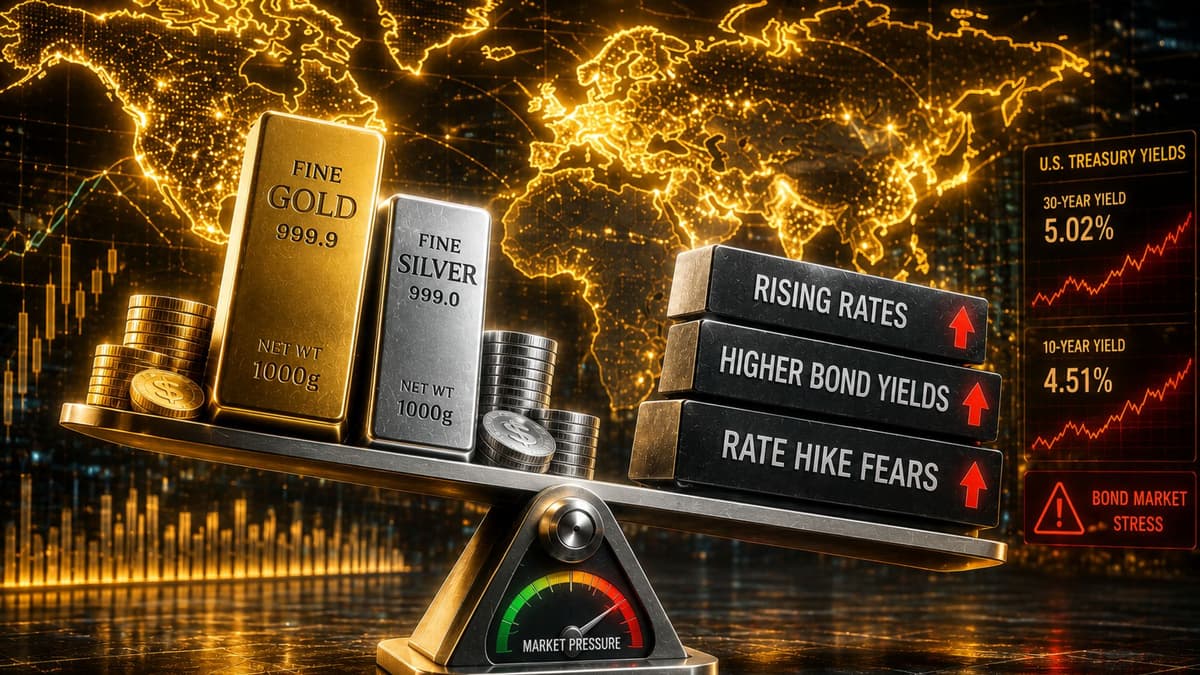
Gold prices fell sharply in early U.S. trading as the U.S. dollar index rallied and U.S. Treasury yields moved higher, offsetting safe-haven demand even as the Iran war intensified. For Indian investors, the drop in global bullion prices matters, but any upside in the U.S. dollar can cushion the fall in domestic gold rates when converted into rupees.
Why did gold price fall sharply today?
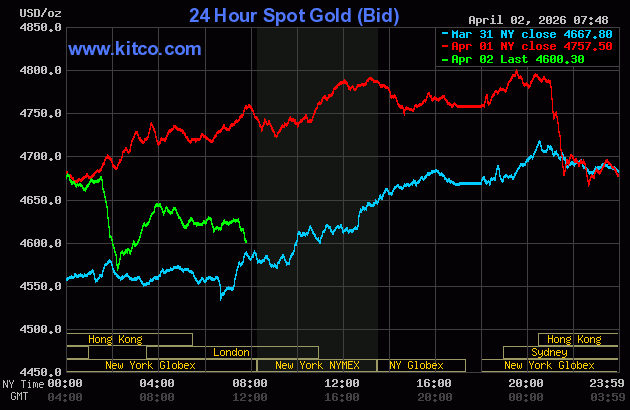
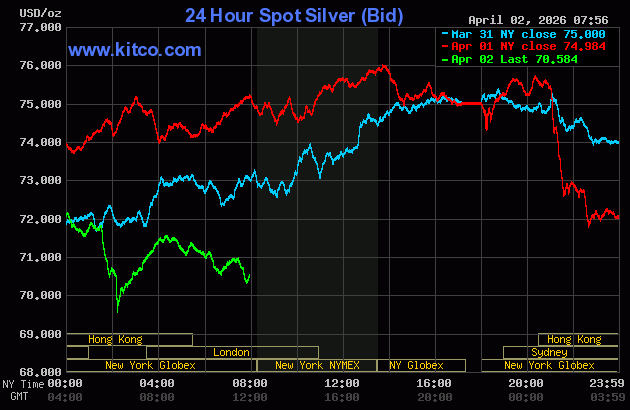
Gold price fell because the U.S. dollar index rose solidly and U.S. Treasury yields climbed, making non-yielding bullion less attractive. In early trade, June gold futures were last down $176.10 at $4,637.70 per troy ounce, while May silver futures fell $5.09 to $70.97.
The sell-off came even though broader market risk aversion remained elevated. Normally, geopolitical stress supports safe-haven assets such as gold, but this time traders favored the U.S. dollar while rising bond yields added pressure to XAUUSD and silver.
Crude oil also moved sharply higher, reinforcing inflation concerns rather than boosting precious metals immediately. That combination of higher oil, a stronger dollar and firmer Treasury yields created a difficult backdrop for gold and silver.
What is happening in the Iran war and why does it matter for bullion?
The Iran conflict remains the key geopolitical driver, but mixed U.S. signals appear to have reduced gold’s immediate safe-haven appeal. Instead of pushing bullion higher, the market focused on the stronger dollar and rising yields.
What were the latest developments on Iran?
The latest developments cited in the market include:
- Donald Trump said the U.S. will hit Iran “extremely hard” in the next two to three weeks.
- Trump said core U.S. goals in Iran “are nearing completion” in a national address.
- Trump said the U.S. will hit Iran’s electric plants if there is no deal.
- Iran and Israel continued to trade strikes as hopes for an end to the war faded.
- News reports said Iran was not willing to negotiate with the U.S.
- U.S. and Israeli attacks battered Iran’s civilian infrastructure.
- Crude oil prices jumped sharply and global stock markets sold off.
- U.S. Treasury yields rose as inflation worries resurfaced.
The Associated Press added: “Notably missing from Trump’s primetime address was his oft-repeated assertion that negotiations with Iran were underway. He softened his rhetoric against NATO allies and did not indicate he was preparing to send in ground troops, particularly to retrieve Iran’s enriched uranium.”
Why didn’t gold get a stronger safe-haven bid?
Gold did not attract stronger safe-haven buying because the market treated the geopolitical shock as dollar-positive and inflationary. When the U.S. dollar index rises and the 10-year Treasury yield moves up, those forces can overpower haven demand in bullion.
For Indian investors, this is a critical signal. Global stress does not automatically mean higher gold prices in dollar terms, especially when bond yields and the dollar rise together.
How are the U.S. dollar, Treasury yields and crude oil affecting gold?
Gold is under pressure because all three outside-market signals turned unfriendly at once. The U.S. dollar index was solidly higher early in the session, the benchmark 10-year U.S. Treasury note yield stood at 4.38%, and Nymex WTI crude oil traded around $108.00 a barrel, a three-week high.
Higher Treasury yields raise the opportunity cost of holding non-interest-bearing assets such as gold. A stronger dollar makes gold more expensive for buyers using other currencies, often weighing on global bullion demand.
At the same time, oil at $108.00 a barrel can increase inflation worries. In many cases that helps gold over time, but in the short term, markets often react first to higher yields and tighter financial conditions.
For Indian buyers, the dollar’s strength is especially important. Even if international gold prices weaken, a firmer U.S. dollar can limit downside in Indian gold prices in INR terms.
What should investors watch from the U.S. jobs report and holiday schedule?
Investors should watch the U.S. Employment Situation Report for March because it can shift expectations for interest rates, yields and the dollar. Although U.S. stock, financial and commodity markets will be closed on Friday for the Good Friday Easter holiday, the U.S. Labor Department will still release the jobs report.
The key non-farm payrolls figure is forecast to rise by around 60,000 workers in March. That compares with a decline of 92,000 workers in the February report.
The overall U.S. unemployment rate is forecast at 4.4% in March, unchanged from February. A stronger-than-expected report could support the dollar and yields further, which would remain a near-term headwind for gold. A weaker report could help bullion stabilize.
How could new U.S. steel and aluminum tariffs influence inflation and precious metals?
New U.S. tariffs could add to inflation worries, and that matters for gold because tariff-driven price pressure can keep bond yields elevated. Bloomberg reported that the Trump administration is preparing a tiered tariff system for steel and aluminum imports.
Under the reported plan, the U.S. will keep 50% tariffs on a large number of derivative products. Many other products will face a lower 25% rate, while some products will fall below that duty level.
Bloomberg also reported that the administration is shifting tariffs from content-based calculations to the full value of the imported product. Certain items would incur a 50% duty and others a 25% tariff, according to people familiar with the matter.
For gold, the market implication is straightforward: if tariffs revive inflation worries, Treasury yields may stay firm. That can suppress gold price gains in the near term even when geopolitical risks remain high.
What are the key technical levels for gold price now?

Gold remains stuck in a technically fragile zone, with bulls needing a move back above major resistance and bears targeting deeper support. According to Wyckoff analysis, April gold futures carry a Wyckoff Market Rating of 5.0, showing a neutral near-term technical posture.
Gold technical levels
- Last price: $4,637.70
- Bulls’ next upside objective: close above $5,000.00
- Bears’ next downside objective: push prices below $4,300.00
- First resistance: $4,700.00
- Second resistance: $4,750.00
- First support: $4,600.00
- Second support: $4,580.40 (overnight low)
What are the key technical levels for silver price?
Silver also suffered a sharp drop and remains highly sensitive to broad risk sentiment and U.S. macro moves. May silver futures were last down to $70.97, and the contract also holds a Wyckoff Market Rating of 5.0.
Silver technical levels
- Last price: $70.97
- Bulls’ next upside objective: close above $80.00
- Bears’ next downside objective: close below $61.21, the March low
- First resistance: $72.50
- Second resistance: $75.00
- First support: $70.00
- Second support: $67.70, this week’s low
How does the futures market setup affect gold price tracking?
Gold pricing currently reflects activity across both spot and futures markets, but futures are especially relevant for active price discovery. The market operates through two primary pricing mechanisms: the spot market for immediate purchase and delivery, and the futures market for delivery at a later date.
The note in the source highlights that, due to year-end positioning market liquidity, the December gold futures contract is currently the most actively traded on the CME. That matters because heavily traded contracts can influence headline pricing, liquidity and short-term volatility.
For Indian readers, the practical takeaway is simple: domestic gold prices respond not only to physical demand and rupee moves, but also to futures-led price discovery in global bullion markets.
The next major watchpoint is whether gold can hold the $4,600 area after the U.S. jobs report and any fresh headlines from Iran. If the dollar index and the 10-year Treasury yield stay elevated, gold may struggle to regain momentum quickly, even with geopolitical risk still high.