# Gold Price Slides Below $4,560 as Iran War Sparks Rate Fears
Gold prices fell sharply as the Iran war kept oil prices elevated, lifted inflation fears, and pushed traders to price in higher U.S. interest-rate expectations. For Indian investors, the sell-off in bullion matters because global XAUUSD moves, a stronger U.S. dollar, and crude-driven inflation can all feed into domestic gold rates in rupee terms.
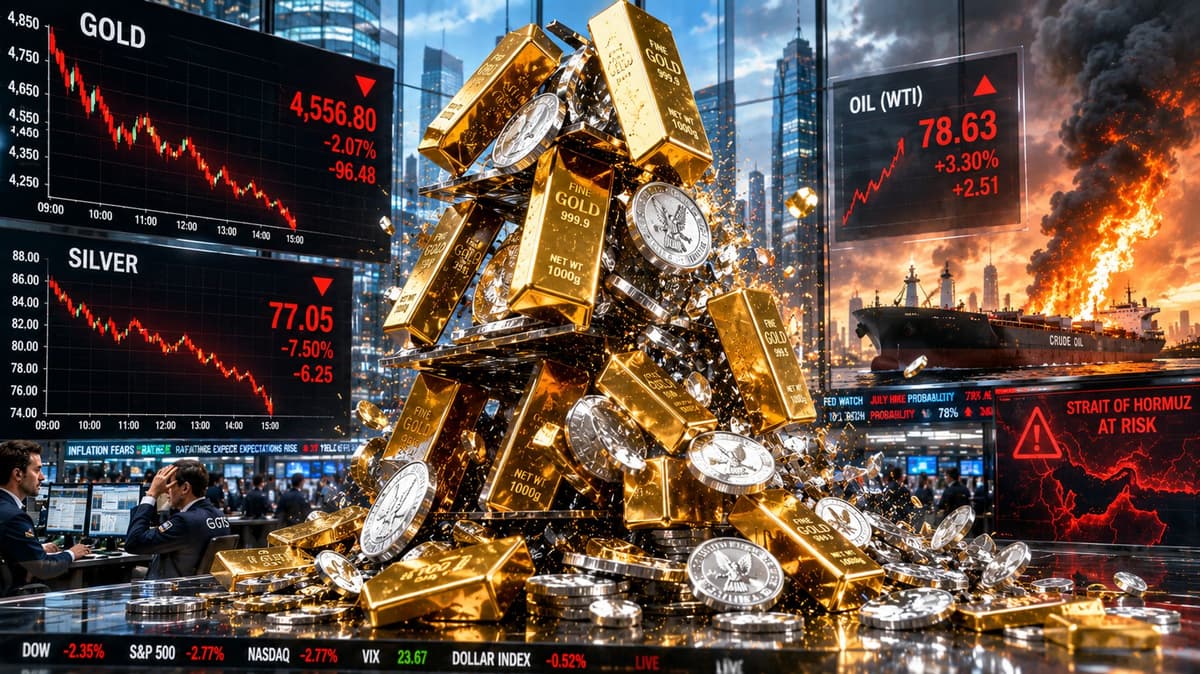
Spot gold last traded at $4,556.80 per troy ounce, down more than 2% on the day and more than 3% on the week. Spot silver fell even harder to $77.05 per troy ounce, down 7.5% on the day and 4% on the week, leaving silver prices more than 13% below their Wednesday peak.
Why did gold prices fall sharply today?
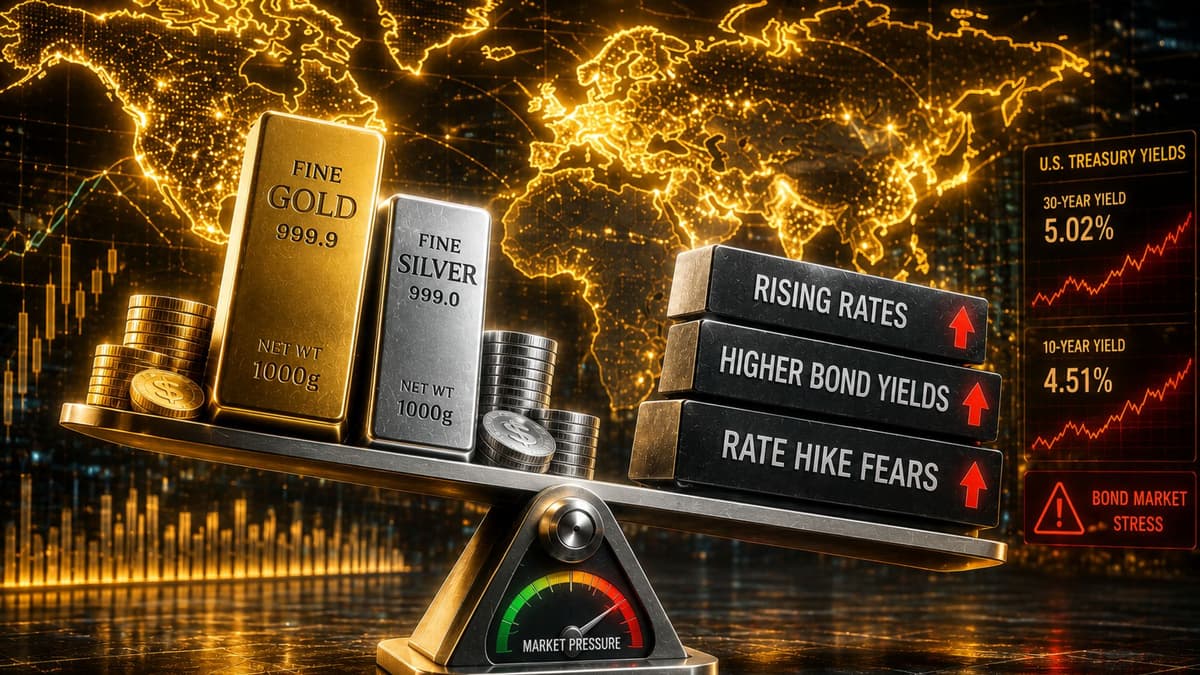
Gold prices dropped because the Iran war continued to disrupt the Strait of Hormuz outlook, drove oil benchmarks back into triple digits, and revived fears that the Federal Reserve may need to keep rates higher or even hike again. That combination raised bond yields, strengthened the U.S. dollar, and increased the opportunity cost of holding non-yielding bullion.
Lukman Otunuga, Senior Analyst at FXTM, said the gold price action looked like “a house of cards falling apart” as interest-rate expectations jumped significantly higher ahead of the weekend. He said sentiment had clearly deteriorated after gold began the week by testing initial resistance at $4,750 an ounce before sliding nearly $200 lower toward support.
Otunuga said, “With oil benchmarks back at triple digits, inflation fears remain rampant, with gold just another casualty of this market chaos. Given how traders are now pricing in a 65% chance that the Fed will hike rates by the end of 2026, the path of least resistance for gold points south — especially as the dollar appreciates.”
For Indian investors, this matters because global gold price weakness can be partly offset if the Indian rupee weakens against the U.S. dollar. But if international bullion keeps falling while the dollar index remains firm, domestic gold prices may still face near-term pressure despite safe-haven demand.
How far can gold prices fall from here?
Gold could test lower technical support levels if selling pressure continues and if oil prices and U.S. yields remain elevated. Analysts said bearish momentum is building, and the market may not have found a short-term floor yet.
Otunuga said bears are watching $4,500 closely on the daily charts. He added that a sustained move below $4,500 could open the door to a deeper decline toward $4,450 and $4,400.
What are the key XAUUSD levels to watch?
The immediate support levels for XAUUSD are $4,500, $4,450, and $4,400. On the upside, Otunuga said that if gold rebounds above $4,600, the next important level is the 50-day simple moving average (SMA).
That means Indian bullion traders should monitor both COMEX and spot gold price action alongside USD/INR moves. If gold stabilizes above $4,600, it may improve sentiment in the local market, but a break below $4,500 could trigger more liquidation across precious metals.
Why is silver more volatile than gold right now?
Silver is falling harder than gold because it rallied aggressively earlier in the week on supply fears and is now unwinding those gains amid broader market stress. Silver also sits at the intersection of precious metals demand and industrial demand, which tends to amplify price swings.
At the start of the week, the market expected silver prices could hit $90 an ounce. Instead, spot silver slumped to $77.05 an ounce, down 7.5% on the day and 4% on the week.
Silver prices are now more than 13% below their peak on Wednesday. That reversal came after strong bullish positioning tied to the Iran war and supply disruption concerns in base metals.
How does the Iran war affect silver supply?
The Iran war has raised concerns about major supply disruptions in base metal production, and that matters because silver is often produced as a byproduct of mining other metals such as copper. Analysts said lower production of copper and other base metals could reduce silver supply.
Lower silver supplies, combined with persistent industrial demand, are expected to worsen an already significant deficit. According to the source article, the silver market has now entered its sixth consecutive year of supply deficit.
For Indian investors, silver’s volatility can create trading opportunities, but it also raises risk. Industrial demand trends, global manufacturing sentiment, and rupee moves can all magnify domestic silver price swings.
What inflation data is driving Fed rate hike fears?
Hot U.S. inflation data is the main reason markets have become more concerned about future Federal Reserve rate hikes. The latest consumer and producer inflation reports showed price pressures are broadening, not easing.
On Tuesday, the U.S. Labor Department reported that headline consumer prices rose 3.8% over the last year. At the same time, core inflation, which excludes food and energy, rose more than expected to 2.8%.
Those readings pushed inflation further away from the Federal Reserve’s 2% target. For gold, that is a problem because sticky inflation can keep real rates and nominal yields elevated for longer.
What did the producer inflation report show?
The producer inflation report was also strong. On Wednesday, the Labor Department said its Producer Price Index surged in April.
Wholesale inflation increased 6.0% over the last 12 months, marking the largest 12-month advance since December 2022, when prices rose 6.4%. Meanwhile, core producer prices rose 4.4%, their largest 12-month increase since February 2023, when they climbed 4.5%.
Economists said the inflation outlook has moved beyond the energy shock alone and could start to weigh on economic growth. That raises the risk of a stagflationary environment, where inflation stays high even as growth slows.
For India, that backdrop matters because higher global oil prices can worsen imported inflation and influence bond yields, currency movements, and expectations for domestic precious metals demand.
Will the Federal Reserve still hike rates under Kevin Warsh?
The market now sees a higher probability of additional Fed tightening, even though incoming Federal Reserve Chair Kevin Warsh has expressed support for lower interest rates. Analysts said hotter inflation may limit how much Warsh can change policy direction.
Warsh was confirmed by the U.S. Senate on Wednesday to replace Federal Reserve Chair Jerome Powell. But analysts noted that even if Warsh prefers lower rates, he is unlikely to persuade other Federal Reserve board members to cut rates while inflation is accelerating.
Otunuga pointed to traders pricing in a 65% chance that the Fed will hike rates by the end of 2026. That shift in market pricing has become a major headwind for gold and silver.
What do analysts say about the Fed outlook?
Naeem Aslam, CIO at Zaye Capital Markets, said the Fed may still be forced to respond even if higher rates do not solve supply-driven inflation. He said, “The Fed still needs to anchor expectations and respond to hot data. Market pricing for hikes isn’t overly aggressive — it’s data-driven. A near-term hike isn’t my base case, but the odds have risen.”
That view is important for precious metals because expectations often move markets before the Fed acts. If yields continue rising, gold price rallies may remain limited in the short term.
Should investors buy the dip in gold and silver now?
Analysts still see a strong long-term bull case for gold and silver, but several say this may not be the right moment to chase prices. The near-term risk is that stronger dollar and higher yields could drive another leg lower before a durable bottom forms.
Fawad Razaqzada, Market Analyst at FOREX.com, said, “I would certainly wait now because bearish momentum is only beginning to build. We could be in for a choppy ride over the next few days. Buckle up.”
Razaqzada added that as long as the chaos in the Middle East keeps oil prices high, bond yields will remain elevated. That keeps pressure on precious metals even when geopolitical risks would normally support safe-haven demand.
Naeem Aslam said he still sees gold as a “buy on dips”, but he is not chasing the market. He said, “Prices can move lower in the short term if the dollar strengthens further. I’m cautiously averaging in on weakness rather than going all-in. The structural bull case — central bank buying, geopolitics, and de-dollarization — remains intact.”
For Indian investors, that suggests a staggered accumulation approach may be more prudent than aggressive buying at one price. Rupee-cost averaging can help manage volatility when XAUUSD, crude oil, and USD/INR are all moving at once.
What should gold investors watch next week?
Gold will likely remain driven by oil prices, bond yields, and Middle East geopolitical headlines because no major top-tier economic data is scheduled next week. Analysts expect bullion to stay highly sensitive to inflation expectations and rate pricing.
The key scheduled data and events for next week are:
- Tuesday: US Pending Home Sales
- Wednesday: Minutes from the March Federal Reserve monetary policy meeting
- Thursday: US jobless claims, Philly Fed Manufacturing Survey, US Housing Starts, S&P Flash Manufacturing and Services PMI
- Friday: Revised University of Michigan Consumer Sentiment