# Gold Price Slides as Stronger Dollar, Yields Hit Bullion
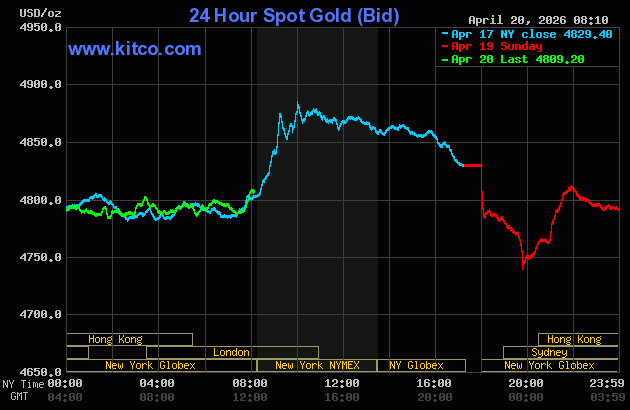
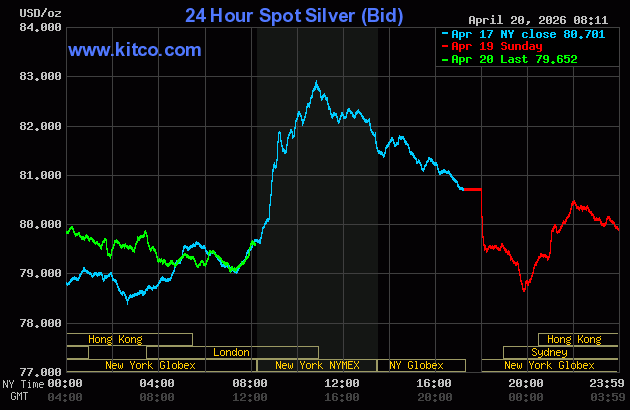
Gold prices fell sharply in early U.S. trading on Monday as a firmer U.S. dollar index and higher U.S. Treasury yields pulled bullion lower, even as geopolitical tensions in the Middle East kept safe-haven demand in focus. June gold futures were last down $68.50 at $4,811.30 per troy ounce, while May silver futures fell $2.437 to $79.395.
For Indian investors, the move matters because global XAUUSD weakness can pressure domestic gold rates, although any decline in international bullion may be partly offset if the Indian rupee weakens against the U.S. dollar. That makes both dollar strength and crude oil prices important watchpoints for India’s gold market.
Why did gold prices fall today?
Gold prices fell because traders focused on two immediate bearish drivers: a stronger U.S. dollar index and a rise in bond yields. Those two factors reduced the appeal of non-yielding bullion despite rising geopolitical risk.
A firmer dollar typically makes gold more expensive for buyers using other currencies, which can curb demand. At the same time, higher Treasury yields raise the opportunity cost of holding gold, since bullion does not pay interest.
In Monday’s early U.S. session, the market chose those bearish daily inputs over the supportive safe-haven narrative. That is why gold and silver both moved lower even as tensions in the Middle East remained elevated.
Latest gold and silver prices
June gold futures were last down $68.50 at $4,811.30. May silver futures were last down $2.437 at $79.395.
The broader outside markets also reinforced pressure on precious metals. Nymex WTI crude oil was trading solidly higher at around $88.50 a barrel, the U.S. dollar index was a bit firmer, and the yield on the benchmark 10-year U.S. Treasury note was around 4.27%.
What is happening in the Middle East and why does it matter for gold?
The Middle East conflict remains a major support factor for gold in theory, but on Monday it was not enough to outweigh the pressure from the dollar and yields. Traders are still watching the war closely because any escalation can quickly revive safe-haven buying in bullion.
The latest developments increased uncertainty around a possible diplomatic breakthrough. According to Bloomberg, Iran wavered on whether to send diplomats to Pakistan for a second round of peace talks after the United States maintained a blockade of the Strait of Hormuz and seized an Iranian ship.
Key developments driving risk sentiment
The latest headlines included:
- Iran wavers on peace talks as tensions rise after U.S. seizes Iranian ship
- Strait of Hormuz shipping traffic grinds to a halt as tensions deepen
- Trump says envoy Witkoff heading to Pakistan for Iran talks
- Trump says Iran committed ‘serious violation’ of ceasefire: ABC
- IEA head pitches Iraq-Turkey oil pipeline to bypass Hormuz
- U.S. preparing to board Iran-linked ships in coming days: WSJ
- U.S. official says Iran attacked commercial ships in Hormuz: Axios
That comment added to uncertainty over whether the two sides would meet before a nascent ceasefire announced on April 7 expires late U.S. time on Tuesday.
What did Donald Trump say?
U.S. President Donald Trump said on Sunday that special envoy Steve Witkoff is traveling to Pakistan for talks on Tuesday, according to Fox. Trump also wrote in a social media post: “We’re offering a very fair and reasonable DEAL, and I hope they take it because, if they don’t, the United States is going to knock out every single Power Plant, and every single Bridge, in Iran.”
Trump added: “NO MORE MR. NICE GUY!”
For gold traders, these headlines matter because the Strait of Hormuz is a critical energy chokepoint. Any prolonged disruption can lift oil prices, stoke inflation fears, unsettle equity markets, and eventually support gold as a safe-haven asset.
How are stagflation fears affecting the gold price outlook?
Stagflation fears are rising, and that is an important medium-term support factor for gold. However, the market is currently balancing those concerns against the short-term drag from higher yields and a stronger dollar.
Bloomberg reported that the cumulative economic impact of seven weeks of war in the Middle East will begin to show up this week through a second round of business surveys across major economies. The key question is whether the twin blow to growth and inflation seen after the first month of the Iran conflict intensified in month two.
What economic data are investors watching?
The initial take for April in economies from Australia to the United States will be published on Thursday. According to Bloomberg, indexes in Germany, France, the euro zone, and the UK are all expected to show broad deterioration, while U.S. indicators are seen as little changed.
Bloomberg said the numbers may reveal how much stagflation is lurking in the global economy. That term refers to the toxic combination of surging prices and stalling growth, similar to the 1970s experience.
IMF Managing Director Kristalina Georgieva told Bloomberg that even if the war ended tomorrow, the recovery would still take quite some time to begin. That warning underlines the risk that growth stays weak while inflation remains elevated.
IMF growth and inflation forecasts
The International Monetary Fund has cut its global growth forecast for 2026 because of the oil-price shock linked to the war in the Middle East. The IMF now expects the world economy to expand 3.1% this year, down from its January forecast of 3.3%.
The IMF also raised its inflation estimate because of higher energy and food prices. For gold investors, that combination is significant because persistent inflation and weaker growth often improve the longer-term case for holding precious metals.
What U.S. data could move gold next?
The biggest scheduled U.S. data release this week is retail sales, and it could influence both Treasury yields and the U.S. dollar. That makes it important for the short-term direction of gold price action.
Economists expect a sizable jump in March retail sales, driven largely by sharply increased spending on gasoline. If the data comes in stronger than expected, yields could stay elevated and weigh further on gold. If the data disappoints, bullion could find support.
For Indian investors, strong U.S. data can strengthen the dollar and influence imported gold costs in rupee terms. That means the global gold trend and the USD/INR exchange rate should be tracked together, not separately.
What are the key technical levels for gold and silver?
Gold remains in a technically constructive but pressured setup, with bulls still holding a broader advantage while facing near-term selling pressure. The next major upside and downside targets are now clearly defined.
June gold futures technical outlook
According to the technical setup in the source report, June gold futures bulls’ next upside price objective is to produce a close above solid resistance at $5,000.00. Bears’ next near-term downside price objective is pushing futures prices below solid technical support at $4,500.00.
The first resistance level stands at the overnight high of $4,834.50, followed by $4,900.00. The first support level is seen at the overnight low of $4,752.00, followed by $4,700.00.
Wyckoff's Market Rating for June gold futures: 6.0.
May silver futures technical outlook
Silver also came under pressure, but the technical structure still shows a balanced market with room for volatility. May silver futures bulls’ next upside price objective is a close above solid technical resistance at $85.00.
The bears’ next downside price objective is a close below solid support at $70.00. First resistance is seen at the overnight high of $80.755 and then at last week’s high of $83.245.
Next support is seen at $77.00 and then at $75.00. Wyckoff's Market Rating for May silver futures: 6.0.
How should Indian investors read this gold market move?
Indian investors should view Monday’s decline as a clash between short-term macro pressure and longer-term geopolitical support. The stronger dollar and higher U.S. yields hurt bullion immediately, but war risk, elevated crude oil, and rising stagflation concerns still provide an underlying floor for gold.
This matters in India because domestic gold prices do not move only with international spot or futures prices. They also react to the rupee-dollar exchange rate, import costs, and shifts in global risk appetite.
Spot market vs futures market
The gold market operates through two primary pricing mechanisms. The first is the spot market, which quotes prices for on-the-spot purchase and immediate delivery. The second is the futures market, which sets prices for delivery at a future date.
The source note also said that, due to year-end positioning market liquidity, the December gold futures contract is currently the most actively traded contract on the CME.
If the U.S. dollar index stays firm and the 10-year Treasury yield remains near or above 4.27%, gold may struggle to regain momentum in the near term. But if Middle East tensions worsen, oil extends gains above $88.50 a barrel, or upcoming business surveys deepen stagflation fears, Indian bullion buyers could quickly see fresh support return to global gold prices.