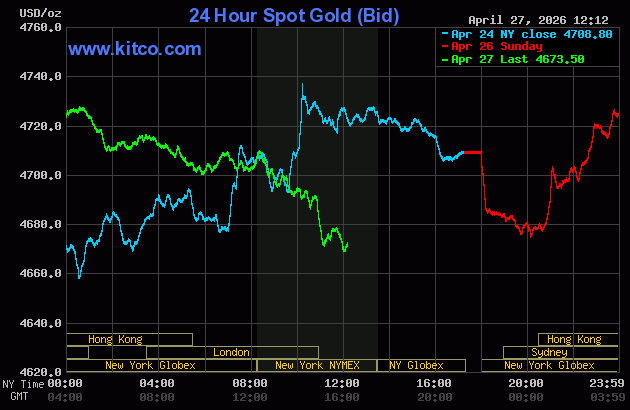
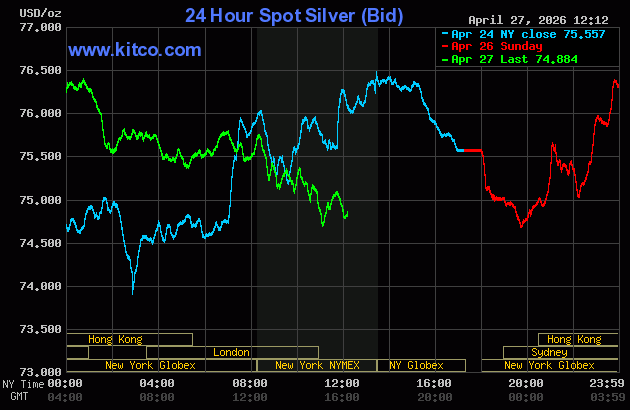
Gold and silver prices fell in midday U.S. trading on Monday as short-term chart-based selling intensified and traders reassessed both the U.S.-Iran war and a packed week of major central bank meetings. June gold futures were last down $24.00 at $4,717.00 per troy ounce, while May silver futures fell $0.804 to $75.60.
For Indian investors, the move matters because global bullion weakness can weigh on domestic gold prices, but any decline in XAUUSD can be partly offset if the Indian rupee weakens against the U.S. dollar. This week, traders in India will also track crude oil, U.S. Treasury yields, and Federal Reserve signals because all three can shift imported gold costs and safe-haven demand.
Why did gold prices fall today?
Gold prices fell because short-term technical selling picked up after the near-term chart outlook for both gold and silver weakened. Traders sold bullion early in the week as momentum deteriorated and markets prepared for fresh geopolitical and monetary policy signals.
June gold futures dropped $24.00 to $4,717.00, showing that sellers remain active below nearby resistance levels. May silver futures declined $0.804 to $75.60, indicating that the broader precious metals complex also faced pressure.
How did chart-based traders drive the sell-off?
Chart-based traders appeared to lead the move lower. When near-term technical structures weaken, these traders often sell first and wait for support zones to prove themselves before re-entering.
That pattern is visible in both gold and silver, where prices are now trading closer to support than resistance. The latest decline suggests that traders are responding more to price action and market structure than to a single headline alone.
How is the U.S.-Iran war affecting gold prices?
The U.S.-Iran conflict is affecting gold by keeping safe-haven demand in play, but Monday’s session showed that geopolitical support was not enough to prevent technical selling. Traders are weighing whether a possible diplomatic opening could reduce immediate supply and war risks.
Iran has given the U.S. a new proposal to reopen the Strait of Hormuz and end the war, while also postponing nuclear negotiations. The proposal calls for extending the ceasefire so the parties can work toward a permanent end to the fighting, with nuclear talks to follow only after a U.S. blockade of the Strait of Hormuz is lifted.
What is in Iran’s latest proposal?
Iran’s proposal includes three major elements: reopening the Strait of Hormuz, extending the ceasefire, and delaying nuclear negotiations until after the blockade is lifted. Pakistani mediators have reportedly delivered the proposal to the White House.
According to an Axios report cited in the source article, it remains unclear whether the U.S. wants to explore the proposal. The White House said the U.S. will only make a deal that puts the American people first.
Why does the Strait of Hormuz matter for bullion and Indian investors?
The Strait of Hormuz matters because it is a critical global energy chokepoint. Any disruption there can lift oil prices, raise inflation expectations, and complicate the policy path for central banks.
That matters directly for India because India imports most of its crude oil. Higher oil prices can pressure the rupee, raise inflation risks, and increase the landed cost of gold in INR terms even if international gold prices soften.
What are central banks expected to do this week?
Major central banks are expected to keep interest rates unchanged this week while closely watching whether higher energy costs fuel inflation. According to Bloomberg, policymakers across the U.S. and the Group of Seven are likely to stay on hold but remain hawkish on inflation risks linked to the Iran war.
The report described three days of decisions in Washington, Ottawa, London, Frankfurt and Tokyo as widely expected to deliver unchanged borrowing costs. Even so, each central bank is seen maintaining a cautious stance because developments in the Middle East could alter the inflation outlook quickly.
Which central banks meet and when?
The Bank of Japan is first on Tuesday, and officials who spoke in the past week have leaned toward holding off this month on a potential rate hike. That makes a policy pause the base case.
The Bank of Canada and the Federal Reserve meet on Wednesday. Economists and investors expect both to insist on waiting and watching incoming events.
The Bank of England and the European Central Bank are expected to echo similar messages on Thursday. According to the Bloomberg report, domestic conditions matter, but events around the Strait of Hormuz could partly dictate the path of monetary policy for all of them.
Why does the Federal Reserve matter for gold?
The Federal Reserve matters because interest-rate expectations influence the U.S. dollar, Treasury yields, and the opportunity cost of holding non-yielding assets such as gold. If the Federal Reserve stays hawkish, gold can struggle even when geopolitical risks remain elevated.
The source article also noted that this week’s FOMC meeting may be the last for Jerome Powell as head of the U.S. central bank. That adds a leadership dimension to a week that is already crucial for bullion markets.
What does Kevin Warsh’s path to the Fed mean for markets?
Kevin Warsh’s path to the Federal Reserve chair now looks clearer after U.S. Senator Thom Tillis said on Friday that he is dropping his blockade of Warsh’s nomination. That decision potentially clears a major political hurdle ahead of a leadership transition at the Fed.
Tillis said the Justice Department’s decision, announced Friday, to end its criminal probe targeting Fed Chair Jerome Powell removed a threat to the central bank’s independence. He said he looks forward to supporting Warsh’s confirmation and called him an “outstanding nominee” who can help the Federal Reserve move beyond distraction and return its full attention to its mission.
When does Powell’s term end?
Jerome Powell’s term ends on May 15, according to the source article. Tillis’ decision sets the stage for Warsh’s swift confirmation to succeed Powell.
For gold traders, any change in Fed leadership matters because it can alter expectations around inflation tolerance, rate policy, and communication style. Indian investors should monitor this closely because shifts in Fed policy often flow through to USD/INR, imported bullion prices, and domestic investment demand.
What are the key outside markets telling gold traders?
The key outside markets sent a mixed signal for gold on Monday. The U.S. dollar index was weaker, which would normally support bullion, but that support was outweighed by technical selling and broader market caution.
At the same time, Nymex WTI crude oil was up and trading around $95.50 a barrel, while the yield on the benchmark 10-year U.S. Treasury note stood at 4.32%. Higher oil prices can feed inflation fears, and elevated yields can reduce the appeal of non-yielding precious metals.

Why do yields, crude oil and the dollar matter for XAUUSD?
Yields matter because rising bond returns increase the opportunity cost of holding gold. Crude oil matters because higher energy prices can lift inflation expectations and influence central bank policy.
The U.S. dollar matters because gold is priced globally in dollars. A weaker dollar can support XAUUSD, while a stronger dollar can pressure it. For Indian buyers, the rupee-dollar exchange rate can either amplify or soften these global moves.
What are the key technical levels for gold and silver now?
Gold bulls need a close above $5,000.00 to regain stronger technical control, while bears want to push prices below $4,500.00. That leaves the market in an important middle zone where traders are likely to react sharply to headlines and central bank signals.
For June gold futures, first resistance stands at $4,750.00 and then $4,800.00. First support is seen at last week’s low of $4,672.20 and then at $4,626.00. Wyckoff's Market Rating: 5.5.
What are the silver levels to watch?
For May silver futures, bulls need a close above solid technical resistance at the April high of $83.245. Bears want a close below solid support at $70.00.
Silver’s first resistance is seen at $77.50 and then $80.00. Next support is seen at last week’s low of $73.845 and then at $72.00. Wyckoff's Market Rating: 5.0.
What does this mean for Indian gold buyers?
Indian gold buyers should watch whether global gold holds above $4,672.20 and whether crude oil remains near $95.50 a barrel. If gold breaks lower while the rupee stays stable, domestic prices may ease; if oil stays high and the rupee weakens, local bullion prices may stay firm despite softer international futures.
One additional note from the source article is that the gold market operates through two main pricing mechanisms: the spot market, which covers immediate purchase and delivery, and the futures market, which sets prices for delivery at a future date. Due to year-end positioning market liquidity, the December gold futures contract is currently the most actively traded on the CME.
The next clear watchpoint for gold investors is whether central banks stay firmly on hold while sounding more hawkish on inflation tied to the Iran war and the Strait of Hormuz. If yields rise further or gold breaks below $4,672.20, bullion could face deeper short-term pressure; if geopolitical risk escalates again, safe-haven demand could return quickly.