Gold prices dropped to fresh yearly lows after bond yields surged and liquidity stress overwhelmed near-term fundamentals, according to the World Gold Council (WGC). For Indian investors, the latest move in global bullion matters because swings in XAUUSD, U.S. yields, Middle East tensions, and USD/INR can quickly feed into domestic gold rates.
Why Did Gold Prices Fall to New Lows?
Gold prices fell because sharply higher real yields, expectations for policy rate increases in 2026, de-leveraging, and profit-taking all hurt sentiment. The World Gold Council said these forces pushed bullion lower even as geopolitical tensions stayed elevated.In its latest Weekly Markets Monitor, the WGC said the drivers of gold's ongoing weakness are still being debated. But the group was clear that liquidity dynamics, rather than traditional gold fundamentals, are dominating price action right now.
WGC analysts wrote: "Sharply higher real yields and expectations that policy rates will now rise in 2026, alongside de-leveraging and profit-taking, have all weighed on sentiment." They added that the speed and breadth of the sell-off echo the risk-off episodes of 2008 and 2020, when liquidity stress temporarily overpowered fundamentals.
That comparison is important for bullion investors. In periods like 2008 and 2020, traders often sell gold alongside other assets to raise cash, even though gold usually benefits from safe-haven demand over a longer horizon.
What Did the World Gold Council Say About 2008 and 2020 Comparisons?
The World Gold Council said the current gold sell-off resembles 2008 and 2020 because liquidity stress is moving markets faster than fundamentals. In other words, traders are focusing on access to cash and rising yields rather than gold's longer-term safe-haven role.According to the WGC, the market backdrop now combines higher bond yields with a rapidly changing geopolitical picture. The analysts said the prospect of a prolonged Middle East conflict is concerning because it increases humanitarian and geopolitical risks while also raising the threat of economic stagnation and higher industrial input prices.
The WGC summed up the near-term stance simply: "We're in wait-and-see mode." That reflects a market that is reacting to headlines and funding conditions more than to strategic asset-allocation logic.
For Indian investors, this matters because global gold price corrections can look sharp even when the broader case for holding precious metals stays intact. If global liquidity tightens, XAUUSD can weaken first, while domestic prices may move differently depending on the rupee.
How Is the Iran Conflict Affecting Gold Prices?
The Iran conflict is shaping gold prices because the WGC expects the market to take its cues from daily developments around the crisis, especially any impact on energy flows. With little major economic data due this week, geopolitical headlines may drive bullion more than macro releases.The WGC said any signs of the Strait of Hormuz reopening could ease energy disruptions and help rebuild investor confidence. That could reduce some of the immediate fear now moving markets.
On the other hand, prolonged disruptions could intensify expectations of rate hikes. The WGC added that political constraints and the mounting debt burden in the United States may limit how much room the Federal Reserve has to raise rates.
The analysts also flagged stagflation risk. That matters because gold has historically responded well when growth slows but inflation pressures remain elevated.
Still, the WGC said liquidity concerns currently dominate market action. So while a stagflation backdrop would usually support bullion, traders are not yet treating that as the main market driver.
What Are the Key Gold Price Support and Resistance Levels Now?
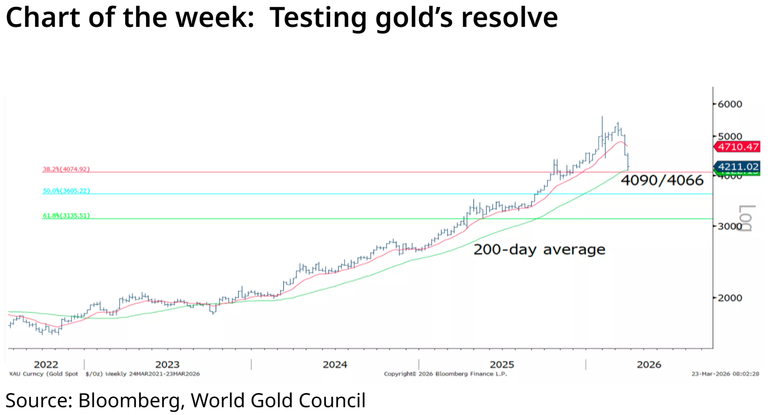
The key technical levels now are support at US$4,090/oz-US$4,066/oz and resistance at US$4,736/oz and US$4,844/oz, according to the WGC. The analysts said gold's break below the early February spike low at US$4,403/oz added fresh downside momentum.The WGC said the fall below US$4,403/oz set fresh annual lows for gold. That break is important because it can trigger additional technical selling in futures and spot bullion markets.
Where Is the Next Support for Gold?
The next key support zone sits at US$4,090/oz-US$4,066/oz. The WGC said this area includes the 38.2% retracement of the 2022/2025 uptrend and the long-term 200-day average.The analysts also noted that net long positioning is already low on a relative basis. Because of that, their bias is to look for an attempt by gold to find a floor in this area.
If gold fails there, the next downside target comes in at the October 2025 low of US$3,887/oz. The WGC said a sustained close below US$4,090/oz-US$4,066/oz would warn of yet further weakness.
What Resistance Levels Should Traders Watch?
Initial resistance is seen at US$4,736/oz, followed by US$4,844/oz. The WGC said the immediate risk remains lower while gold trades below the 13-day exponential and 55-day simple moving averages at US$4,922/oz-US$4,932/oz.For short-term traders in XAUUSD, that means rebounds may still face selling pressure unless gold can reclaim those moving-average levels decisively. For Indian investors, these global technical markers can influence MCX gold sentiment and imported bullion pricing.
Where Is Spot Gold Trading Right Now?
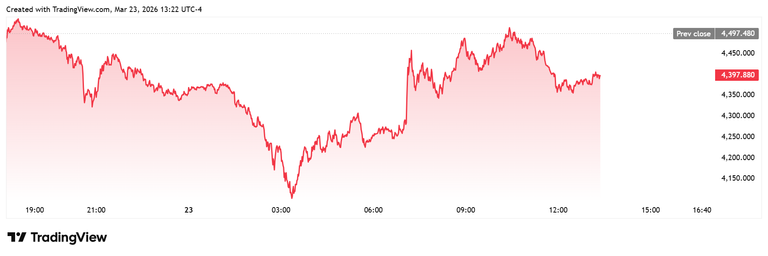
Spot gold last traded at US$4,398.11 per ounce, down 2.21% on the session, after recovering from an earlier low below US$4,100/oz. The metal then ran into near-term resistance at US$4,500/oz before trying to reclaim US$4,400/oz in early afternoon trading on Monday.That intraday rebound suggests buyers are still active near lower levels. But the failure to clear US$4,500/oz cleanly shows that selling pressure has not disappeared.
For Indian gold investors, the takeaway is straightforward. Global bullion has become highly sensitive to yield moves, liquidity conditions, and Middle East developments, so local prices may stay volatile even if strategic demand for gold remains intact.
Why Does This Matter for Indian Gold Investors?
This matters for Indian investors because global gold price weakness does not automatically mean a one-way fall in domestic rates. Imported bullion prices in India also reflect the rupee, global risk sentiment, and safe-haven flows.If international gold remains under pressure but USD/INR stays firm, domestic downside can be smaller than the move in XAUUSD suggests. If the rupee weakens during a geopolitical shock, Indian buyers could even see local prices hold up better than global charts imply.
The WGC's broader message is that short-term shocks can still hit gold hard, but the longer-term strategic case remains in place. The council said multi-polarisation, rising geopolitical fragmentation, and persistent sovereign debt concerns should continue to support gold's strategic role over time.
That leaves one key watchpoint for the days ahead: whether liquidity stress eases or deepens. Indian investors should track the Strait of Hormuz situation, U.S. real yields, Federal Reserve rate expectations for 2026, and whether gold can hold the US$4,090/oz-US$4,066/oz support band.