Gold prices fell sharply in early U.S. trading as rising U.S. Treasury yields, a firmer U.S. dollar, and renewed inflation worries hit bullion demand. For Indian investors, the move matters because a stronger dollar and elevated U.S. yields can pressure international gold prices even when geopolitical risks remain high.
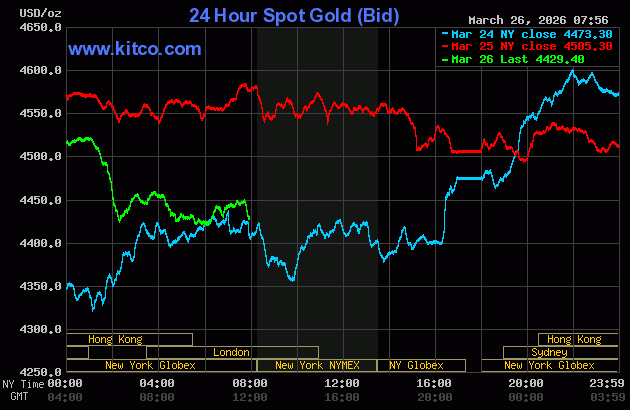
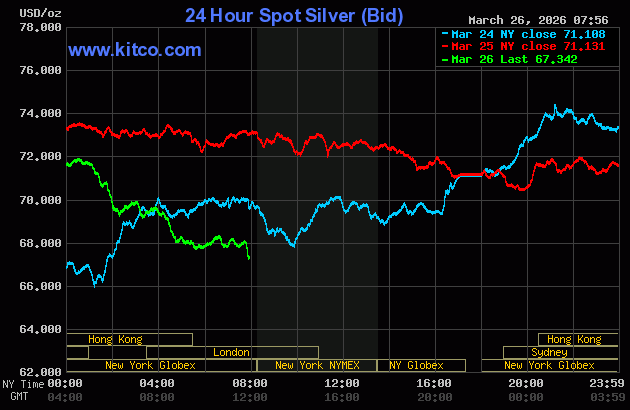
April gold was last down $108.70 at $4,443.10, while May silver fell $4.376 to $68.25. In the background, traders were also tracking the Iran conflict, stress in the U.S. corporate bond market, Federal Reserve rate expectations, and the upcoming Trump-Xi summit in Beijing on May 14-15.
Why did gold price fall sharply today?
Gold price fell because U.S. Treasury yields rose, the U.S. dollar index firmed, and traders focused more on inflation risks than on safe-haven buying. That combination reduced near-term appetite for gold and silver despite persistent geopolitical tension.
April gold futures were last quoted at $4,443.10, down $108.70 in early U.S. trading. May silver futures were down $4.376 at $68.25.
How did bond yields and the dollar pressure bullion?
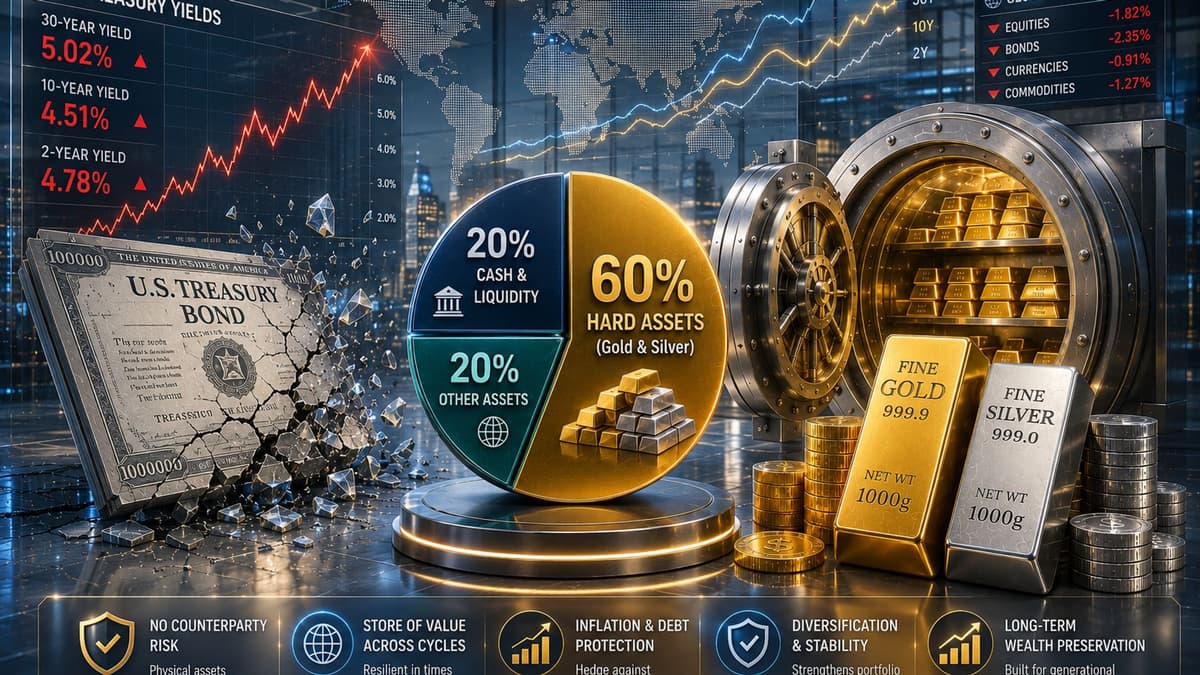
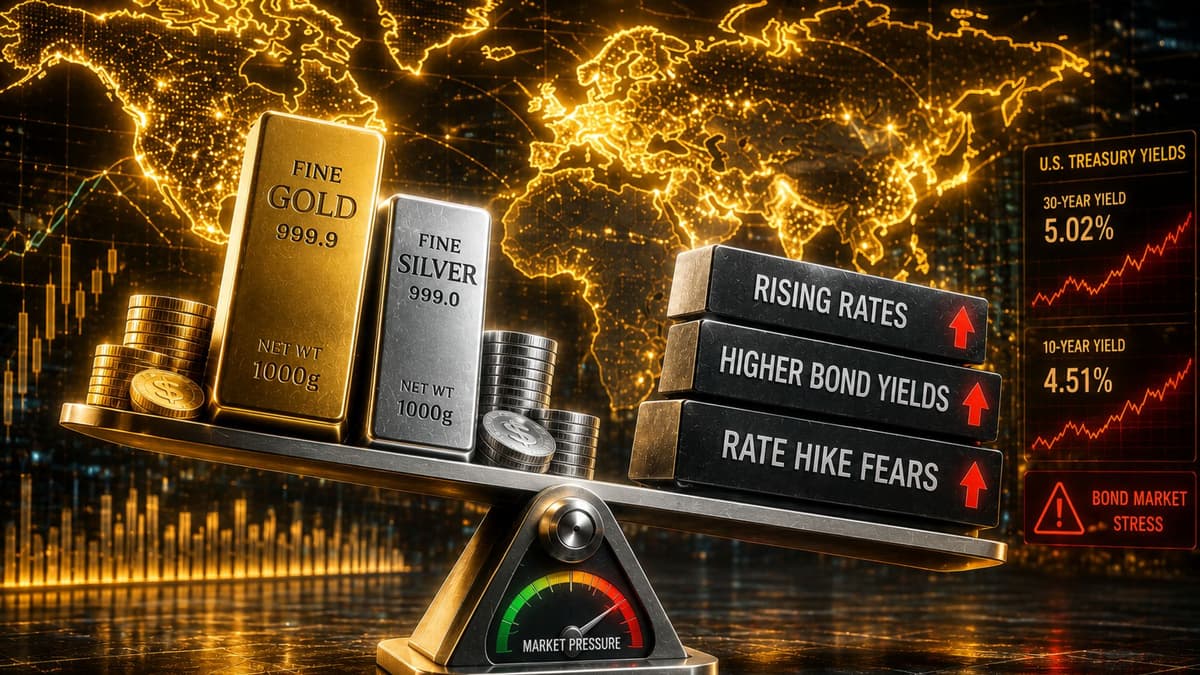
Higher bond yields raise the opportunity cost of holding non-yielding assets like gold. A firmer U.S. dollar also makes dollar-priced bullion, including XAUUSD, more expensive for buyers using other currencies.
The benchmark 10-year U.S. Treasury note yield stood at 4.37%. At the same time, the U.S. dollar index was slightly higher early in the session.
Why were traders watching inflation so closely?
Traders focused on problematic inflation prospects because sticky price pressures can keep interest rates elevated for longer. That outlook tends to weigh on precious metals when yields move higher.
The inflation theme became even more important after fresh comments from Federal Reserve Governor Stephen Miran, who said disappointing inflation data changed his year-end rate outlook.
What is happening in Iran, and why does it still matter for gold?
The Iran conflict remains a major market risk, but on this session it did not overpower the negative effect from higher yields and a stronger dollar. Gold usually benefits from safe-haven demand during war, yet macro pressure dominated trading.
Markets tracked several fast-moving developments tied to Iran, Israel, and the United States:
- The White House insisted peace talks are ongoing, while Tehran rejected U.S. overtures.
- The U.S. was preparing options for a “final blow” in Iran, which may include ground forces and major bombing.
- U.S. troop movements increased fears of a risky ground attack on Iran.
- The Israel Defense Forces completed a wave of strikes in Isfahan in Iran.
- Iran lawmakers were working on a draft bill to impose a safe-passage toll for the Strait of Hormuz.
- The U.S. had a 15-point peace proposal that Pakistan delivered to Iran.
- Vice President JD Vance may travel to Pakistan for Iran talks this weekend, according to CNN.
What did President Trump say about Iran negotiations?
President Donald Trump escalated the rhetoric in a social media post, adding another layer of geopolitical uncertainty to financial markets. His message suggested frustration with Iran's public stance on the U.S. proposal.
Trump wrote: “The Iranian negotiators are very different and ‘strange.’ They are ‘begging’ us to make a deal, which they should be doing since they have been militarily obliterated, with zero chance of a comeback, and yet they publicly state that they are only ‘looking at our proposal.’ WRONG!!! They better get serious soon, before it is too late, because once that happens, there is NO TURNING BACK, and it won’t be pretty! President DJT”
Why should Indian investors watch the Strait of Hormuz angle?
Indian investors should watch the Strait of Hormuz closely because any threat to oil flows can lift crude prices, worsen imported inflation, and affect the rupee. That mix can reshape domestic gold price trends even if international gold temporarily weakens.
Nymex WTI crude oil was trading around $93.00 a barrel. If oil stays elevated, Indian inflation expectations and INR volatility could remain important drivers for local bullion prices.
How does U.S. credit market stress affect gold prices?
U.S. credit market stress signals broader financial fragility, but it did not immediately support gold enough to offset yield pressure in this session. Instead, the market focused on how tighter credit and inflation concerns could keep financial conditions restrictive.
A New York Federal Reserve index showed the U.S. corporate bond market became more dysfunctional in March. The Corporate Bond Market Distress Index (CMDI), launched in 2022 to assess brewing risks in the U.S. credit market, rose earlier this month to its highest level since May 2025.
What did the New York Fed distress data show?
The data showed a clear deterioration in corporate bond market functioning, especially in investment-grade credit. According to Bloomberg, the high-grade bond market was more bruised than the high-yield market.
The CMDI, which runs on a 0 to 1 scale with 1 marking the highest stress, rose to 0.16 from 0.09 in late February. The high-grade index jumped to 0.28 from 0.09.
The investment-grade sub-index ended the period around the historical 60th percentile, meaning conditions were more stressed than usual. The New York Fed said on Wednesday: “Credit market functioning deteriorated over the past month. The investment-grade CMDI sector increased more than its high-yield counterpart.”
Why does a distressed bond market matter for bullion traders?
A stressed credit market matters because it can tighten liquidity, raise borrowing costs, and amplify volatility across risk assets, the dollar, and Treasury yields. Gold often benefits from systemic stress over time, but in the short run traders may still sell bullion when yields rise and cash becomes more attractive.
The index measures corporate bond market functioning by aggregating changes in indicators such as the pricing of newly issued bonds and measures of secondary-market liquidity, according to Bloomberg.
What did Federal Reserve Governor Stephen Miran say about interest rates?
Federal Reserve Governor Stephen Miran said he raised his projection for where U.S. interest rates should end the year by half a percentage point because inflation data disappointed. That comment reinforced the idea that rates may stay higher for longer, which is negative for gold price momentum.
Miran said on Wednesday in New York that he “boosted my policy rate by half a percent, not due to oil and Iran, but due to the inflation data that we received,” as reported by Bloomberg. He added that the revised projection puts his view “at about neutral.”
How does Miran's stance compare with the Fed's last decision?
Miran voted against the Federal Reserve's March 18 decision to leave rates steady. He preferred a quarter-point cut at that meeting.
Even so, Miran still said a percentage point of rate cuts this year would be appropriate to bring rates to neutral levels for the economy. For gold traders, that mix creates confusion: a longer wait for easing now, but still potential cuts later in the year.
Why do Fed expectations matter for Indian gold buyers?
Fed expectations matter because U.S. rates influence the dollar, global bond yields, and capital flows into safe-haven assets. For Indian investors, those shifts often feed directly into rupee-denominated gold prices through both XAUUSD moves and USD/INR changes.
If the dollar strengthens while the rupee weakens, domestic gold prices in India can remain firm even when international bullion corrects.
What should investors know about the Trump-Xi meeting in China?
The Trump-Xi summit matters because it could affect trade policy, Taiwan tensions, and the wider market reaction to the Iran war. Those issues can influence risk appetite, oil prices, the dollar, and safe-haven demand for gold.
The White House said President Trump and Chinese President Xi Jinping will meet in Beijing on May 14-15 after a delay caused by the war with Iran. White House Press Secretary Karoline Leavitt said at midday Wednesday that Xi would later visit Washington this year.
Why was the summit delayed?
The summit was delayed because of the conflict with Iran. Leavitt said the administration had “always estimated approximately four-to-six weeks” for the war in Iran to be completed.

Leavitt also said: “There was a discussion about the rescheduling of the meeting between the President and President Xi. President Xi understood that it’s very important for the President to be here throughout these combat operations right now. He understood, obviously the request to postpone and accepted it, which is why we have new dates on the books.”
What are markets watching from the summit?
Markets are watching whether Trump and Xi remain comfortable with the status quo on trade, U.S. support for Taiwan, and the fallout from U.S. strikes on Iran. Bloomberg said the rescheduled meeting will test those issues as oil prices remain sensitive to Middle East developments.
China and the U.S. remained in communication about Trump's visit, according to Chinese Foreign Ministry spokesman Lin Jian, who spoke at a regular briefing in Beijing.
What are the key technical levels for gold and silver now?
Gold remains under technical pressure, and futures traders are watching whether prices can hold above near-term support or slide toward this week's lows. Silver also faces a weaker near-term setup, though both metals still have clearly defined resistance and support zones.
What are the critical levels for April gold futures?
April gold futures bulls need a close above $4,750.00 to regain stronger upside control. Bears are targeting a break below solid technical support at this week's low of $4,100.00.
First resistance stands at $4,500.00 and then at the overnight high of $4,541.60. First support is seen at $4,400.00 and then at $4,350.00.
Wyckoff's Market Rating for April gold futures is 4.0, which signals a weaker near-term technical posture.
What are the key levels for May silver futures?
May silver futures bulls need a close above solid technical resistance at $80.00. Bears are aiming for a close below solid support at $60.00.
With May silver at $68.25 after a $4.376 decline, traders will watch whether silver stabilizes before testing lower support zones.
What pricing structure should investors understand?
Gold trades through two main pricing mechanisms: the spot market and the futures market. Spot prices reflect on-the-spot purchase and immediate delivery, while futures prices reflect delivery at a later date.
Because of year-end positioning market liquidity, the December gold futures contract is currently the most actively traded contract on the CME. That detail matters for investors comparing live market quotes with headline gold price references.
For Indian investors, the next watchpoint is clear: if U.S. yields stay elevated near 4.37%, the dollar remains firm, and crude holds around $93, global gold may stay under pressure even as geopolitical risk in Iran keeps safe-haven demand alive. A reversal in yields or a fresh escalation in credit stress could quickly change that balance for bullion and domestic gold prices in INR.