# Gold Price Safe-Haven Status Under Fire, Says Brookings’ Brooks
Gold may no longer be acting like the defensive asset investors expect during market stress. Robin Brooks, Senior Fellow at the Brookings Institution, says gold has recently behaved like a high-beta asset, meaning it has amplified market selloffs instead of cushioning them.
For Indian investors, that matters because gold is widely held as a hedge against equity volatility, inflation, rupee weakness, and geopolitical shocks. If gold starts trading more like a risk asset in the short term, swings in global bullion prices can quickly feed into domestic rates through both XAUUSD moves and the USD/INR exchange rate.
Why does Robin Brooks say gold is no longer acting like a safe-haven asset?
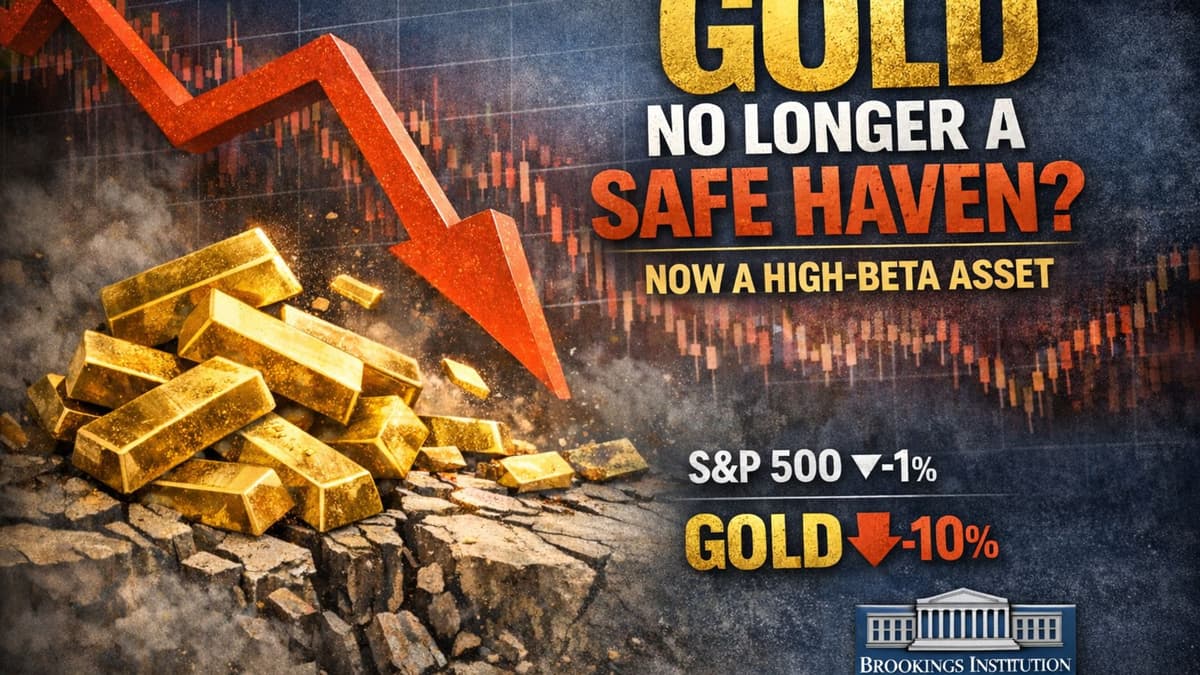
Gold has failed the safe-haven test in the latest bout of market stress, according to Robin Brooks. He said gold fell harder than the S&P 500 during the past six weeks of war, which undermines its traditional role as a hedge.
Brooks wrote that gold has historically been “a good place to hide when other assets plummet.” But he said that pattern has broken down recently. Over the past six weeks of war, gold is down 10%, while the S&P 500 is down less than 1%.
That gap is central to his argument. A safe-haven asset should hold up better than equities in a shock, not fall more sharply. In Brooks’ words, if gold sells off harder than the S&P 500 during a bad shock, it is “the opposite” of a risk hedge.
He summed up the shift in blunt terms: “Gold is behaving like a high-beta asset that amplifies sell-offs.”
What does “high-beta asset” mean for gold investors?
A high-beta asset typically moves more aggressively than the broader market. If that label fits gold, bullion is no longer dampening volatility in the way many investors assume.
For Indian buyers, this changes portfolio expectations. Gold can still work as a long-term store of value, but Brooks’ analysis suggests it may not always protect capital during sudden global risk-off events.
What caused gold prices to behave like a risk asset instead of a hedge?
Brooks said several theories have been used to explain gold’s unusual price action, but he believes one explanation stands out. In his view, the main driver is that the powerful rally of the past year pulled in newer, weaker-handed buyers tied to the so-called debasement trade.
Did emerging market central banks sell gold?
Only in a limited way, according to Brooks. He said the idea that emerging market central banks broadly sold gold during the recent shock does not hold up.
Brooks pointed specifically to Turkey as the exception. He said Turkey’s gold holdings fell by 128 tons as authorities mobilized foreign exchange reserves to defend the lira.
He argued that Turkey is an outlier. According to Brooks, Turkey’s effort to maintain a peg to the U.S. dollar forces its central bank to sell reserves during bad shocks, unlike most other emerging markets, which abandoned that approach long ago.
What is the “debasement trade” in gold?
The debasement trade is the idea that easier monetary policy and elevated inflation can erode fiat currency value, making gold more attractive. Brooks said this theme helped fuel the massive gold rally over the past year.
He argued that the rally likely drew in many new buyers who were more nervous and more likely to exit when markets turned volatile. That, he suggested, would explain why gold has traded like a high-beta asset in recent weeks.
Brooks said if that is the real cause—and he believes it is—then the current weakness may be temporary. In that scenario, once the debasement-trade crowd is “washed out,” gold could return to behaving like a more traditional safe-haven asset.
His conclusion was nuanced rather than outright bearish on bullion’s long-term role. He said gold’s safe-haven status is not gone forever, but is “contaminated at the moment.”
How did Federal Reserve policy and geopolitics drive the gold rally?
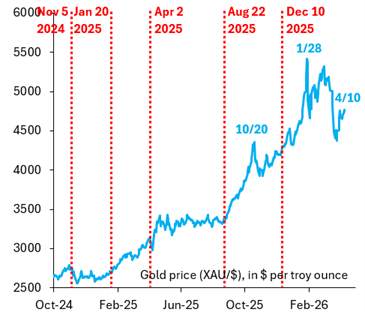
Brooks said gold’s two-year rally was powered by a combination of geopolitical stress and a major shift in Federal Reserve expectations. He highlighted several specific dates that, in his view, defined the move higher.
Why was April 2, 2025 important for gold prices?
Brooks said “Liberation Day” on April 2, 2025 triggered a major rise in gold prices. That event added geopolitical momentum to bullion and helped strengthen the safe-haven narrative around the metal.
Why did Powell’s Jackson Hole speech matter so much?
According to Brooks, the more important turning point came on August 22, 2025, when Federal Reserve Chair Jerome Powell delivered his Jackson Hole speech. Brooks said that speech effectively signaled the start of a Fed easing cycle even though inflation remained elevated.
That combination mattered because it gave investors a reason to worry about currency debasement while interest rates were moving lower. Brooks said this was the moment when the debasement trade was born.
What role did the December 10 rate cut play?
Brooks identified the December 10 rate cut—the final Federal Reserve cut of 2025—as another major catalyst. In his view, it pushed the gold rally further and reinforced bullish momentum.
He noted that by its peak on January 28, 2026, gold was up almost 100% from a year before. Brooks said the rally had rational drivers, but by the end, the move had become excessive and “totally out of control.”
For Indian investors, such a surge in the international gold price per troy ounce would normally support domestic bullion rates as well, though the final rupee price also depends on import duty, local premiums, and the direction of the rupee.
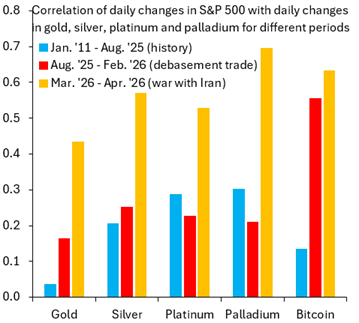
How has gold’s correlation with the S&P 500 changed?
Gold has become more pro-cyclical, according to Brooks. That means gold has increasingly moved in the same direction as risk assets rather than offsetting them.
Brooks referred to a chart comparing the correlation of daily moves in the S&P 500 with daily changes in precious metals and bitcoin. He split the analysis into three periods:
- January 1, 2011 to August 21, 2025
- August 22, 2025 to February 27, 2026
- the past six weeks of war
Is gold now behaving like other risk assets?
Partly yes, though Brooks said gold’s correlation with the S&P 500 is still lower than the correlation seen in other precious metals or bitcoin. Even so, he warned that this is “little comfort” for investors who expect gold to zig when equities zag.
That observation is especially important for portfolio construction. Indian investors often buy gold or gold ETFs to diversify equity-heavy holdings. If gold and equities start falling together during severe stress, the short-term diversification benefit becomes weaker.
What does this mean for Indian gold investors now?
Indian investors should not assume gold will always provide immediate downside protection during global shocks. Brooks’ analysis suggests gold can still be a strategic long-term asset, but its short-term safe-haven function may be less reliable when speculative positioning is crowded.
How could this affect gold prices in India?
If international gold price weakness continues, domestic bullion prices could face pressure. However, a weaker Indian rupee against the U.S. dollar can cushion local losses, since India imports most of its gold and prices are sensitive to both XAUUSD and USD/INR.
What should investors watch next?
Investors should closely track whether the debasement-trade buying continues to unwind, how the Federal Reserve signals its next policy path, and whether gold’s correlation with equities remains elevated. If Brooks is right, gold may recover its safe-haven character after speculative excess clears—but until that happens, Indian investors may need to treat bullion as a more volatile asset than usual.