# Gold Price Rises on Weak Dollar, Oil Risks Boost Bullion
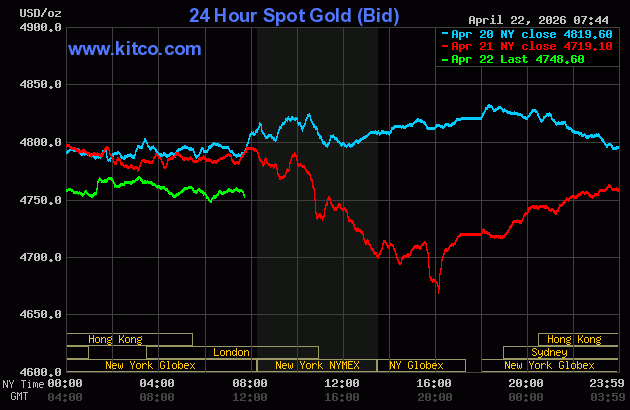
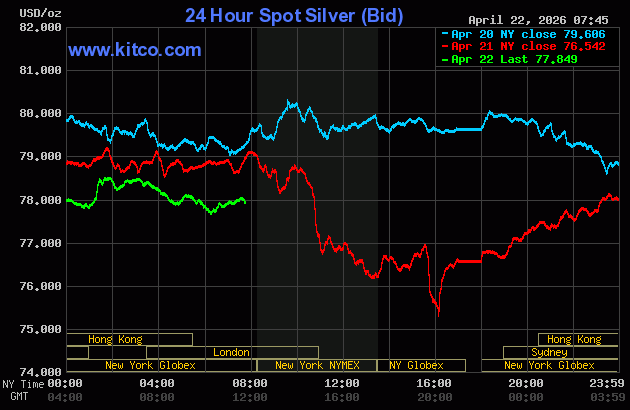
Gold prices moved higher in early U.S. trading on Wednesday as a weaker U.S. dollar, firmer crude oil prices and slightly softer U.S. Treasury yields lifted demand for bullion. Bargain hunting after Tuesday’s losses also supported precious metals, with June gold futures rising $56.80 to $4,777.30 and May silver futures gaining $1.58 to $78.07.
For Indian investors, the move matters because global XAUUSD trends, oil prices and the U.S. dollar often feed directly into domestic gold rates through import costs and the rupee-dollar exchange rate. If crude oil stays elevated near $90 a barrel and geopolitical risk remains high, Indian gold prices could stay firm even if international markets turn volatile.
What drove gold prices higher today?
Gold prices rose because the U.S. dollar index weakened, Nymex WTI crude oil firmed and benchmark U.S. Treasury yields edged lower. Those three outside-market signals improved the near-term appeal of safe-haven assets such as gold and silver.
June gold futures were last up $56.80 at $4,777.30 in early U.S. trading Wednesday. May silver futures were up $1.58 at $78.07.
Perceived bargain hunting also helped both precious metals markets. Traders stepped in after Tuesday’s losses, buying gold and silver at lower levels.
Why do the dollar and yields matter for XAUUSD?
Gold usually benefits when the U.S. dollar weakens and Treasury yields ease. A softer dollar can make bullion cheaper for non-U.S. buyers, while lower yields reduce the opportunity cost of holding non-interest-bearing assets such as gold.
The key outside markets showed the U.S. dollar index slightly weaker on the day. The yield on the benchmark 10-year U.S. Treasury note stood at 4.28%.
How did oil support precious metals?
Firmer oil prices added to inflation and geopolitical concerns, which can support safe-haven demand for gold. Nymex WTI crude oil was trading around $90.00 a barrel.
For Indian investors, higher oil prices can pressure India’s import bill and affect inflation expectations. That combination can help keep domestic bullion demand resilient, especially during periods of geopolitical uncertainty.
How is the Middle East conflict affecting gold and silver?
The Middle East remains a key support factor for precious metals because supply risks in energy markets and uncertainty around U.S.-Iran relations continue to drive safe-haven interest. Even though the U.S.-Iran ceasefire was extended indefinitely, peace talks remain on hold and the Strait of Hormuz is still effectively constrained.
According to the report, President Donald Trump indefinitely extended a ceasefire with Iran while stepping back from threats to resume fighting. The truce began just over two weeks ago and will continue until Iran submits a new proposal and discussions are concluded, “one way or the other,” Trump said on Truth Social late Tuesday.
Pakistan was described as the main mediator between the two sides, with Trump saying Pakistan asked the U.S. to hold off on fresh strikes. Tehran denied that was the case.
What are the latest reported developments?
The latest developments listed in the source report were:
- U.S.-Iran ceasefire indefinitely extended but peace talks on hold
- Ships come under Iran gunfire near Strait of Hormuz, according to the U.K. navy
- Iran oil tankers go dark to sneak past the U.S. blockade
- Trump says the U.S. caught a Chinese “gift” for Iran, testing a red line
Why does the Strait of Hormuz matter so much?
The Strait of Hormuz matters because it is a critical route for global oil and gas shipments. The report said there is still no sign the vital waterway will be reopened to oil and gas shipments soon.
The U.S. and Iran appear closer to resolving longer-term issues, including the status of Iran’s nuclear and missile programs. Still, the market remains focused on immediate shipping disruptions and the risk of tighter energy supply.
For India, this is especially important because the country imports most of its crude oil needs. Any prolonged disruption in Hormuz can influence inflation, the rupee and local gold prices.
What does China’s stimulus mean for gold markets?
China’s central bank added liquidity to the banking system, signaling support for growth and easier funding conditions. That move can help broader commodity sentiment and reinforce investor appetite for hard assets, including gold and silver.
The People’s Bank of China added a net 9.5 billion yuan using seven-day reverse repos on Tuesday and Wednesday. The move suggested policymakers are prioritizing low funding costs and smooth government financing to support the economy.
What bond issuance is China planning?
Chinese authorities will start selling ultra-long special government bonds this week as part of a 1.3 trillion-yuan plan. A total of 119 billion yuan of 20-year and 30-year notes will be offered on Friday.
The liquidity injection boosted confidence that the bond rally may have further to run. Easier Chinese liquidity conditions can support broader financial markets and, indirectly, sentiment across precious metals.
For Indian investors, China matters because it is a major driver of global commodity demand. Policy easing there can shape risk sentiment, industrial demand expectations and trading flows in bullion and silver.
Why are oil market disruptions still supporting safe-haven demand?
Oil market disruptions are supporting gold because traders expect supply stress to last for months even if the war ends. Prolonged dislocation in crude flows can raise inflation risks and recession fears at the same time, a mix that often strengthens the case for holding precious metals.
Bloomberg reported that the impact on crude oil flows from the U.S.-Iran war will continue for months even after any deal to restore shipping through the Strait of Hormuz. Executives at some of the world’s largest oil traders warned that the rewiring of the oil market would take months even if a peace deal is agreed soon.
What did oil traders warn about prices and recession risk?
According to the Bloomberg report cited in the source, prices may need to ratchet higher to the point of pushing the global economy toward a recession if the conflict continues. Executives and analysts warned of a guaranteed supply loss and said the oil market would come under growing strain if a resolution is not reached soon.
Some also said flows through the Strait of Hormuz may never return to normal. That is a major macro signal for gold investors because persistent energy disruption can keep safe-haven demand elevated.
Who is benefiting from the disruption?
Large commodity trading houses are reportedly profiting heavily from the dislocations. Bloomberg said several traders, including Vitol Group and Trafigura Group, have reported some of their best-ever quarters.
Those profits were driven by premiums on immediately available cargoes of oil and fuel products. Some trades reportedly generated profits of as much as $20 to $30 a barrel.
What technical levels should gold and silver investors watch now?
Gold bulls still hold a near-term technical edge, but they need a close above $5,000.00 to strengthen momentum decisively. Bears, meanwhile, need to push prices below $4,500.00 to regain stronger control.
Gold futures technical levels
June gold futures bulls’ next upside price objective is a close above solid resistance at $5,000.00. Bears’ next near-term downside objective is pushing futures below solid technical support at $4,500.00.
The first resistance level is seen at $4,800.00. The next resistance level is this week’s high of $4,854.80.
The first support level is this week’s low of $4,733.10. The next support level is $4,700.00.
Wyckoff's Market Rating for June gold futures is 6.0.
Silver futures technical levels
May silver futures bulls’ next upside price objective is a close above solid technical resistance at $85.00. Bears’ next downside objective is a close below solid support at $70.00.
The first resistance level is this week’s high of $80.755. The next resistance level is last week’s high of $83.245.
The next support level is this week’s low of $75.38. After that, support comes in at $75.00.
Wyckoff's Market Rating for May silver futures is also 6.0.
How do spot and futures gold prices differ?
Gold trades through two main pricing mechanisms: the spot market and the futures market. The spot market quotes prices for immediate purchase and delivery, while the futures market sets prices for delivery at a future date.
The source note adds that, due to year-end positioning market liquidity, the December gold futures contract is currently the most actively traded contract on the CME. That distinction matters for traders tracking price discovery, volatility and rollover activity.
For Indian investors, this difference is useful when comparing international gold price moves with MCX gold contracts and local physical bullion rates. Futures pricing can sometimes move differently from spot because of positioning, liquidity and expectations around future macro conditions.
Gold now faces a clear near-term test: whether weaker U.S. dollar conditions, elevated oil around $90.00 and unresolved Hormuz risks can push prices above $4,800.00 and eventually toward $5,000.00. Indian investors should also watch the rupee, crude oil and any update on the U.S.-Iran ceasefire, because those factors could quickly shape domestic bullion prices.