# Gold Price Rises on Technical Buying as Middle East Risks Simmer
Gold prices edged higher in early U.S. trading on Thursday as short-term futures traders returned to technical buying. Silver also gained, while ongoing uncertainty around the U.S.-Iran conflict, energy prices, inflation, and freight costs kept safe-haven and commodity markets in focus.
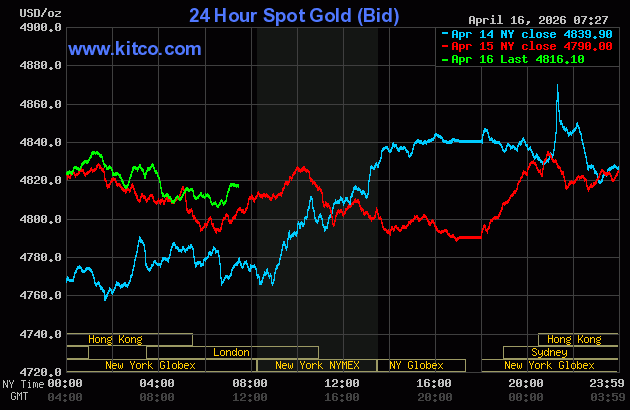
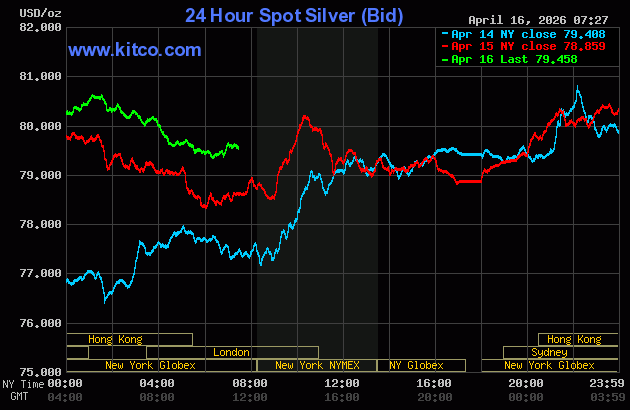
June gold futures were last up $15.70 at $4,839.30 per troy ounce, while May silver futures rose $0.212 to $79.81. For Indian investors, the move matters because firmer global bullion prices, combined with any weakness in the Indian rupee against the U.S. dollar, can quickly feed into higher domestic gold rates.
Why is gold price rising today?
Gold price is rising because short-term futures traders are doing technical buying as gold and silver both show fledgling near-term uptrends on their daily charts. The gains were modest, but they reflected improving short-term chart momentum in bullion.
In early U.S. trading on Thursday, June gold gained $15.70 to $4,839.30, and May silver climbed $0.212 to $79.81. In the XAUUSD market, traders were also watching whether gold could extend this move toward nearby resistance zones.
This kind of buying usually happens when traders see chart patterns improving, even if macro signals remain mixed. Gold and silver prices often attract fresh speculative interest when futures charts begin to trend higher over the short term.
For Indian bullion buyers, these technical moves can matter even on days without a major macro shock. If international gold prices rise while the rupee weakens, local gold prices in India can rise faster than the global move alone would suggest.
What is happening in the Middle East and why does it matter for gold?
The Middle East conflict is supporting uncertainty, which is typically positive for safe-haven assets such as gold. At the same time, shifting ceasefire headlines have limited a more aggressive move higher in bullion.
According to Bloomberg, Pakistan has intensified efforts to help the United States and Iran extend a ceasefire that is set to end next week. Both countries are considering a two-week ceasefire extension, according to a person familiar with the matter.
Another person familiar with the talks said neither side wants fighting to restart, especially after the war devastated Iran’s infrastructure and pushed energy prices sharply higher, including in the United States. Still, major issues remain unresolved.
Which unresolved issues are keeping markets on edge?
The biggest sticking points include the reopening of the Strait of Hormuz, Iran’s nuclear and missile programs, and possible sanctions relief for Iran. Washington and Tehran have said they have not agreed to any ceasefire extending beyond late Tuesday U.S. time.
Shipping disruption remains a key concern. Reports indicate Strait of Hormuz shipping traffic remains way down amid blockade, highlighting the ongoing threat to crude oil flows.
Other regional and energy-related developments also underscored market stress:
- U.S. Treasury Secretary Scott Bessent said he is optimistic gasoline prices will drop to $3 per gallon over summer.
- A half-full oil tanker heading to Japan showed how buyers are scrambling for crude.
- Pakistan faces extensive blackouts as a worsening gas shortfall strains supply.
How is the Federal Reserve viewing the war-driven uncertainty?
The Federal Reserve said the Middle East war is creating major business uncertainty. That matters for gold because elevated uncertainty tends to support safe-haven demand, even when interest rates and the U.S. dollar remain firm.
The Fed’s Beige Book, released Wednesday afternoon, said the conflict has complicated decisions on hiring, pricing, and capital investment. Many firms have adopted a wait-and-see posture.
What did the Beige Book say about the U.S. economy?
The report said U.S. economic activity continued to increase at a slight-to-modest pace across most regions. It also said overall price growth remained moderate, but energy and fuel costs rose sharply in all 12 Federal Reserve districts.
The U.S. labor market remained stable across most districts, although several districts reported stronger demand for temporary or contract workers. Businesses appear reluctant to commit to permanent hiring while uncertainty remains elevated.
For gold traders, this is a mixed macro backdrop. Rising energy costs can lift inflation expectations, which can support bullion, but a cautious Federal Reserve and firm yields can also limit upside in XAUUSD.
What do shipping costs and global growth signals mean for bullion?
Higher shipping costs and stronger-than-expected Chinese growth are reinforcing the broader commodity story, even though their direct effect on gold is less immediate than geopolitical risk. They matter because they shape inflation expectations, industrial demand sentiment, and overall risk appetite.
The Baltic Dry Index rose 5.5% to 2,484 points on Wednesday in London, reaching its highest level since early December. The index has now rallied for a ninth straight session.
The Baltic Dry Index tracks freight rates for Capesize, Panamax, and Supermax vessels carrying raw materials such as iron ore, coal, and grains. Demand was concentrated in Capesize ships, which are the segment most exposed to iron ore.
Higher freight costs can feed into global inflation pressure. That is relevant for precious metals because inflation-sensitive investors often use gold as a store of value.
How strong was China’s economic growth?
China’s economy grew faster than expected in the first quarter, with GDP expanding 5% from a year earlier. Industrial output rose 5.7% in March from a year ago.
However, retail sales increased only 1.7%, down from 2.8% growth in the first two months. The data showed that growth relied heavily on manufacturing and exports, while consumer spending and private investment continued to cool.
For Indian investors, stronger Chinese industrial activity can support commodity prices more broadly, including silver and mining-linked inputs. But weaker Chinese consumption may temper enthusiasm across parts of the precious metals complex.
Why is euro-zone inflation important for gold prices?
Euro-zone inflation matters because higher inflation can support demand for gold as an inflation hedge and can complicate the path of interest rates globally. On Thursday, the inflation reading was revised higher.
Euro-zone inflation for March was revised up to 2.6% year-on-year from 2.5%, according to Eurostat. Core inflation came in at 2.3%, while services inflation stood at 3.2%.
March marked the first increase this year above the European Central Bank’s 2% annual target. The fighting in the Middle East has pushed energy costs higher, contributing to that pressure.
The revision followed similar upward moves this week in France, Italy, and Spain. For bullion markets, persistent inflation in Europe adds to the case that geopolitical energy shocks are spilling into broader price trends.
What are the key outside markets telling gold traders now?
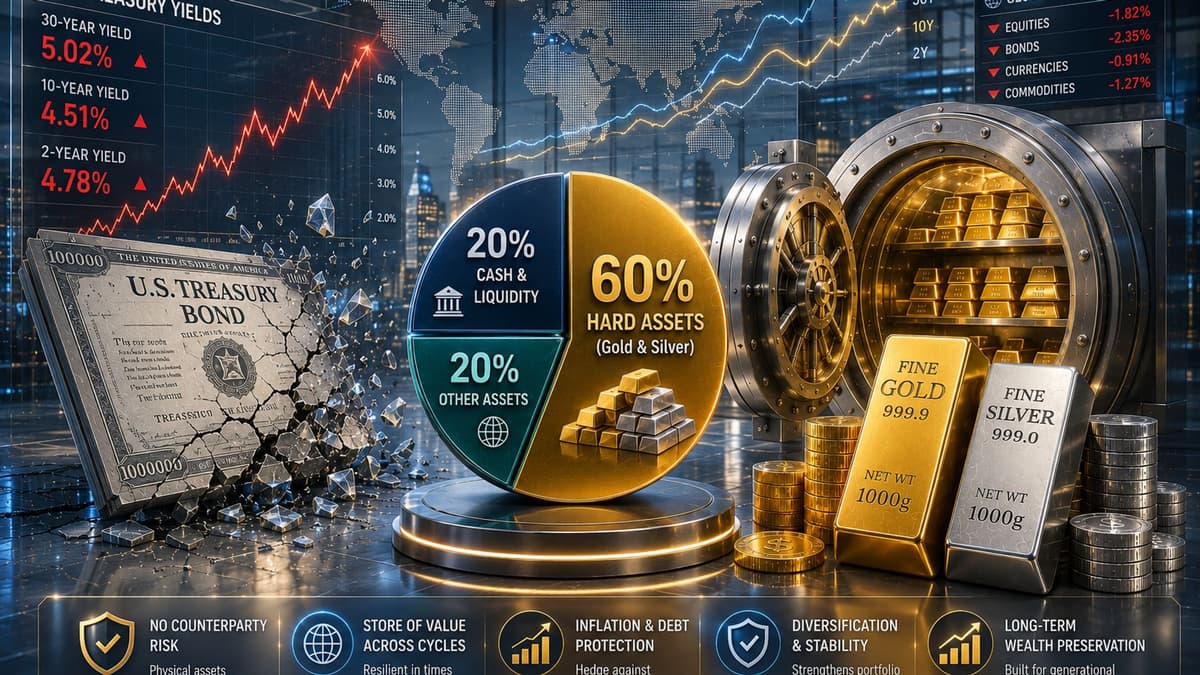
The outside markets show a supportive but not fully bullish backdrop for gold. Oil is higher, the U.S. dollar index is a bit firmer, and Treasury yields remain elevated.
Nymex WTI crude oil was trading around $92.50 a barrel. The U.S. dollar index was a bit firmer, while the yield on the benchmark 10-year U.S. Treasury note stood at 4.28%.
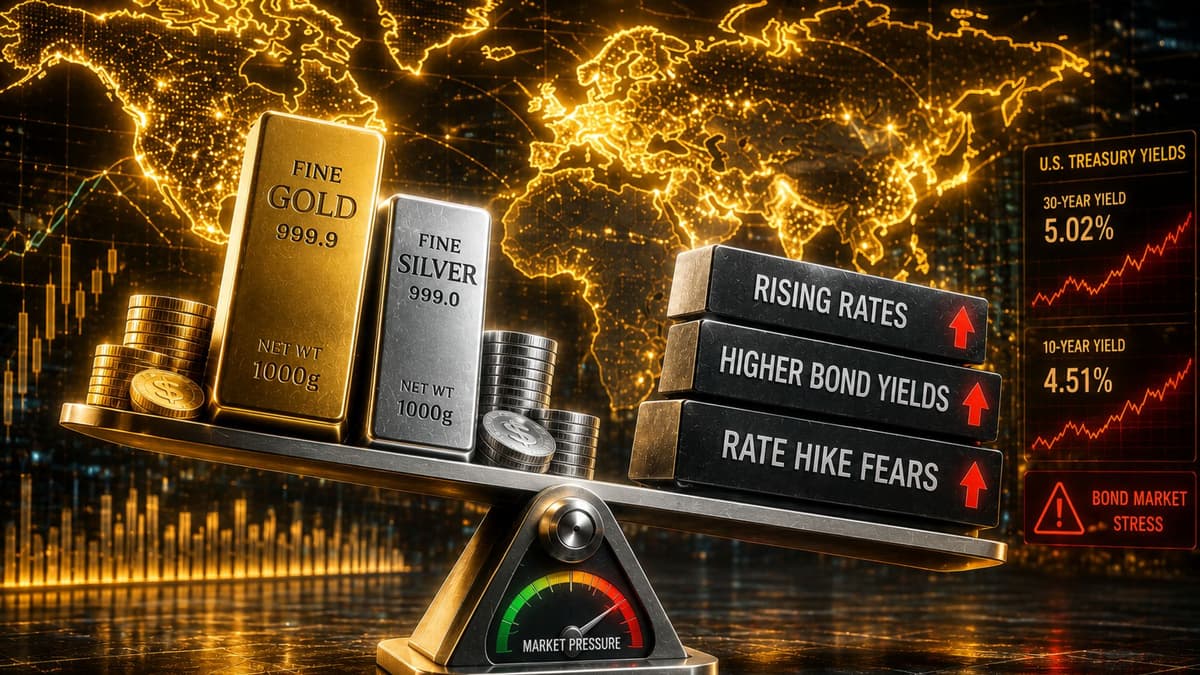
Higher oil prices can support inflation hedging demand for bullion. But a firmer U.S. dollar and elevated Treasury yields can reduce some of gold’s appeal because they raise the opportunity cost of holding non-yielding assets.

For Indian investors, crude near $92.50 is especially important. Higher oil prices can worsen India’s import bill and pressure the rupee, and a weaker rupee often amplifies domestic gold price gains even if international prices rise only modestly.
What are the latest technical levels for gold and silver?
Gold and silver remain in near-term uptrends, but both markets still need to clear important resistance levels to strengthen the bullish case. Traders are now watching whether futures can break above this week’s highs.
Gold technical levels
Technically, June gold futures bulls next upside objective is a close above solid resistance at $5,000.00. The bears’ next near-term downside objective is to push prices below solid support at $4,500.00.
The first resistance level is this week’s high of $4,895.40, followed by $4,950.00. First support is seen at $4,800.00 and then at $4,750.00.
Wyckoff's Market Rating for gold: 6.5.
Silver technical levels
For May silver futures, bulls’ next upside objective is a close above solid technical resistance at $85.00. Bears’ next downside objective is a close below solid support at $70.00.
The first resistance level is this week’s high of $81.155, followed by $82.50. Next support is seen at $77.00 and then at $75.00.
Wyckoff's Market Rating for silver: 6.5.
These levels matter for Indian traders tracking COMEX-linked moves in bullion and XAUUSD direction. If gold clears $4,895.40 and then $4,950.00, traders may start looking for momentum toward $5,000.00. If prices slip below $4,800.00, near-term sentiment could soften quickly.
What is the difference between spot gold and futures gold prices?
Spot gold and futures gold are different pricing mechanisms. Spot gold reflects immediate purchase and delivery, while futures gold reflects a contract for delivery at a later date.
The source article notes that the gold market operates through these two primary pricing systems. It also says that because of year-end positioning market liquidity, the December gold futures contract is currently the most actively traded on the CME.
That distinction matters for Indian investors following international gold price headlines. News reports may cite spot gold, front-month futures, or actively traded deferred contracts, and those prices can differ slightly depending on market structure and liquidity.
Looking ahead, Indian investors should closely watch three triggers: whether the U.S.-Iran ceasefire extends beyond next week, whether crude oil stays near or above $92.50 a barrel, and whether June gold futures can break $4,895.40 on the way toward $5,000.00. Those factors are likely to shape both global bullion sentiment and domestic gold prices in India in the coming sessions.