# Gold Price Rises Above $4,800 After U.S. Core PCE Meets Forecasts
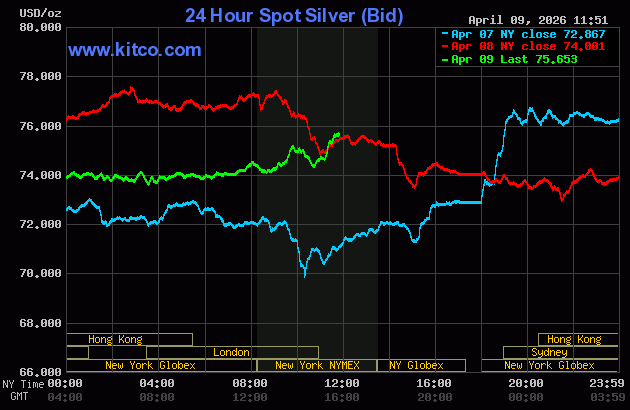
Gold prices moved higher on Thursday after fresh U.S. inflation data matched expectations, easing the risk of an immediate market shock. June gold futures were last up $26.40 at $4,803.50 by midday, while May silver futures added $0.15 to $75.54 in choppy two-way trading.
For Indian investors, the move matters because global bullion prices, the U.S. dollar, and Treasury yields directly influence domestic gold rates in rupees. A weaker U.S. dollar can support gold, but elevated international prices can still keep Indian buyers cautious at higher levels.
Why did gold prices rise after the U.S. inflation data?
Gold prices rose because the latest U.S. core PCE inflation data delivered no surprise and did not force traders to sharply reprice Federal Reserve expectations. With inflation figures in line with market consensus, bullion found support in a weaker U.S. dollar and steady risk sentiment.
The U.S. core PCE price index, the Federal Reserve’s preferred gauge of underlying inflation, rose 0.4% month-on-month in February 2026. That matched market expectations and maintained the 10-month high seen over the previous two months.
On a year-on-year basis, the core PCE price index increased 3.0%, compared with 3.1% in the prior month. Even with that slight cooling, inflation remains well above the Federal Reserve’s 2% target.
That combination helped keep gold firm rather than triggering a sharp selloff. Traders often buy gold as a safe-haven asset when inflation stays sticky, especially when data do not materially change the broader interest-rate outlook.
What were gold and silver prices at midday on Thursday?
June gold futures were up $26.40 at $4,803.50, while May silver futures were up $0.15 at $75.54 at midday Thursday. Both precious metals traded in a choppy, two-sided session.
Gold held comfortably above the psychologically important $4,800 per troy ounce area. Silver also stayed firm, though its gains were more modest than gold’s.
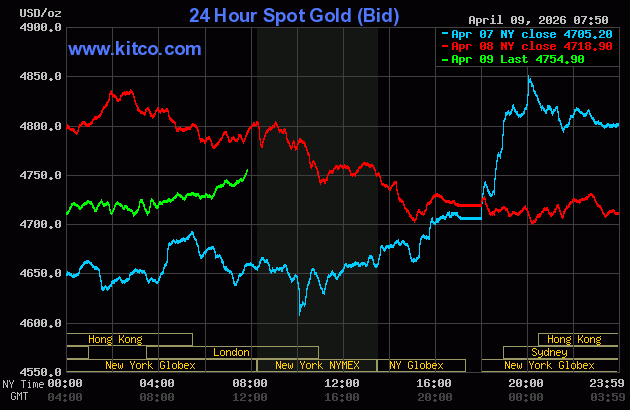
The price action suggests traders were balancing inflation, currency, and yield signals rather than taking a one-way view. That usually leads to volatile intraday moves in XAUUSD and silver futures.
For Indian bullion watchers, these global price levels are important because any sustained rally above $4,800 in gold can feed into higher domestic rates, especially if the Indian rupee weakens against the U.S. dollar.
How did the U.S. dollar, crude oil, and Treasury yields affect bullion?
A weaker U.S. dollar supported gold, while higher crude oil and firm Treasury yields created a mixed backdrop. That is why trading stayed choppy instead of trending strongly in one direction.
At midday, Nymex WTI crude oil was solidly higher and traded around $101.00 a barrel. Higher crude prices can reinforce inflation concerns, which often supports demand for precious metals such as gold and silver.
The U.S. dollar index was weaker. A softer dollar usually makes gold cheaper for buyers holding other currencies, which can improve demand for bullion.
The yield on the benchmark 10-year U.S. Treasury note stood at 4.285%. Higher yields can limit upside in non-yielding assets like gold, because they raise the opportunity cost of holding bullion.
This mix explains why gold rose but did not break decisively higher. For Indian investors, the dollar trend remains especially important because it affects both imported gold costs and rupee-denominated retail prices.
What technical levels matter most for gold price now?
The key upside level for June gold futures is $5,000.00, while the major downside support level is $4,500.00. Those are the next big technical objectives identified in the market.
According to the technical outlook in the source report, June gold futures bulls’ next upside price objective is a close above solid resistance at $5,000.00. Bears’ next near-term downside objective is to push prices below solid technical support at $4,500.00.
Gold resistance levels
First resistance stands at this week’s high of $4,888.00. The next resistance comes at $4,900.00.
If gold clears those levels on a closing basis, traders will likely focus more aggressively on the $5,000.00 mark. That level would be a major psychological and technical milestone for the gold market.
Gold support levels
First support is seen at Thursday’s low of $4,718.60. The next support level is this week’s low of $4,626.20.
If gold falls below those levels, bearish momentum could build toward the larger support zone at $4,500.00. The report assigns June gold futures a Wyckoff Market Rating of 6.0, suggesting bulls still hold a modest near-term technical advantage.
What are the key silver price levels to watch?
Silver’s key upside target is $80.00, while the main downside target is the March low of $61.21. May silver futures remain in a more balanced technical setup than gold.
May silver futures bulls’ next upside price objective is a close above solid technical resistance at $80.00. Bears’ next downside price objective is a close below solid support at the March low of $61.21.
Silver resistance levels
First resistance is seen at this week’s high of $77.80. The next resistance level is $80.00.

A sustained move above $77.80 would strengthen bullish momentum in silver and bring the $80.00 zone into sharper focus. That would also matter for Indian investors tracking industrial precious metals demand alongside bullion trends.
Silver support levels
Next support is seen at Thursday’s low of $72.925. Below that, this week’s low of $69.78 is the next important floor.
If silver breaks under those levels, traders would start watching the March low of $61.21 more closely. The report gives May silver futures a Wyckoff Market Rating of 5.5, indicating a more neutral-to-slightly-bullish near-term structure.
How do spot and futures prices affect gold investors?
Gold trades through both spot and futures markets, and that distinction matters because the most actively traded contract can shape market pricing. Futures prices often lead short-term headlines, while spot prices reflect immediate delivery.
The source notes that the gold market operates through two primary pricing mechanisms. The first is the spot market, which quotes prices for on-the-spot purchase and immediate delivery. The second is the futures market, which sets prices for delivery at a future date.
Because of year-end positioning market liquidity, the December gold futures contract is currently the most actively traded on the CME, according to the source note. Even so, the article’s main technical discussion focuses on June gold futures.
For Indian investors, the distinction matters because domestic jewellers, bullion dealers, and gold traders often react to both international spot gold and COMEX futures when pricing inventory and hedging risk in rupees.
What should Indian gold investors watch next?
Indian gold investors should watch whether gold can hold above $4,800, how the U.S. dollar behaves, and whether U.S. inflation stays sticky enough to delay Federal Reserve easing. Those factors will likely decide whether bullion tests $4,888, $4,900, and eventually $5,000, or slips back toward $4,718.60 and $4,626.20.
If the rupee weakens while global gold remains elevated, domestic gold prices in India could stay firm even during periods of sideways international trade. That makes U.S. inflation prints, Treasury yields, and currency moves the most important near-term watchpoints for Indian bullion buyers and investors.