# Gold Price Reset? Why BNP Sees $10,000 Gold Ahead
Global markets are undergoing what BNP Paribas Fortis calls a major physical realignment, with gold and silver at the center. According to Philippe Gijsels, Chief Strategy Officer at BNP Paribas Fortis, a paralyzed Federal Reserve, rising inflation pressure, and escalating energy disruption around Iran could set up a historic bull market in bullion and other hard assets.
For Indian investors, the message is significant. If global gold prices, Brent crude, and inflation expectations all move higher together, domestic gold rates in rupees could stay elevated or rise further, especially if the Indian rupee weakens against the U.S. dollar.
What did the Federal Reserve decide, and why does it matter for gold price?
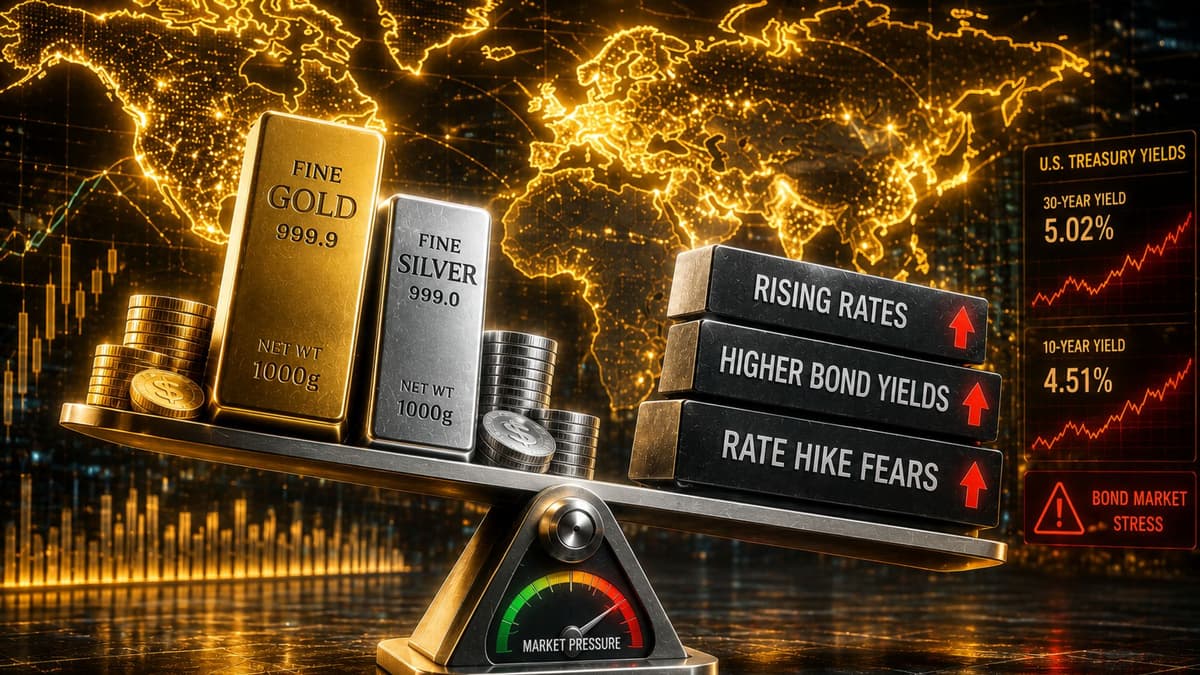
The Federal Reserve kept interest rates unchanged, and that matters for gold because it signals ongoing policy uncertainty at a time of sticky inflation and geopolitical stress. Gold typically benefits when investors expect real interest rates to stay under pressure and central banks to fall behind inflation.
The Federal Open Market Committee voted 11-1 on Wednesday to keep the benchmark interest rate in a target range of 3.5%-3.75%. The Federal Reserve said the economic implications of the broadening conflict in Iran remain "uncertain."
At the same time, the Federal Reserve still signaled one rate cut by the end of 2026. However, it also raised its year-end median projection for core inflation to 2.7%, acknowledging that price pressures remain stubbornly elevated despite the recent tightening cycle.
That mix matters for XAUUSD and broader precious metals markets. When the Federal Reserve keeps rates steady but inflation projections rise, investors often read it as a sign that monetary policy may not fully contain price pressures.
Why does sticky inflation support bullion?
Sticky inflation supports bullion because gold is widely used as a store of value when fiat currency purchasing power weakens. If inflation stays elevated while growth slows, investors often increase exposure to safe-haven assets such as gold and, at times, silver.
For Indian buyers, that can translate into higher landed costs for imported gold. India imports most of its gold, so a stronger U.S. dollar, rising global gold price levels, and energy-driven inflation can all influence local bullion prices.
Why does Philippe Gijsels see gold at $10,000 and silver at $200?
Philippe Gijsels sees gold at $10,000 and silver at around $200 because he believes the world is entering a stagflationary cycle in which central banks eventually choose inflation over economic collapse. He argues that structural supply constraints and monetary degradation will drive a major revaluation in physical precious metals.
Gijsels told Kitco News that the recent volatility in precious metals is a temporary "de-leveraging" event. In his view, paper markets are in panic, while the physical market is only beginning to price in a much larger long-term shift.
He said he is "absolutely convinced that central banks eventually will all choose to let inflation run" in order to manage massive global debt loads, particularly in the United States, Europe, and Japan. He believes that once investors recognize that fiat currencies are losing purchasing power, they will rotate back into hard assets such as gold and silver.
Gijsels argued that central bankers had an easier task for decades because inflation kept trending lower, allowing them to cut rates over time. Now, he said, policymakers are cornered by rising costs and slowing growth, and will likely prioritize growth even if inflation runs well above the traditional 2% target.
Based on that outlook, Gijsels issued aggressive long-term targets. He said "gold will go to $10,000 in a couple of years' time" and added that he "would not be surprised to see $200 or so on silver."
What does the "paper market" versus "physical market" argument mean?
The paper-versus-physical argument means price discovery in futures and financial products may be diverging from demand for actual bullion bars and coins. Gijsels believes the current stress in derivatives and leveraged trading is temporary, while the physical market for real metal is in the early stages of a stronger secular move.
He described the current phase as the beginning of what could become "the largest bull market in history." That view rests on physical scarcity, inflation risk, and weakening confidence in fiat money rather than on short-term speculative flows alone.
For Indian investors, this distinction matters because domestic demand often responds strongly to physical gold availability, import costs, festival buying, and central bank trends rather than only to futures market volatility.
How is the Iran conflict affecting oil, inflation, and precious metals?
The Iran conflict is affecting oil, inflation, and precious metals by increasing energy supply risk and pushing crude prices higher, which can feed directly into global inflation expectations. Higher energy prices can strengthen gold's appeal as a safe-haven and inflation hedge.
Gijsels said this physical reset is unfolding as direct military strikes hit Iran's energy infrastructure, especially the South Pars gas field. Following that escalation, Brent crude surged past $109 a barrel.
The disruption has already halted Iranian gas exports to Iraq. That outage has cut critical power supplies and prompted President Trump to issue an emergency 60-day Jones Act waiver to limit domestic fuel cost pressures.
Gijsels said the oil market is now fragmenting into competing political blocs. In his view, the United States is using energy as a weapon against China, while Beijing is securing the "marginal barrel" through its own strategic reserves.
Why is the Strait of Hormuz so important for gold investors?
The Strait of Hormuz matters because a prolonged disruption there could trigger another sharp jump in oil prices and inflation, which would likely increase demand for gold. Gold often gains when investors expect geopolitical shocks to destabilize growth and currencies.
Gijsels called a potential closure of the Strait of Hormuz a major case study in global energy stability. He noted that 20 million barrels of oil, nearly 20% of global daily consumption, are now at risk.
He warned that if the blockade remains in place for even a few more weeks, oil prices could spike to $150 a barrel. That level of volatility, he said, would challenge the current global economic order.
He also argued that oil may be starting to resemble natural gas in one key way: fragmentation. As he put it, the gas market has long been fragmented because transport is difficult, but now oil may be moving in the same direction.
For India, this is critical. India is a major crude importer, so any move from Brent above $109 toward $150 could worsen imported inflation, pressure the rupee, and amplify gains in domestic gold prices even if international gold pauses temporarily.
What is the HALO framework, and why does it matter for bullion and commodities?
The HALO framework matters because it favors real, scarce, economically essential assets over purely digital or financial abstractions. Gijsels uses HALO to describe a world that increasingly values "Heavy Assets, Low Obsolescence."
According to Gijsels, "this is a material world more than ever." He argued that even artificial intelligence and digital systems still depend on real-world inputs such as copper for electrification and silver for industrial demand.
That argument broadens the investment case beyond spot gold price action alone. It suggests that commodities and precious metals could benefit together if investors shift capital toward tangible assets with supply constraints and lasting industrial or monetary value.
Which metals did Gijsels highlight?
Gijsels highlighted gold and silver most directly, while also pointing to copper as a key real-world input. Gold remains the monetary hedge, silver carries both precious-metal and industrial demand characteristics, and copper underpins the electrical revolution.
For Indian investors, silver can become especially relevant in a HALO-style cycle because it combines bullion appeal with industrial demand exposure. That can make silver more volatile than gold, but also potentially more responsive in a strong commodity uptrend.
Why are institutions verifying physical bullion now?
Institutions are verifying physical bullion now because confidence in financial claims alone is weakening as inflation, rate volatility, and market stress rise. Gijsels said institutional investors increasingly want direct, and in some cases tokenized, claims on actual physical inventory.
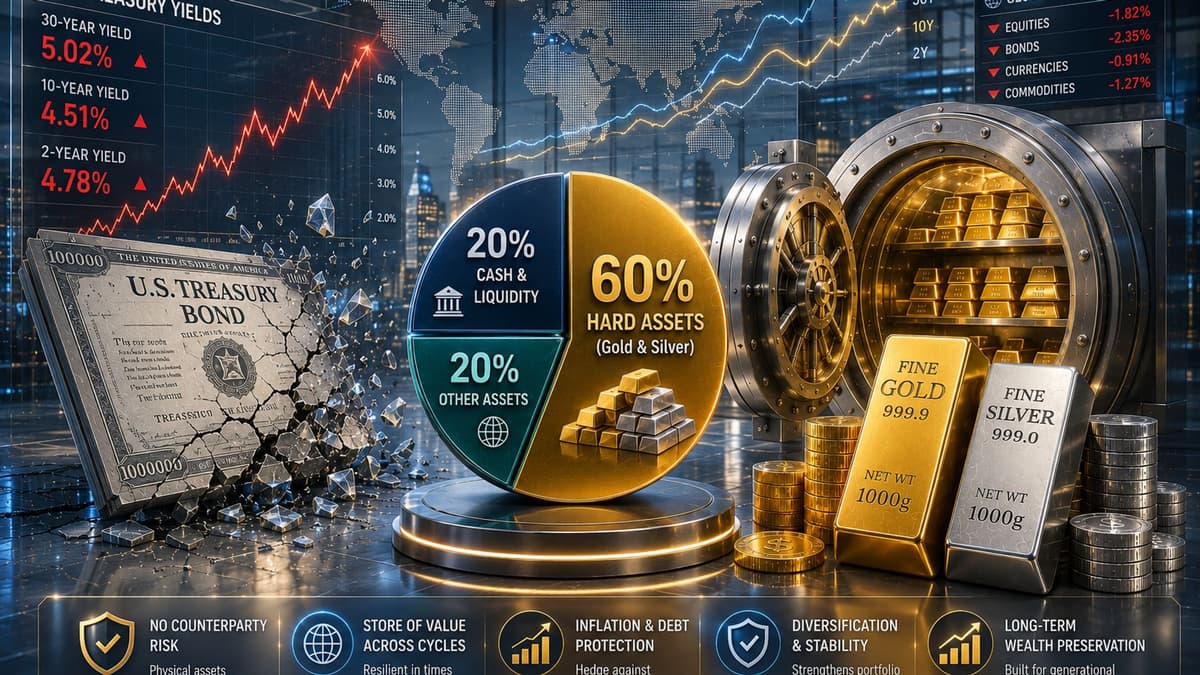
He argued that the traditional 60/40 portfolio is breaking down under the weight of rising inflation and higher interest rates. In that environment, investors may no longer be satisfied with synthetic exposure if they are worried about scarcity and counterparty risk.
Gijsels revealed that his team at BNP Paribas has started physically verifying the bullion backing their trackers. He said the goal is to make sure the "real stuff" actually exists.
That detail is especially notable for the global bullion market. It suggests major financial institutions are paying closer attention to physical backing, bar availability, and custody quality rather than relying only on paper claims.
What could this mean for Indian gold buyers and investors?
This could mean Indian gold buyers and investors face a market where physical ownership, product purity, and trusted storage become even more important. If global institutions increasingly focus on real bullion availability, premiums and supply dynamics may matter more alongside headline XAUUSD moves.
For Indian households, sovereign gold bonds, ETFs, digital gold, coins, and bars each carry different forms of exposure. In a market increasingly focused on physical verification, investors may pay closer attention to issuer structure, redemption terms, and whether the product has clear bullion backing.
What should Indian investors watch next in the gold price outlook?
Indian investors should watch the Federal Reserve's inflation path, the Iran conflict, Brent crude, the Strait of Hormuz, and signs of stress between paper and physical bullion markets. These factors will likely shape the next major move in gold price, silver, and the broader precious metals complex.
If the Federal Reserve keeps rates in the 3.5%-3.75% range while core inflation remains projected at 2.7%, gold could retain support as a hedge against policy drift. If Brent crude stays above $109 or rises toward $150 because of prolonged disruption around the Strait of Hormuz, inflation risk could intensify quickly.
The bigger signal may come from whether institutional demand continues shifting toward physically verified bullion and tokenized claims on inventory. If that trend strengthens, the global gold market may move further toward the "physical scarcity" story that Gijsels says is only just beginning.