# Gold Price Rebounds Sharply as Iran War Risks Roil Markets
Gold and silver prices rose in early U.S. trading after a corrective bounce from Thursday's sharp losses, but the broader trend remained choppy as traders weighed safe-haven demand against inflation pressure and softer physical demand. For Indian investors, this mix matters because higher global bullion prices can support domestic gold rates, while a firm U.S. dollar and elevated bond yields can limit upside in rupee terms.
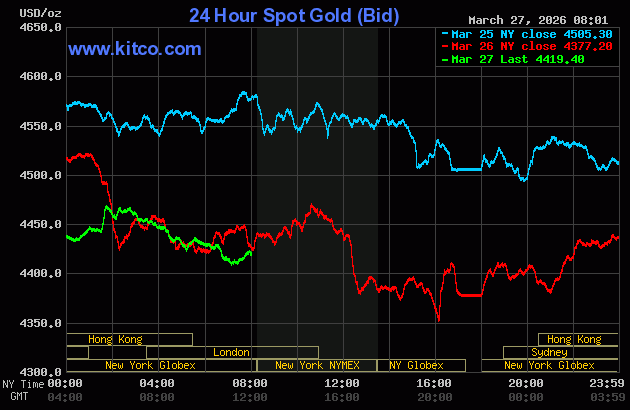
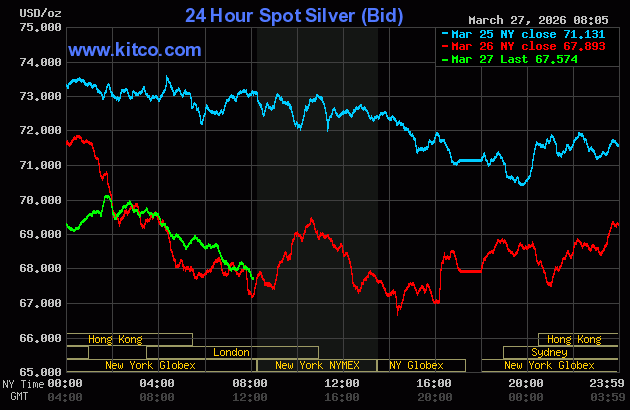
April gold futures were last up $34.40 at $4,410.70 per troy ounce, while May silver futures gained $0.436 to $68.375. The rebound came as markets tracked the Iran conflict, fresh China-U.S. trade tension, hawkish Federal Reserve commentary, higher crude oil prices, a firmer U.S. dollar index, and a 4.45% yield on the benchmark 10-year U.S. Treasury note.
Why did gold price rise today?
Gold price rose because traders bought bullion after Thursday's solid losses, creating a corrective rebound in early U.S. trading. The move was technical in nature, but it was also supported by safe-haven demand linked to war uncertainty in the Middle East.
It has been a choppy week for gold and silver. Bulls focused on safe-haven buying as the war risk stayed elevated, while bears argued that problematic inflation is choking consumer and commercial demand for precious metals.
For Indian investors, such corrective rebounds in XAUUSD often feed into local bullion pricing, especially when geopolitical risk boosts global safe-haven demand. However, domestic price gains can vary depending on the rupee's movement against the U.S. dollar and import-related costs.
What were the latest gold and silver prices?
April gold futures were last up $34.40 at $4,410.70. May silver futures were last up $0.436 at $68.375.
These gains followed solid losses on Thursday. That pattern suggests traders were repositioning rather than signaling a clear breakout in precious metals.
How is the Iran war affecting gold and silver markets?
The Iran conflict is supporting gold through safe-haven demand, but it is also pushing oil higher and bond yields up, which complicates the bullish case for bullion. Markets are reacting not just to the war itself, but to the risk of wider regional disruption.
Key developments tied to the war included:
- Donald Trump delaying an Iran energy attack deadline by 10 days while claiming the U.S. and Iran are talking.
- The Pentagon considering sending as many as 10,000 more U.S. troops to the region, according to the Wall Street Journal.
- Iran continuing drone and missile strikes across the Middle East.
- Oil rising as traders brace for a longer war, while European stocks slide and bond yields rise.
- Iran saying it turned back three vessels of different nationalities trying to transit the Strait of Hormuz.
- Two Chinese container ships attempting a Hormuz exit before making a U-turn.
- Macquarie warning to brace for $200 oil if the war lasts until June.
Why does the Strait of Hormuz matter for Indian investors?
The Strait of Hormuz matters because it is a critical energy chokepoint, and any disruption can push crude oil sharply higher. For India, higher oil prices can pressure inflation, weaken the rupee, and raise imported gold costs.
That means Indian gold buyers could see domestic prices move not only because of global XAUUSD changes, but also because of INR weakness and energy-driven inflation pressure. If the conflict broadens, local bullion prices could stay volatile even if global gold pauses.
What is China doing on trade, and why does that matter for gold price?
China launched investigations into U.S. trade practices, adding another layer of macro uncertainty that can support safe-haven assets like gold. At the same time, renewed trade friction can strengthen the U.S. dollar and hurt industrial demand expectations, creating mixed signals for precious metals.
China started two investigations into U.S. trade practices, retaliating against similar probes from the Trump administration. According to a Bloomberg report, the move mirrored steps U.S. President Donald Trump took to revive his tariff agenda after the Supreme Court last month struck down some of his duties.
China's Commerce Ministry directly criticized the U.S. action. A spokesperson said, "China expresses its strong dissatisfaction and firm opposition to these actions," referring to the Section 301 investigations initiated on March 11.
The timing is important. The Chinese measures came only days after the White House said Trump will travel to China in mid-May to meet President Xi Jinping for a summit delayed by the U.S. conflict with Iran.
The world's two biggest economies have largely stabilized ties after last year's tariff tit-for-tat, but Beijing has signaled opposition to fresh U.S. moves. For gold investors, that means geopolitics is now coming from two fronts: war risk and trade risk.
Why are Federal Reserve signals and bond yields limiting gold upside?
Federal Reserve policy is limiting gold upside because hawkish signals keep rate-cut expectations in check and support higher Treasury yields and a firmer dollar. That combination usually acts as a headwind for bullion prices.
Federal Reserve Governor Michael Barr said on Thursday that Fed policymakers are well positioned to hold U.S. interest rates steady because the Middle East conflict and other factors are complicating the effort to bring inflation back to the annual 2% target.
Barr said non-housing services inflation and core inflation are both elevated. He also warned that the inflation impact of tariffs may continue beyond this year.
Those comments reinforced a higher-for-longer rates narrative. In the key outside markets, Nymex WTI crude oil traded around $97.00 a barrel, the U.S. dollar index was slightly higher early in the day, and the benchmark 10-year U.S. Treasury note yielded 4.45%.
For Indian investors, this matters because higher U.S. yields and a stronger dollar can cap global gold rallies even when safe-haven demand is strong. But if the rupee weakens at the same time, local gold prices may still remain elevated.
What are the key technical levels for gold price now?
Gold futures remain technically weak in the near term, with bulls needing a move above major resistance and bears targeting this week's low. The current setup suggests traders are watching defined levels rather than chasing momentum.
Gold futures technical levels
According to the technical setup, April gold futures bulls' next upside objective is a close above solid resistance at $4,750.00. Bears' next near-term downside objective is to push prices below solid technical support at this week's low of $4,100.00.

First resistance stands at the overnight high of $4,469.30 and then at $4,500.00. First support is seen at the overnight low of $4,369.10 and then at $4,300.00.
Gold's Wyckoff Market Rating is 4.0, which indicates the bears still hold the near-term technical advantage.
Silver futures technical levels
May silver futures bulls need a close above solid technical resistance at $80.00 to regain stronger control. Bears are targeting a close below solid support at $60.00.
First resistance in silver is seen at the overnight high of $70.43 and then at $72.385. Next support is seen at $66.00 and then at $62.50.
Silver's Wyckoff Market Rating is also 4.0. That keeps silver in a fragile technical position despite the latest bounce.
How do spot gold and futures gold pricing work?
Gold trades through both the spot market and the futures market, and that distinction matters for investors tracking fast price moves. Spot gold reflects on-the-spot purchase and immediate delivery, while futures contracts price gold for delivery at a later date.
Because of year-end positioning and market liquidity, the December gold futures contract is currently the most actively traded on the CME. That can influence how traders interpret price action, especially when comparing active contracts with spot gold.
For Indian investors following international bullion markets, understanding the difference between spot and futures is useful because headlines may cite either one. Local jewellers and bullion dealers may also respond differently depending on whether the move comes from physical demand, spot buying, or futures-led speculation.
Gold's next move now depends on whether safe-haven demand from the Iran conflict and renewed China-U.S. trade friction can overpower the drag from elevated inflation, firm Treasury yields, and a stronger dollar. Indian investors should closely watch oil near $97.00, the 4.45% U.S. 10-year yield, the rupee's direction, and whether April gold can break $4,469.30 and $4,500.00 on the upside or slips back toward $4,369.10 and $4,300.00.