# Gold Price Rebounds From Lows as Powell Stays Patient on Rates
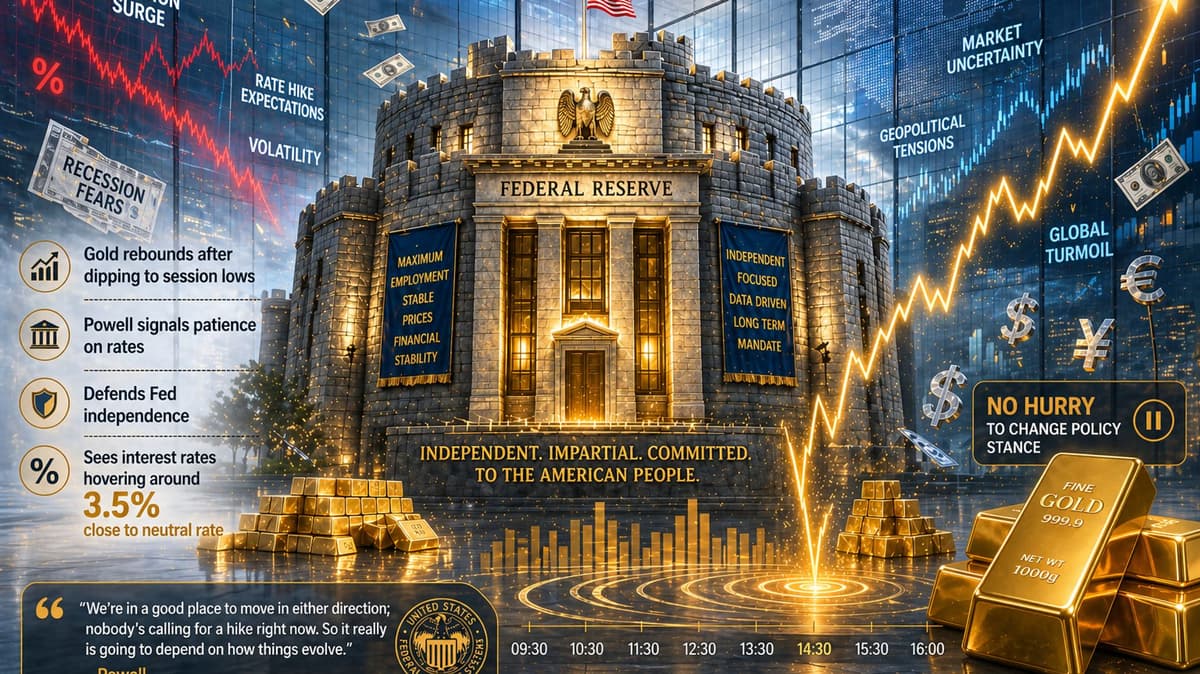
Gold prices stayed under pressure but recovered from session lows after Federal Reserve Chair Jerome Powell signaled that the U.S. central bank is in no rush to change interest rates. Spot gold was last at $4,538.20 per troy ounce, down 1.2% on the day, as traders weighed Powell’s comments on monetary policy, inflation, and Federal Reserve independence.
For Indian investors, the move matters because global XAUUSD prices, U.S. rate expectations, and geopolitical inflation risks directly influence domestic bullion prices in rupee terms. A steadier U.S. rate outlook can limit upside in gold in the near term, but concerns over inflation, oil shocks, and central bank credibility continue to support safe-haven demand.
Why did gold price bounce off session lows today?
Gold price bounced off session lows because Jerome Powell did not deliver any new hawkish surprise, even as he said the Federal Reserve is not in a hurry to change policy. Traders kept pressure on bullion, but the absence of signals for a rate hike helped gold recover from deeper intraday losses.
Spot gold last traded at $4,538.20 an ounce, down 1.2% on the day. The market showed no major reaction to Powell’s remarks, suggesting investors had already adjusted to a slower path for U.S. rate cuts.
What exactly did Jerome Powell say on rates?
Powell said the Federal Reserve is in a position to move in either direction depending on incoming data. He added: “We're in a good place to move in either direction; nobody's calling for a hike right now. So it really is going to depend on how things evolve.”
That comment mattered for bullion because it confirmed a wait-and-watch approach. Gold usually performs better when investors expect lower real rates, but it can also stay supported when the Federal Reserve avoids tightening further.
What did Powell say about the neutral rate?
Powell said he sees interest rates hovering around 3.5%, which he described as close to the neutral rate. He added: “I’ve always had it between three and four percent. We're a little north of three-and-a-half, so that's well within the range of what I consider reasonable.”
That range is important for gold investors because it signals that Powell does not see current policy as far out of line with long-run equilibrium. In practical terms, that can reduce expectations for aggressive easing, which may cap near-term upside in gold price.
What does Powell’s patience on rates mean for gold?
Powell’s patience means gold may face short-term pressure, but the broader support structure for bullion remains intact because markets still see a rate hike as unlikely. Analysts said markets have priced out potential rate cuts this year, yet they do not expect the Federal Reserve to tighten further.
That mix is important for precious metals. If rate cuts are delayed, non-yielding assets like gold can lose momentum. But if rate hikes remain off the table, downside in XAUUSD may stay limited.
Why are analysts still constructive on bullion?
Analysts said gold remains well supported because the Federal Reserve is still unlikely to raise rates. Even without cuts this year, a stable-to-easier long-term policy outlook tends to preserve demand for safe-haven assets and monetary hedges.
The market is also watching whether political pressure could eventually push the U.S. central bank toward looser policy. If investors believe rates could be cut too aggressively later, inflation concerns could strengthen gold demand.
How are inflation and the U.S.-Iran war affecting gold price?
Inflation and geopolitical risks are still supporting gold, even though Powell said longer-term inflation expectations remain anchored. The ongoing U.S.-Iran war has created significant supply shocks in oil markets and pushed up energy prices.
Higher energy prices can feed inflation expectations and increase demand for bullion as a hedge. That is especially relevant for Indian investors because higher crude prices can weaken the rupee, widen imported inflation pressures, and lift domestic gold prices even if international gold pauses.
What did Powell say about inflation expectations?
Powell said long-term inflation expectations remain anchored around 2%. That suggests the Federal Reserve does not yet see an uncontrolled inflation spiral despite the oil-market shock.
For gold, this creates a balance. Anchored inflation expectations reduce the urgency for panic buying, but supply-driven price shocks in energy still support the case for holding some safe-haven exposure.
Why does Federal Reserve independence matter for gold?
Federal Reserve independence matters for gold because investors often buy bullion when they fear political pressure could weaken central bank credibility. According to many analysts, the growing threat to the Federal Reserve’s independence has provided significant support for gold as a neutral monetary asset.
Gold tends to benefit when investors question whether a central bank can control inflation without political interference. In that environment, bullion becomes attractive as an alternative store of value.
What did Powell say about legal attacks on the Federal Reserve?
Powell said he is concerned about a series of legal attacks on the Federal Reserve that could undermine its ability to set monetary policy independently. He stated: “My concern is really about the series of legal attacks on the Fed, which threaten our ability to conduct monetary policy without considering political factors.”
He also said he would remain a governor on the Federal Reserve Board until he believes the institution’s political independence is secure. Powell added: “In terms of when I will leave, I will leave when I think it's appropriate to do so.”
Why do investors see gold as a neutral monetary asset?
Investors see gold as a neutral monetary asset because it carries no direct policy or sovereign credit risk. When confidence in fiat policy frameworks weakens, gold often attracts flows as a hedge against monetary instability and future inflation.
Analysts said investors are concerned that political pressure could force the Federal Reserve to cut interest rates too aggressively. That scenario could drive inflation pressures higher and reinforce long-term support for gold prices.
What did Powell say about the Fed’s future decisions?
Powell said he remains confident that the Federal Reserve will continue to make decisions based on rigorous analysis rather than politics. He said the institution has had to fight to preserve that independence.
His exact words were: “I am confident, as I said in my remarks, that the Fed will continue to make its decisions based on analysis, rigorous analysis, and not political considerations. But we've had to fight for it.”
That reassurance may help calm markets in the short term. Still, for gold investors, the very fact that Federal Reserve independence has become a market issue keeps a strategic floor under bullion.
How could this affect Indian gold investors?
Indian gold investors should watch both U.S. monetary policy and oil-driven inflation because both can shape local bullion prices. Even with spot gold down 1.2% to $4,538.20 per ounce, any rise in crude oil or weakness in the Indian rupee can cushion domestic price declines.
For buyers in India, the key variables now are U.S. rate expectations, the trajectory of the U.S.-Iran war, inflation trends, and whether concerns over Federal Reserve independence intensify. If political pressure on the Federal Reserve grows while energy prices remain elevated, gold could retain strong support in global markets and in India’s bullion trade.