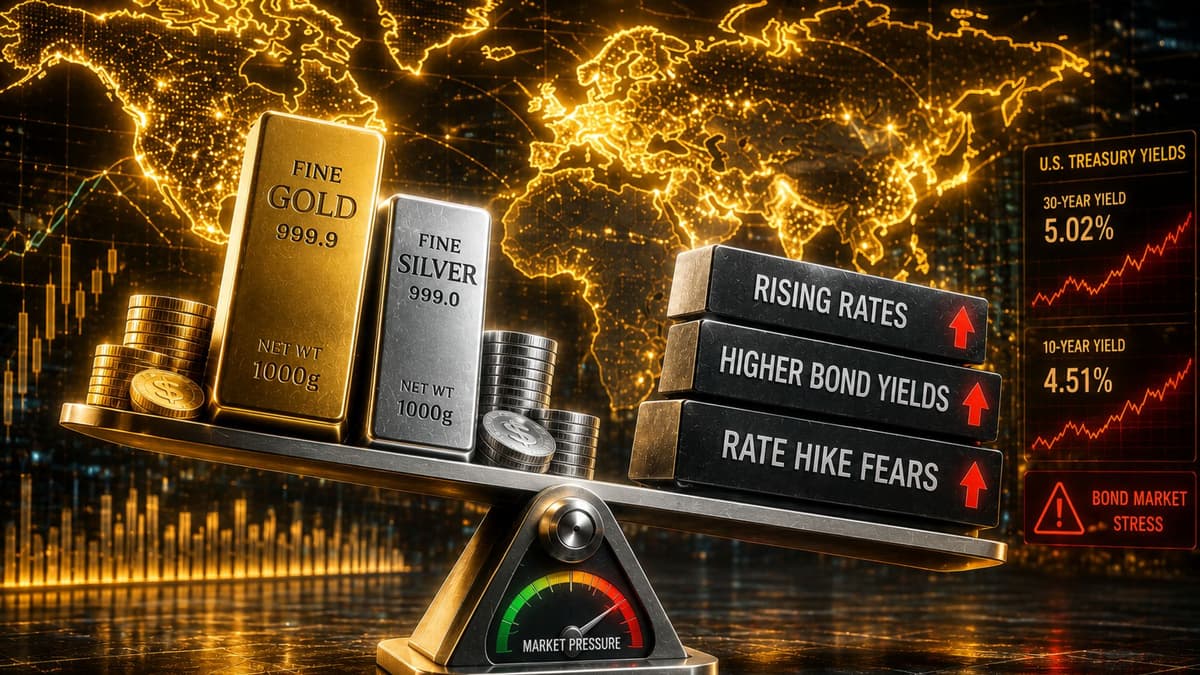
# Gold Price Rebounds Above $4,500 as Stagflation Fears Build
Gold price ended a three-week losing streak after holding key long-term support, even as oil prices and the U.S. dollar moved higher. That unusual mix is drawing fresh attention from bullion investors because it suggests safe-haven demand may be returning despite headwinds.
Spot gold last traded at $4,525.70 per troy ounce, up more than 3% on the day and 0.65% from last Friday. The rebound followed an early-week drop to $4,099, a level several analysts now see as a major support zone for XAUUSD.
For Indian investors, the move matters beyond global bullion charts. A stronger U.S. dollar can pressure the rupee and raise local landed gold costs in INR terms, while elevated crude oil prices can worsen imported inflation in India and reinforce gold’s role as a hedge.
Why did gold price rise even as oil and the U.S. dollar moved higher?
Gold price rose because buyers stepped in after bullion held critical support near $4,100, signaling that bargain hunting and safe-haven demand are returning. The rally came even though conditions were not fully supportive, with both oil prices and the U.S. dollar climbing at the same time.
Analysts said the gold market is looking to end the week slightly above initial resistance at $4,500 an ounce. That is a notable recovery after gold fell to $4,099 at the start of the week.
At the same time, May West Texas Intermediate (WTI) crude futures traded above $98 a barrel, up nearly 4% on the day. Normally, a stronger dollar can weigh on gold price, but Friday’s gain suggests investors were willing to buy bullion despite that pressure.
What does the move above $4,500 mean for XAUUSD?
The move above $4,500 suggests gold may be stabilizing after a sharp correction, but analysts are not yet calling a full trend reversal. The market still needs stronger confirmation that the recent low was durable.
Michael Brown, Senior Market Analyst at Pepperstone, said the rebound is an encouraging start. According to Michael Brown, “This suggests that we might well have put in a durable bottom, and that gold’s haven dynamics could well be starting to reassert themselves to an extent.”
For Indian bullion buyers, that means the international gold price may have found near-term footing. If the rupee weakens while XAUUSD stays firm, domestic gold rates could remain elevated even without a fresh global surge.
What support and resistance levels are analysts watching for gold price?
Analysts are watching $4,100 as the key support level and $4,500 as the first resistance area that gold is trying to reclaim. A sustained hold above higher support bands would be needed to open the way toward the next bullish target.
Michael Brown said $4,100/oz looks like a “significant turning point.” He added that he would be surprised to see gold make renewed moves below that level in the short term, with bulls likely to defend it strongly if selling resumes.
Why is $4,100 so important?
The $4,100 zone matters because gold bounced sharply after slipping below it earlier in the week. That reaction suggests buyers view the area as value territory after the heavy pullback from January highs.
Neil Welsh, Head of Metals at Britannia Global Markets, said gold is still in a wait-and-see phase despite this week’s bargain hunting. He noted that gold is down around 20% from the highs of the end of January, and said the rebound from below $4,100 is encouraging, even though several forces are still influencing price.
According to Neil Welsh, “That turn has not happened yet, but the conditions may be forming.” He added that once the circumstantial influences settle, gold may return to its “natural role as a safe-haven trade.”
What does the chart need to show next?
The chart needs to show that gold can hold a higher base before traders chase a larger rally. A one-day surge alone is not enough to confirm a durable bottom.
Aaron Hill, Chief Market Analyst at FP Markets, said this week’s sharp bounce from sub-$4,100 levels looks more like a liquidity sweep than a confirmed bottom. He said a sustainable base probably requires a retest or hold of the $4,200-$4,300 zone with stronger momentum before any convincing rally toward $4,800+ can develop.
That technical view is important for Indian investors using dips to accumulate. If global gold price can hold the $4,200-$4,300 range while macro risks stay high, local buyers may treat weakness as a medium-term entry point.
How are central bank gold sales affecting the gold market?
Central bank gold sales are creating a major risk for bullion because official-sector monetization can increase supply and reverse one of the strongest drivers behind the gold rally of the last few years. Analysts said this is one reason gold remains vulnerable even after the latest bounce.
Michael Brown warned that a prolonged war with Iran could push more central banks to monetize their official gold reserves. That risk became more concrete after updated reserve data published on Thursday showed that Turkey’s central bank monetized nearly 60 tonnes of gold in the last two weeks.
According to Michael Brown, if more central banks follow Turkey, that could put “notable downward pressure” on spot gold and reverse the dynamic that helped drive prices higher over the last two or three years.
Why do TD Securities analysts still expect weakness?
TD Securities expects further weakness because some central banks may use official reserves to fight inflation caused by rising energy costs. That would weaken the structural official-sector bid that has supported gold.
Commodity analysts at TD Securities said gold is currently trading more like a risk asset. They argued that the official-sector buying trend was deeply tied to USD diversification, which in turn depended on USD surpluses.
According to TD Securities, the war in the Middle East has inflicted significant damage on Gulf economies and also reduced surpluses in East Asia. The analysts said this has created a rupture in official-sector demand “for the time being.”
For India, this matters because official buying has been a powerful support for global gold price. If central bank demand cools while the rupee stays soft, Indian investors could see volatile domestic pricing driven by both international bullion swings and currency moves.
How is the Middle East conflict shaping gold and stagflation fears?
The Middle East conflict is lifting energy prices and reviving stagflation concerns, which could become supportive for gold if economic growth starts to weaken. Analysts said that mix of slower growth and sticky inflation is often one of the most constructive settings for bullion over time.
Analysts noted that a prolonged conflict that drives energy prices higher is stoking stagflationary fears, although they also said the risks are still relatively low. In that environment, central banks could be forced to cut interest rates even as inflation remains elevated, pushing real yields sharply lower.
Lower real yields typically support gold price because bullion does not pay interest and becomes more attractive when inflation-adjusted returns on bonds fall.
Is stagflation a real risk right now?
Stagflation is not the base case yet, but the risk could build quickly if growth data weakens while energy-led inflation stays high. Markets will be watching incoming U.S. data closely for that signal.
Aaron Hill said it is still too early to start worrying seriously about stagflation, but those fears could continue to grow next week as key manufacturing data arrives. According to Aaron Hill, “Stagflation fears are only likely to overshadow pure energy-driven inflation threats once growth data clearly softens (weaker PMIs, rising unemployment), as that classic 1970s dynamic often pressures gold short-term before it shines.”
For Indian investors, stagflation worries are especially relevant because India is a major oil importer. Higher crude prices can feed into domestic inflation, pressure the rupee, and strengthen the long-term case for gold as a store of value.
Why do some analysts still see lower gold prices as a buying opportunity?
Some analysts still see pullbacks in gold price as buying opportunities because inflation risks are rising and gold remains a hedge against falling purchasing power. Even if near-term volatility persists, the macro case for bullion has not disappeared.
Naeem Aslam, Chief Investment Officer at Zaye Capital Markets, said he cannot rule out lower gold prices in the near term, but he continues to view weakness as a chance to buy. He said the inflation threat is still growing, which supports gold as protection against eroding real incomes.
According to Naeem Aslam, retailers are already saying they are under pressure, and if the war drags on longer, prices will rise further. He said, “So inflation is actually on our doorstep, and it is knocking hard.”
That message is likely to resonate in India, where households often buy physical gold as an inflation hedge. If consumer prices remain firm and imported energy costs rise, demand for jewellery, coins, bars, and digital gold could stay resilient on declines.
What economic data could move gold price next week?
Next week’s U.S. jobs and industry data could decide whether gold extends its rebound or faces another wave of volatility. Markets will also watch comments from Federal Reserve Chair Jerome Powell for clues on growth, inflation, and interest rates.
The coming week will be shorter because of the Easter long weekend, but investors will still focus heavily on the U.S. economy. Although markets will be closed for Good Friday, it is not a U.S. government holiday, so the March nonfarm payrolls report will still be released.
Investors will then have to wait until the Asian open on Sunday to react to that payrolls data. That delayed reaction could make the start of the new trading week especially volatile for XAUUSD, silver, and broader precious metals markets.
Which events are on the calendar?
The key events next week are:
- Monday: Federal Reserve Chair Jerome Powell participates in a moderated discussion at Harvard University
- Tuesday: U.S. JOLTS job openings, U.S. Consumer Confidence
- Wednesday: ADP nonfarm payrolls, U.S. Retail Sales, ISM Manufacturing PMI
- Thursday: U.S. weekly jobless claims
- Friday: U.S. Nonfarm Payrolls
For Indian investors, the main watchpoint is clear: if U.S. growth indicators weaken while inflation signals stay hot, gold price could regain stronger safe-haven momentum. If payrolls stay firm and the U.S. dollar strengthens further, bullion may struggle near resistance even after reclaiming $4,500 per ounce.