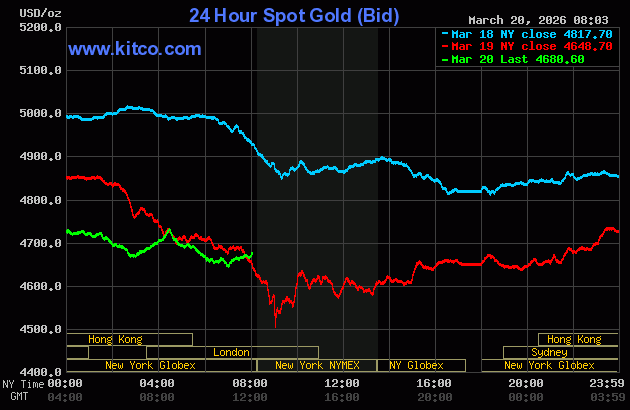
Gold and silver prices rebounded in early U.S. trading on Friday after heavy selling earlier in the week, but the broader trend still points to the worst weekly drop in gold in six years. For Indian investors, the bounce in bullion may offer short-term relief, yet elevated crude oil prices, a stronger U.S. dollar, and reduced expectations for Federal Reserve rate cuts remain key risks for XAUUSD and domestic gold rates in INR.
Why did gold and silver prices rise today?
Gold and silver rose on Friday because traders bought the dip after steep losses pushed both precious metals to six-week lows on Thursday. The move was corrective rather than a clear trend reversal.
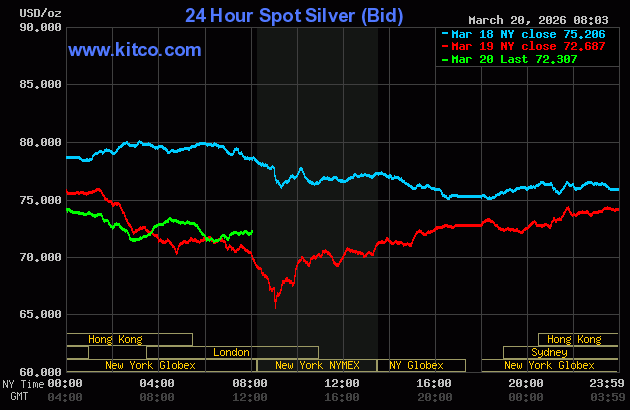
April gold was last up $54.90 at $4,660.60 in early U.S. trading. May silver was up $0.97 at $72.19.
The rebound came after a week of strong selling pressure. Even with Friday's gains, sentiment stayed fragile because investors remained worried that stubborn inflation could keep central banks on a tighter monetary path for longer.
For Indian investors, a rebound in international bullion prices can support domestic gold prices, especially if the Indian rupee weakens against the U.S. dollar at the same time. Since India imports most of its gold, any rise in XAUUSD and USD/INR can quickly feed into local bullion rates.
Why is gold heading for its biggest weekly loss in six years?
Gold is heading for its worst weekly loss in six years because the war in the Middle East has lifted energy prices and reduced expectations for central bank interest-rate cuts. Higher oil prices have increased inflation concerns, and that has hurt non-yielding assets such as gold in the short term.
Bullion has dropped every week since the U.S. and Israel attacked Iran last month. Gold was trading near $4,675 an ounce, down about 7% this week.
Despite the sharp pullback, gold remains about 8% higher this year. Some analysts also argue that a temporary decline in prices could encourage central bank buying again, which may help stabilize the market.
That matters in India because gold demand often responds to both price corrections and safe-haven sentiment. If central banks resume buying and geopolitical stress persists, Indian investors could see renewed support for both investment demand and jewellery buying once volatility cools.
How is the Iran war affecting gold, oil and wider markets?
The Iran war is affecting gold mainly through the inflation channel, not just safe-haven demand. While geopolitical shocks often support bullion, this conflict has also driven up energy risks, which in turn has pushed bond yields higher and weakened the case for rate cuts.
The latest developments from the conflict remained highly market-sensitive on Friday:
What are the latest Iran war developments?
- Iran continues Gulf strikes after Israel vowed to spare energy sites following a rebuke from U.S. President Donald Trump.
- Crude oil and gas prices declined as the U.S. and Israel sought to reassure investors.
- Global stocks are set for a third weekly loss, with no end in sight to the war.
- The European Union is bracing for a potentially years-long energy squeeze following a strike in Qatar.
- Kuwait will partially shut its Al Ahmadi refinery.
- The UAE and Saudi Arabia said they intercepted missiles overnight.
- Asian countries are turning to coal for energy as the Iran war rapidly shrinks gas supplies.
- The oil market's seaborne tanker buffer is running down fast as the Iran war drags on.
Why does this matter for precious metals?
These developments matter because they keep energy markets unstable and inflation expectations elevated. When inflation risk rises because of oil and gas disruptions, traders often expect the Federal Reserve and other central banks to keep policy tighter.
That can pressure gold and silver even during geopolitical turmoil. For Indian investors, the energy angle is especially important because higher oil prices can widen India's import bill, affect inflation, pressure the rupee, and ultimately alter domestic gold price moves.
Why are U.S. Treasury yields rising and pressuring gold?
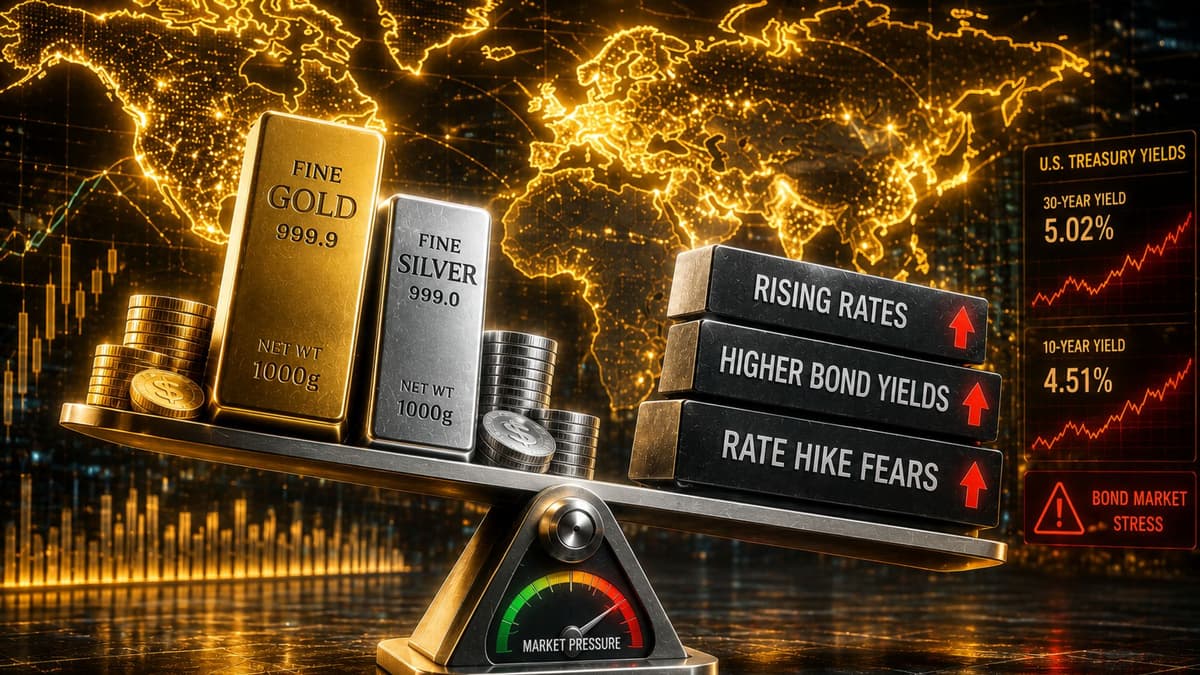
U.S. Treasury yields are rising because markets are reacting to hawkish central bank signals and elevated crude oil prices. Higher yields increase the opportunity cost of holding gold, which does not pay interest.
On Friday, the 2-year U.S. Treasury yield rose four basis points to 3.83%. The 5-year yield gained three basis points to 3.91%.
The benchmark 10-year U.S. Treasury note yield was at 4.3%. At the same time, the U.S. dollar index was higher, while Nymex crude oil traded slightly higher around $96.50 a barrel.
Markets also sharply reduced expectations for Federal Reserve easing this year. Before the start of the Iran war, swaps traders had priced in 61 basis points of Fed easing. Now they expect just three basis points.
James Reilly, senior markets economist at Capital Economics, told Bloomberg that "the inflation backdrop is growing increasingly problematic for the Fed and rate cuts are not likely anytime soon." That view helps explain why gold has struggled despite strong geopolitical uncertainty.
What did major central banks do this week?
The Federal Reserve, the European Central Bank, and the Bank of England all left interest rates unchanged this week. Policymakers said the outlook remains uncertain because of the conflict in the Middle East.
Central bank officials are also signaling that they are ready to act soon if necessary to contain inflation pressures. For gold, that means policy flexibility now cuts both ways: geopolitical fear can support safe-haven demand, but sticky inflation can delay rate cuts and limit upside.
What is happening in silver and why is China important?
Silver remains one of the most volatile precious metals this year, and China is a major reason why. Strong Chinese industrial and investment demand has kept physical buying firm even after the metal's sharp price swings.
Bloomberg reported that China's overseas silver purchases rose to an eight-year high at the start of 2026. According to Chinese customs data released on Friday, China imported more than 790 tonnes in the first two months of the year, including nearly 470 tonnes in February alone, the highest ever for that month.
Strong demand pushed local silver prices well above international benchmarks. That has reduced already-low exchange stockpiles and pulled more metal in from abroad.
Silver prices have had an exceptionally volatile start to the year. The metal surged about 70% on speculative buying from China and other markets before abruptly giving up those gains at the end of January.
The latest import data suggests physical consumption in China remained resilient despite shifts in trading flows. For Indian investors, that is important because strong Chinese demand can tighten the global silver market and influence local bullion sentiment alongside gold.
What are the key technical levels for gold prices now?
Gold futures remain technically weak in the near term, although Friday's rebound has eased some immediate pressure. The next major move in XAUUSD and futures will likely depend on whether prices can reclaim resistance or break lower support.
April gold futures technical levels
April gold futures bulls' next upside price objective is a close above solid resistance at $5,000.00. Bears' next near-term downside price objective is to push prices below solid technical support at the February low of $4,423.20.
First resistance stands at the overnight high of $4,738.20. The next resistance level is $4,800.00.

First support is seen at $4,600.00. The next support level is this week's low of $4,505.00.
Wyckoff's Market Rating for April gold futures is 4.0. That suggests bears still hold the near-term technical advantage.
How do spot and futures gold prices differ?
Gold trades through two main pricing mechanisms: the spot market and the futures market. The spot market quotes prices for immediate purchase and delivery, while the futures market sets prices for delivery at a later date.
Because of year-end positioning and market liquidity, the December gold futures contract is currently the most actively traded contract on the CME. Indian investors tracking international prices should keep this distinction in mind, since headline gold price moves can refer either to spot bullion or to futures contracts.
What are the key technical levels for silver prices now?
Silver futures also remain under technical pressure despite Friday's bounce. Traders will now watch whether May silver can clear nearby resistance or slip back toward February support.
May silver futures technical levels
May silver futures bulls see their next upside price objective as a close above solid technical resistance at $90.00. Bears' next downside price objective is a close below solid support at the February low of $64.66.
First resistance is at the overnight high of $74.62. The next resistance is $75.00.
Next support is seen at $70.00 and then at $67.50. Wyckoff's Market Rating for May silver futures is also 4.0.
For Indian investors, these levels matter because silver often shows bigger percentage swings than gold. That can create opportunity, but it also raises risk during periods of geopolitical stress and rapidly changing rate expectations.
The next major watchpoint for bullion is whether oil stays near $96.50 a barrel, whether U.S. Treasury yields extend higher, and whether central banks push back even further against rate-cut hopes. If yields keep rising and the dollar stays firm, gold and silver could struggle to sustain Friday's rebound even as safe-haven demand remains active.