Why does WisdomTree still favour gold over other alternative assets?
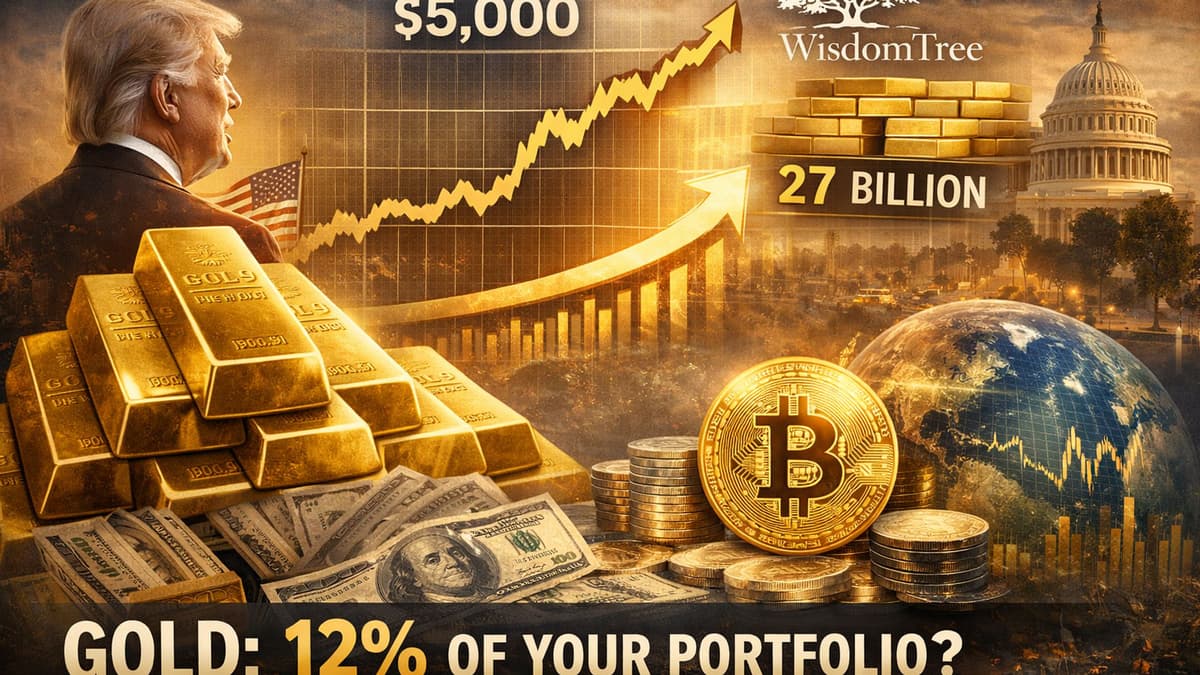
Gold remains WisdomTree’s preferred alternative asset because Jonathan Steinberg sees it as an alternative store of value with multiple demand drivers still in place. He said gold performs well during inflationary periods, helps offset global political crises, and benefits from central bank efforts to reduce U.S. dollar exposure.In an interview with Barron’s, Steinberg said WisdomTree favors gold over other alternatives even after bullion surged above $5,000 per troy ounce. He made the case as founder and CEO of WisdomTree, which he described as the fourth-largest manager of gold in the world with around $27 billion tied to the asset.
How does Steinberg define gold’s role in a portfolio?
Steinberg called gold an “alternative store of value.” That framing matters because it places gold alongside assets investors use to protect purchasing power, diversify risk, and hedge against geopolitical shocks.He said gold often does better in inflationary moments. He also said gold works as an offset when global political crises intensify, reinforcing its safe-haven appeal for investors tracking XAUUSD, bullion funds, and physical precious metals.
Why does WisdomTree think gold’s long-term case is intact?
Steinberg said the underlying case for gold has not weakened. He argued that the features that made gold a store of value for centuries are still present and continue to support a bullish outlook.He said, “I think the underpinnings for gold, which has been a store of value for centuries, isn't going anywhere.” He added that those characteristics remain “very interesting,” which is why WisdomTree stays constructive on gold price trends.
What is driving gold prices above $5,000 per ounce?
Steinberg said central bank buying has been the main force behind gold’s rise above $5,000 per ounce. He argued that reserve managers worldwide want to diversify away from dollar exposure, especially after sanctions on Russia highlighted the vulnerability of foreign reserves held inside the Western financial system.He told Barron’s that this theme has driven gold for the last few years. In his view, the buying is structural, not temporary, which helps explain why bullion has traded strongly even as other risk assets have become more volatile.
Why are central banks buying more gold?
Central banks are buying more gold because they want reserve diversification and insulation from geopolitical financial risks. Steinberg said they watched what happened after Russia invaded Ukraine and saw how quickly a country could be cut off from the financial system.That experience, he argued, pushed more reserve managers to reduce reliance on U.S. dollar assets. For the gold market, that matters because official-sector demand can anchor prices and tighten available supply in the global bullion market.
What did Steinberg mean by a “Trump world” for gold?
Steinberg said that in a “Trump world,” central banks have no desire to stop buying gold. His argument is that political uncertainty, trade friction, and a less predictable global order can keep safe-haven demand elevated.He said central banks are “really buying gold” and are buying more than retail investors globally. He summed up the market logic in simple terms: more buying than selling pushes gold prices higher, which helps explain why gold has been “trading incredibly well.”
How does Bitcoin affect the gold price outlook?
Steinberg sees Bitcoin and gold as related portfolio assets because both serve as alternative stores of value. He said Bitcoin may have done a better job of selling its role in portfolios, but he believes the two assets ultimately play very similar roles.That comparison matters because investors often debate gold versus Bitcoin when building hedges against currency debasement, inflation, and financial-system risk. Steinberg’s view is that the relationship is not either-or; instead, strength in one can validate the investment case for the other.
Why does Steinberg link Bitcoin and gold?
Steinberg said there is a relationship between gold and silver, and there is also a relationship between gold and Bitcoin. He argued that Bitcoin cannot rise to $500,000 a coin without gold also moving higher.That statement suggests he sees both assets responding to the same broad forces: demand for scarce stores of value, distrust of fiat systems, and the search for alternatives to traditional financial assets. For gold investors, the point is that Bitcoin adoption does not necessarily weaken bullion demand.
What has happened over the last 15 years?
Steinberg said that for the last 15 years, investor attention centered far more on Bitcoin than on gold. He added that while Bitcoin has been down lately, gold has been soaring.His conclusion was that gold has now “caught up.” In practical terms, that implies gold has reasserted itself in the alternative-assets conversation after years in which digital assets dominated investor mindshare.
How much gold should investors hold in a portfolio?
Steinberg said gold would account for about 12% of a portfolio when investors use global market-cap weighting. He based that view on a framework linked to Vanguard founder Jack Bogle’s approach of owning the world of liquid assets in proportion to their total market capitalization.This is one of the clearest portfolio-allocation numbers in the interview. Rather than treating gold as a small tactical hedge, Steinberg presented gold as a meaningful strategic holding within a diversified asset mix.
How does Jack Bogle’s market-cap framework apply to gold?
Steinberg said investors can think about asset allocation by comparing each asset’s share of the world’s liquid market value. Under that approach, gold’s place in a portfolio is not arbitrary.He said, “If you go back to Jack Bogle, the founder of Vanguard, and his approach to investing: own the world of liquid assets proportionally to their market cap. Under that scenario, gold would be about 12% of your portfolio.”
Why is that 12% figure important?
The 12% figure is important because Steinberg believes gold is still drastically underowned. If investors currently hold less than that level, his argument implies they may be underexposed to a major store-of-value asset at a time when central banks are steadily accumulating bullion.For wealth managers and self-directed investors, the number also reframes gold from a niche hedge into a core allocation. That could matter for flows into gold ETFs, physical bullion, and related precious-metals products.
What does this gold outlook mean for Indian investors?
For Indian investors, Steinberg’s bullish gold price view supports the case for keeping strategic exposure to bullion, especially when global uncertainty and central bank buying remain strong. If international gold prices stay elevated above $5,000 per ounce, domestic gold rates in India can remain firm, particularly if the rupee weakens against the U.S. dollar.India is one of the world’s largest gold-consuming markets, so global price trends quickly feed into local jewellery prices, coins, bars, and sovereign accumulation decisions. A stronger XAUUSD trend usually supports higher landed bullion costs in India.
How should Indian investors read the central bank buying trend?
Indian investors should read central bank buying as a long-term support factor for gold. When official-sector demand stays strong, it can reduce downside pressure and reinforce gold’s role as a portfolio diversifier during periods of inflation, currency volatility, or geopolitical tension.That matters in India because gold often serves both as an investment and a savings asset. Families, high-net-worth investors, and ETF buyers may all see continued value in gold when reserve managers worldwide are still adding to holdings.
Does the Bitcoin comparison change the case for Indian gold buyers?
The Bitcoin comparison does not weaken the case for gold; Steinberg argued the opposite. He said Bitcoin and gold serve similar portfolio roles, and he suggested a major long-term rise in Bitcoin toward $500,000 would likely come with higher gold prices as well.For Indian investors, that means gold does not have to lose relevance as digital assets grow. Instead, gold can remain the more established safe-haven allocation within a broader portfolio that may also include equities, debt, and selective exposure to other alternatives.
The key watchpoint now is whether central banks continue buying at the same pace that helped lift gold above $5,000 per ounce. If that demand stays intact and global political risk remains elevated, the gold price outlook is likely to stay constructive for both international and Indian bullion markets.