# Gold Price Outlook: Why JP Morgan Says Gold Is an Asset, Not a Hedge
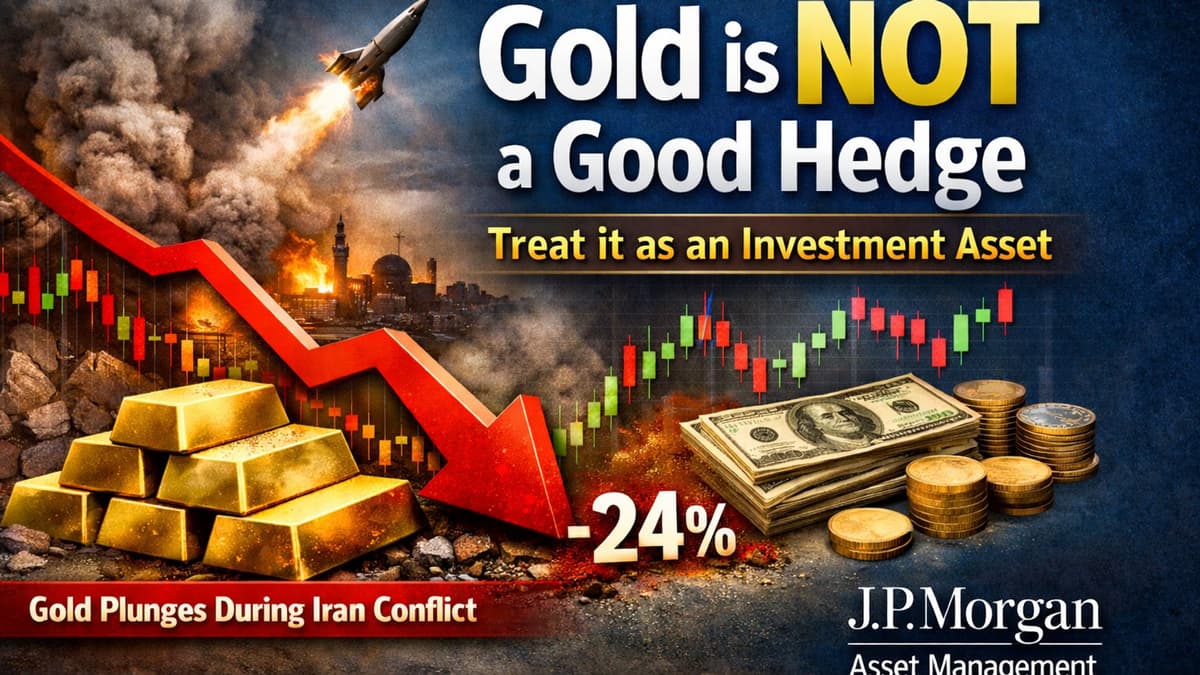
Gold should be treated as an investment asset rather than a reliable hedge against geopolitical shocks, according to Tai Hui, chief market strategist for Asia Pacific at J.P. Morgan Asset Management. His view comes after gold fell sharply during the Iran conflict, challenging the widely held belief that bullion always protects portfolios in times of crisis.
For Indian investors, that distinction matters. Gold remains deeply embedded in savings, jewellery demand, and portfolio allocation in India, but Hui’s message is that gold price moves can be volatile and should not be assumed to offset every market drawdown or geopolitical event.
Why does JP Morgan say gold is not a reliable hedge?
J.P. Morgan’s Tai Hui says gold is not a consistently dependable hedge because its correlation with equities and other risk assets is unstable. In his view, investors should stop assuming gold will automatically rise during geopolitical or market stress.
Speaking during a media briefing on Thursday, Hui said, “gold did not work as a hedge against geopolitics.” He added, “We’ve been arguing for quite some time that gold is not a very good hedge against anything.”
Hui said the problem is consistency. If investors buy gold as portfolio insurance, they need it to respond predictably when risk assets fall. According to Hui, gold has not delivered that dependability over time.
He said, “If you look at its correlation with equities or risk assets, it’s not very consistent.” That makes gold less effective as a pure risk-management tool than many investors believe.
What happened to gold prices during the Iran war?
Gold prices sold off sharply during the 20 days after the attacks on Iran began, undermining gold’s reputation as a safe-haven asset in that episode. The metal dropped from a high of $5,415 per ounce to a low of $4,100 per ounce, a 24% peak-to-trough decline.
That is a dramatic move for bullion. Although gold recovered from the lows, Hui said prices still struggled to build momentum even as the conflict continued.
The market reaction is central to J.P. Morgan’s argument. Many investors expected XAUUSD to strengthen as geopolitical risk rose, but the actual price action showed that safe-haven demand was not strong enough to prevent a deep correction.
For Indian investors, such volatility is important because global gold price moves feed directly into domestic bullion rates, alongside the USD/INR exchange rate, import duties, and local premiums. A sharp fall in international gold prices can ease rupee-denominated rates, but a weaker rupee can offset part of that benefit.
How strong is gold’s track record during geopolitical events?
Tai Hui says gold’s long-term record during geopolitical events is weak rather than compelling. He argued that over the past 30 years, gold has not shown a clear tendency to rise when geopolitical shocks hit.
Hui said many investors still treat gold as a hedge against geopolitical events, but the evidence does not strongly support that belief. He said the success rate is close to random.
“We’re not even talking about 70% of [geopolitical] events get an upside,” Hui said. “It’s like 50/50. It’s a coin toss.”
That comment matters because it reframes how investors should think about precious metals. A 50/50 outcome is not the profile of a reliable hedge. It is the profile of an asset that may perform well in some crises and poorly in others.
What are the main risks of owning gold as a hedge?
The biggest risks are gold’s volatility, its lack of income, and the cost of carry. Hui said these drawbacks make gold less attractive if the primary goal is to protect a portfolio from corrections or volatility in other asset classes.
How volatile is gold compared with other assets?
Hui said gold’s volatility is as high as emerging market equities. That is a striking comparison because investors often view gold as a stable defensive asset.
If gold behaves with equity-like volatility, it can produce large drawdowns even while retaining a long-term bullish case. That makes position sizing especially important for Indian investors using gold ETFs, sovereign gold bonds, digital gold, or physical bullion.
Why does gold’s lack of income matter?
Gold does not generate income, which raises the opportunity cost of holding it. Hui said that while investors may have ignored this issue over the past two years, the carry cost still matters.
He said, “It does not generate income. Obviously, in the last two years, if you owned gold, you didn’t care about income, but the cost of carry is something to think about.”
This point becomes more important when bond yields are elevated or when investors can earn better returns from interest-bearing assets. For Indian households, that comparison often includes fixed deposits, debt funds, and other yield-generating instruments.
Can gold protect against market corrections?
Hui’s answer is no, not reliably. He said gold can make sense as a return-enhancing asset if investors believe in the long-term drivers behind the rally, but not as a dependable shield during equity selloffs.
“If you’re owning it to enhance your return because of the fundamentals of central bank buying and the so-called debasement trade, that makes sense, but if you’re owning it in the belief that it can help you to offset market corrections, it’s not a particularly reliable tool,” Hui said.
Why does JP Morgan still like gold as an investment asset?
J.P. Morgan still sees a strong long-term investment case for gold because central bank buying, limited supply growth, and fears of currency debasement continue to support the bullion market. Hui said investors simply need to be clear about what role gold plays in a portfolio.
“As the supply of gold growth is limited, so there’s an investment case for gold, but we have to be super clear that gold is an investment asset, not a hedge asset,” he said.
He added, “Gold, to us, is still an interesting asset to be included in asset allocation, but we just need to understand that in terms of the role it plays, it’s more of a return enhancement rather than a risk management tool.”
That distinction is useful for Indian investors building long-term portfolios. Gold can still serve as a strategic allocation, especially in periods of currency concerns, inflation anxiety, and sovereign debt expansion, but expectations should be realistic.
What long-term drivers does JP Morgan see behind the gold rally?
J.P. Morgan says the long-term drivers of the gold rally remain intact, even if prices face temporary pullbacks. The bank has repeatedly argued that structural demand and macro concerns continue to support higher gold prices.
On Feb. 17, J.P. Morgan’s senior investment team said there is a reasonable case against gold’s continued appreciation, but that bearish case is wrong. Kriti Gupta, Executive Director of J.P. Morgan Private Bank, and Justin Biemann, Global Investment Strategist, wrote that gold has surged more than 170% over the last five years.
“Gold has had a ferocious rally over the last five years, skyrocketing over 170%,” Gupta and Biemann wrote. They said one of the biggest drivers may be “a new era of geopolitical volatility and fragmentation,” which has encouraged investors to buy the precious metal.
They also highlighted broader macro support. “Now add on worries about currency debasement, growth, inflation and irresponsible fiscal finances that haven’t been fully reflected in sovereign assets,” they wrote. “It’s no wonder the precious metal has been a popular asset for investors during times of stress.”
For India, these themes matter because domestic investors often buy gold not just for price gains, but also as a defence against rupee weakness, inflation, and global uncertainty. When the U.S. dollar weakens and macro fears increase, gold priced in rupees can still react differently depending on the INR exchange rate.
What could derail the gold rally from here?
J.P. Morgan identified two major risks: a slowdown or reversal in central bank buying, and weaker demand from retail investors. Both risks could hit the gold price if the current drivers lose momentum.
Could central banks stop buying gold?
Yes, and J.P. Morgan says that would be a major risk because central banks have been one of the biggest drivers of gold demand. Gupta and Biemann wrote, “The biggest driver of gold prices has been central banks.”
They said net purchases of gold have doubled since Russia’s war on Ukraine began in 2022. Central banks increased buying as they sought to diversify reserves away from the U.S. dollar after the United States froze Russian assets.
The authors asked a critical question: “What if that structural demand from global central banks waned? Or worse, what if they wanted to outright sell the commodity?”
They noted that a similar episode happened before. From 1999 to 2002, the United Kingdom sold more than 50% of its gold holdings through public auctions and shifted reserves into foreign currencies. Around the same period, Switzerland voted to delink the Swiss franc from gold.
Gold prices fell 13% in the three months after the United Kingdom’s announcement. J.P. Morgan said that would be equivalent to about a $650 drop in today’s terms.
The selling wave only eased after several central banks signed The Washington Agreement on Gold to coordinate and cap large sales that could move prices. That agreement lapsed in 2019, by which time central banks had largely become buyers rather than sellers.
For Indian investors, central bank demand is a major global signal. If official-sector buying remains strong, it supports the structural bull case for bullion. If that demand softens, global gold price momentum could weaken even if domestic jewellery and festival demand stays healthy.
Could retail investors also pull back?
Yes. J.P. Morgan said retail demand is another risk because many newer buyers entered gold as a hedge against geopolitical and macro uncertainty.
“Don’t forget retail investors,” Gupta and Biemann warned. “They’ve also been flocking to gold. These new buyers are often building a position as a hedge against rising geopolitical risks and macro uncertainty.”
If those investors lose confidence in gold’s defensive role, inflows could slow. That would matter for exchange-traded products, bars, coins, and other retail channels globally, including India’s large physical gold market.
Does JP Morgan see reasons for retail investors to keep owning gold?
Yes, J.P. Morgan still says retail investors have valid reasons to hold or even add gold. The bank argues that gold can still play a long-term diversification role despite its weaker record as a short-term geopolitical hedge.
“In addition to hedging against short-term geopolitical risks, gold is a long-term diversifier,” Gupta and Biemann wrote. “It’s an asset that can protect against inflation, outperform during drawdowns and reduce overall portfolio volatility, given its relatively low correlation to other assets.”
This is a more nuanced case than Hui’s remarks may first suggest. J.P. Morgan is not bearish on gold. Instead, it is refining the message: gold can be valuable in asset allocation, but investors should not expect it to behave like perfect portfolio insurance in every crisis.
For Indian savers, that means gold may still deserve a strategic allocation through physical bullion, ETFs, or sovereign products, but it should sit alongside equities, fixed income, and cash rather than replace them.
What is JP Morgan’s gold outlook for 2026?
J.P. Morgan Global Research said in December that fresh demand from Chinese insurance companies and the crypto community could push gold prices higher in 2026. That outlook reinforces the bank’s broader bullish stance on the long-term gold price trend.
Natasha Kaneva, head of Global Commodities Strategy at J.P. Morgan, said, “While this rally in gold has not, and will not, be linear, we believe the trends driving this rebasing higher in gold prices are not exhausted.”
She added, “The long-term trend of official reserve and investor diversification into gold has further to run.”
The source article also notes that a weaker U.S. dollar and lower U.S. inte—suggesting lower U.S. interest rates or easing rate pressure—remain part of the broader supportive backdrop, though the final sentence provided was incomplete.
For Indian investors, the next watchpoints are clear: official central bank buying, retail demand, the U.S. dollar, U.S. rates, and rupee moves against the dollar. If structural demand remains firm, pullbacks in XAUUSD may still be viewed as buying opportunities, but the latest Iran-war price action is a reminder that gold price volatility can be sharper than many safe-haven buyers expect.