HSBC says the gold price outlook remains bullish over the medium to long term even after a sharp pullback, because gold still improves portfolio diversification and continues to attract safe-haven demand, central bank buying, and support from the global de-dollarisation trend.
Commodity strategists Willem Sels and Lucia Ku at HSBC reiterated a constructive six-month view on bullion and said the bank is maintaining its Overweight position on gold. For Indian investors, that matters because global gold moves, the U.S. dollar, and safe-haven flows often feed directly into domestic bullion prices in rupees.
Why is HSBC still bullish on gold over the next six months?
HSBC is still bullish because it believes gold remains a stronger portfolio diversifier as correlations across major asset classes rise. Sels and Ku said the bank continues to see supportive long-term fundamentals even after the recent sell-off.
They wrote that inflation concerns have increased rate volatility and triggered a repricing of monetary policy expectations. In their view, policymakers are likely to keep current interest rates unchanged for some time before easing later.
HSBC added that it continues to seek quality yields from investment-grade credit and emerging-market local currency bonds for income generation. At the same time, the bank uses gold and alternative assets to improve diversification because cross-asset correlations have increased.
What exactly did HSBC say about gold?
HSBC said the recent pullback has not changed its medium- to long-term stance. Sels and Ku wrote, "Despite the recent pullback, we remain bullish on gold over the medium to long term due to its diversification benefits and safe-haven demand."
They also said the recent headwinds should prove short-lived because the underlying fundamentals remain supportive. According to the analysts, gold continues to serve as a compelling diversifier amid geopolitical uncertainty and central bank buying.
For Indian investors, this argument is important because gold often acts as a hedge when equity, bond, and currency markets become more correlated. If the rupee weakens against the U.S. dollar while global bullion stays firm, domestic gold prices can remain supported even when international XAUUSD is volatile.
What drove gold prices lower despite geopolitical tensions?
Gold fell because the stronger U.S. dollar, a hawkish repricing of interest-rate expectations, and liquidation by leveraged buyers outweighed the usual safe-haven response. HSBC said the market move since the Iran conflict broke out has defied the conventional playbook.
On March 30, analysts at HSBC Asset Management said gold has behaved more like a risk asset in 2026, selling off sharply despite heightened geopolitical tensions. They said the usual assumption was that rising geopolitical risk and economic uncertainty would push the gold price higher, much like last year's "Liberation Day" episode that helped sustain a spectacular two-year rally.
Instead, gold moved in the opposite direction. HSBC noted that the yellow metal was down 15% month to date in March.
Why did the usual safe-haven reaction fail?
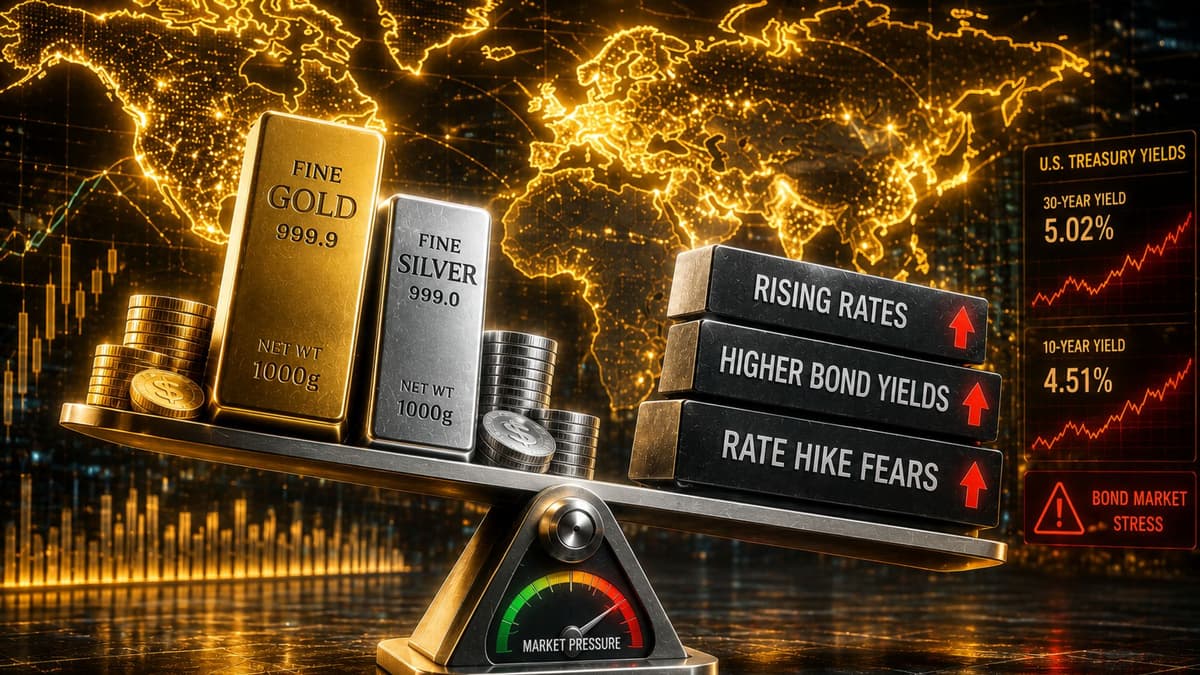
HSBC said a stronger U.S. dollar discouraged non-U.S. buyers, while higher expected interest rates increased the opportunity cost of holding a non-yielding asset such as bullion. That combination created a major headwind for gold prices.
The analysts also pointed out an important historical contrast. Gold managed to withstand a similar rise in the dollar and interest rates in 2022, which weakens the traditional argument that higher rates and a stronger dollar must automatically push gold lower.
For Indian buyers, this matters because the U.S. dollar has a double effect. A stronger dollar can pressure international gold price action, but it can also lift domestic gold rates if the Indian rupee weakens enough against the dollar.
How do cross-asset correlations make gold more valuable in a portfolio?
Gold becomes more valuable when stocks, bonds, and other assets start moving together because diversification becomes harder to achieve elsewhere. HSBC said that is exactly why it continues to favor gold alongside alternative assets.
Sels and Ku argued that rising cross-asset correlations have made gold more useful, not less, even though recent price action looks disappointing. In other words, gold's portfolio role extends beyond short-term price momentum.
Why is diversification so important now?
HSBC said investors are dealing with inflation uncertainty, shifting expectations for Federal Reserve policy, and unstable rate markets. When multiple asset classes react to the same macro shock, portfolios need holdings that can still provide protection or behave differently over time.
That is where gold, alternative assets, and selective fixed-income exposure come in. HSBC specifically highlighted investment-grade credit and EM local currency bonds for income, while retaining gold for diversification and safe-haven purposes.
For Indian households and investors, this framework is familiar. Many Indian portfolios already hold physical gold, gold ETFs, or sovereign gold bonds as a strategic hedge against inflation, currency volatility, and geopolitical shocks.
Why does HSBC say gold is behaving like a risk asset in 2026?
HSBC says gold is behaving like a risk asset because market ownership has shifted toward retail and leveraged buyers, who often sell during stress instead of buying more. That ownership change can make bullion more volatile in the short term.
According to HSBC Asset Management, gold ownership has increasingly moved toward retail investors and other leveraged participants. In periods of market stress, these investors may face margin calls or risk limits, forcing them to liquidate gold holdings for cash.
That dynamic can make gold trade more like equities or other risk-sensitive assets during sudden market shocks. HSBC said the recent volatility is a reminder that strong diversification requires a broad-based approach, not reliance on a single safe-haven asset.
Does de-dollarisation still support the long-term gold case?
Yes, HSBC said the long-term case remains intact partly because of ongoing global de-dollarisation. Even though short-term positioning and volatility have distorted price behavior, the bank still sees a decent long-term investment case for gold.
This point is especially relevant for Indian investors tracking reserve diversification and central bank demand. Persistent official-sector buying can support bullion over time, even when speculative flows temporarily drive the market lower.
What did James Steel say about yields, real rates, and gold volatility?
James Steel, Chief Precious Metals Analyst at HSBC, said volatility will define the precious metals market in 2026, and he argued that gold is no longer reacting to real rates the way it once did. He made the comments in an interview with CNBC on Feb. 15.
Steel was asked why gold did not seem to respond to the drop in the U.S. 10-year Treasury yield, which had fallen from 4.30% to 4.00% in just a few days. He replied that the old relationship between gold and real rates largely broke down after 2022.
Has gold's inverse correlation with real rates weakened?
Yes, according to Steel, the inverse correlation has weakened sharply. He said that before 2022, the real rate on the 10-year Treasury yield - the 10-year yield minus inflation - had shown a strong inverse relationship with gold going back to the end of Bretton Woods.
Steel said that relationship has now broken down. He attributed the shift to stronger retail buying, elevated geopolitical risks, and sustained central bank buying.
He added that the relationship could return in the future, but said clearly that it is not as strong as it used to be. That is an important signal for investors who still rely on older rate-driven gold models.
What did Steel say about real highs in gold?
Steel said he prefers to judge gold in real, inflation-adjusted terms rather than simply looking at nominal record highs. He estimated that, in today's money, gold needed to reach around $3,400 per troy ounce to exceed prior real highs.
He said gold broke above that level in April, which means bullion has already made a series of new highs in real terms. In his view, the fact that gold has not surged again immediately does not undermine the broader bull market.
Steel also noted that the market attracted a lot of new money and experienced a parabolic rally in January. He said that kind of move naturally invites volatility, and repeated that volatility will be the defining word for gold in 2026.
He stressed a final point that matters for both global and Indian investors: just because gold is a safe-haven and a quality asset does not mean it cannot be volatile.
What does HSBC's gold outlook mean for Indian investors now?
For Indian investors, HSBC's message is that short-term gold volatility does not necessarily damage the long-term investment case. The bank still sees gold as a strategic diversifier even after a 15% decline in March 2026 and amid unusual price behavior.
Indian investors should watch three variables closely: the U.S. dollar, Federal Reserve policy expectations, and continued central bank buying. These drivers can shape both international XAUUSD prices and domestic bullion rates in rupees.
How could this affect gold prices in India?
If the U.S. dollar stays strong, international gold may remain under pressure in dollar terms. But if the rupee weakens at the same time, Indian gold prices may stay relatively firm or fall less sharply than global prices.
That is why Indian buyers should not track only COMEX or spot gold in dollars per troy ounce. They should also monitor rupee movement, import-cost trends, and whether global safe-haven demand returns as volatility persists.
HSBC's stance suggests that the next major watchpoint is whether gold can regain its traditional safe-haven behavior if rate expectations ease later and the dollar loses momentum. If that happens while central bank buying and de-dollarisation remain in place, the longer-term bullish case for gold could strengthen again for Indian portfolios.