# Gold Price Outlook: Why Bullion Is Stuck Before the Fed
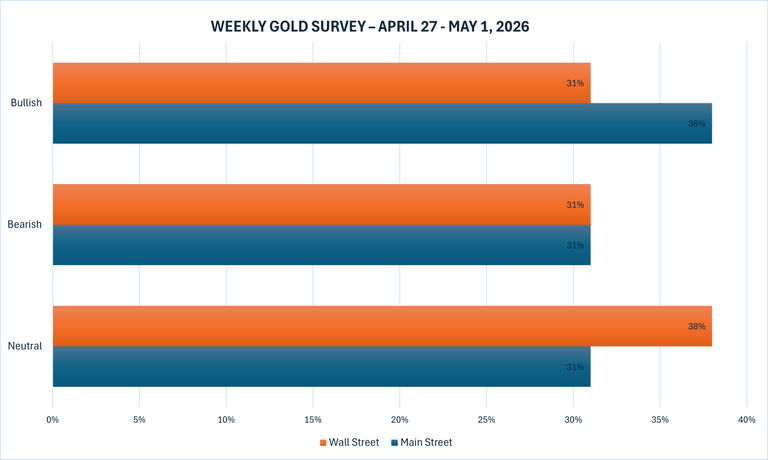
Gold prices ended a volatile week lower as traders turned cautious ahead of the next Federal Open Market Committee meeting and ongoing developments in the U.S.-Iran conflict. The latest Kitco News Weekly Gold Survey showed Wall Street and Main Street split almost evenly on gold’s near-term direction after bullion snapped a four-week winning streak.
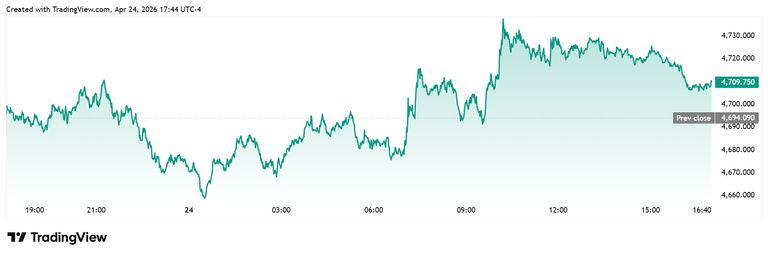
Spot gold started the week at $4,790.17 per ounce, briefly tested support near $4,750, then surged to the weekly high of $4,830 per ounce shortly after 6:30 p.m. EDT on Monday. Heavy selling then hit the market, and on Tuesday gold fell more than 2% to the weekly low near $4,672 per ounce about half an hour before the North American equity close. By the end of the week, spot gold had recovered somewhat and settled just above $4,700 per ounce, but still logged its biggest weekly drop in more than a month.
For Indian investors, this range-bound but volatile gold price action matters because global XAUUSD moves directly influence domestic bullion rates, alongside the rupee-dollar exchange rate and import costs. If the U.S. dollar stays strong and U.S. yields remain elevated, Indian gold prices in INR may stay firm even when international prices struggle to break higher.
Why did gold prices swing sharply this week?
Gold prices swung because traders reacted to a stronger U.S. dollar, rising bond yields, sticky inflation expectations, and fast-changing geopolitical headlines. Those forces pulled bullion in opposite directions throughout the week.
Analysts said the sharp Tuesday selloff reflected growing expectations that persistent inflation could keep interest rates higher for longer. That reduced the appeal of non-yielding bullion, even as geopolitical tension in the Middle East remained elevated.
Renewed disruptions to shipping through the Strait of Hormuz pushed oil prices sharply higher. That increase reinforced inflation fears and forced traders to reassess the outlook for Federal Reserve policy, adding pressure to gold rather than boosting safe-haven demand in a straightforward way.
By midweek, gold stabilized as markets absorbed shifting headlines around a fragile ceasefire and negotiations linked to the U.S.-Iran conflict. Dip buyers also emerged near the key support zone of $4,650-$4,700 per ounce, helping XAUUSD recover from the weekly low.
What supported gold prices on Friday?
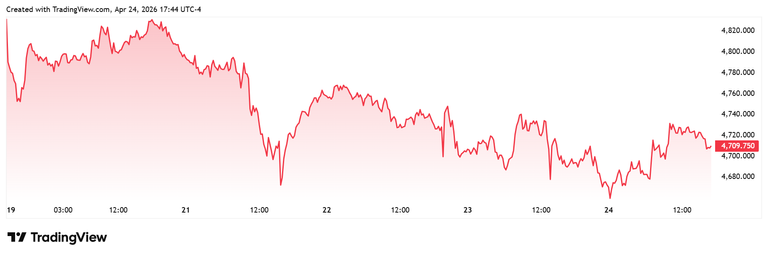
Gold rebounded modestly on Friday because weak U.S. consumer sentiment and rising inflation expectations revived demand for gold as an inflation hedge. That helped bullion climb back toward $4,740 per ounce during the session.
The support came after the final print of the University of Michigan’s consumer sentiment index confirmed the preliminary trend of sharply higher one-year inflation expectations and weaker sentiment. That combination highlighted persistent price pressures in the U.S. economy.
Even so, the rebound remained limited. Elevated oil prices and unresolved geopolitical uncertainty kept traders focused on the risk that interest rates could stay high for longer, which capped upside in precious metals.
What are Wall Street analysts saying about gold next week?
Wall Street analysts are split on gold’s near-term direction, with some expecting more weakness, others calling for consolidation, and a few staying outright bullish. The divide reflects uncertainty around the next FOMC decision and geopolitical headlines.
Why does Rich Checkan expect gold to fall?
Rich Checkan, president and COO of Asset Strategies International, said he expects gold to move down next week. He argued that recent price behavior has defied traditional safe-haven logic.
Checkan said escalating tensions between the U.S. and Iran have coincided with lower gold prices, while easing tensions have supported gold, which he described as the opposite of what many investors would expect. He also said the market narrative around the Fed is hurting sentiment.
“Everyone expects rates to remain unchanged. The narrative is that gold will suffer if interest rates are not lowered. And investors have bought that silly narrative hook, line, and sinker,” Checkan said.
He added that inflation is running near 3% officially, while interest rates are at 3.5%, leaving only a 0.5 percentage point real return. In his view, that is not enough to stop investors from buying gold, though he still expects bullion to decline next week.
Why does Adrian Day see gold moving sideways?
Adrian Day, president of Adrian Day Asset Management, said gold is likely to remain unchanged in the near term. He expects more back-and-forth trading while the Iran situation remains unresolved.
Day said the market has probably already seen the post-conflict lows. However, he does not expect new highs until the conflict ends and investors refocus on monetary and fiscal concerns.
Why is Darin Newsom still bullish on gold?
Darin Newsom, senior market analyst at Barchart.com, said gold could move up even though it remains in a short-term downtrend on the daily chart. He said the broader fundamental backdrop remains constructive.
Newsom pointed to continued central bank buying of gold around the world. He also said that if fund selling eases next week, the futures market could rally through what he called a Vacuum Trade until sellers reappear near the 50-day moving average.
“For the record, the June futures contract hasn’t been above this technical indicator since March 18,” Newsom added.
What is Mark Leibovit’s gold call?
Mark Leibovit, publisher of the VR Metals/Resource Letter, remains firmly bullish. His view was blunt: “BULL, BULL, BULL. Surprise to the upside coming.”
How are trading volumes and open interest shaping gold’s outlook?
Trading volumes and open interest suggest many market participants are waiting on the sidelines. That is one reason gold has become range-bound despite sharp intraday moves.
Kevin Grady, president of Phoenix Futures and Options, said the market is in a waiting pattern. In his view, traders do not know how long the current geopolitical situation will last, so they are reluctant to take large positions.
Grady said open interest in gold has dropped dramatically and remains low. He also noted that the CME lowered interest rates the night before, with the change effective at that day’s close, which he linked to light volatility and weak volumes.
According to Grady, the move was formula-driven rather than discretionary. He said volatility has been very light and volumes have been anemic, reinforcing the view that traders, banks, and institutions are in risk-off mode and waiting for clearer direction.
Why are equities competing with gold for investor flows?
Equities are attracting more risk appetite than precious metals because earnings season has been strong and investors see better near-term upside in stocks if geopolitical tension eases. That shift has limited demand for bullion.
Grady said earnings have been very good and that investors are increasingly looking ahead to a post-Iran resolution environment where markets refocus on corporate fundamentals. In that setup, equities appear more attractive than metals.
He said investors looked at improving conditions and started buying stocks, while metals lagged. He also stressed that the market remains highly headline-driven, making many institutions unwilling to trade more than necessary.
“The problem is that everything is news-driven right now,” Grady said. “You never know when something's going to come out.”
For Indian investors, that means domestic gold prices could remain volatile even without a clear trend in international bullion. A stronger dollar, firm crude oil prices, and any weakness in the Indian rupee could keep local gold rates supported, while a dovish Federal Reserve or a sharp escalation in geopolitical risk could quickly revive safe-haven buying.
The key watchpoint now is the next Federal Open Market Committee meeting. If the Federal Reserve keeps rates unchanged but signals that inflation risks remain high, gold may stay trapped in a broad range near $4,650-$4,830 per ounce. If fund selling fades and geopolitical risks intensify again, bullion could regain momentum, with Indian buyers closely watching both XAUUSD and USD/INR for the next breakout signal.