# Gold Price Outlook Weakens as Rising Real Yields Hit Bullion
Gold prices weakened sharply this week as rising U.S. real yields reduced the appeal of non-yielding assets such as bullion. For Indian investors, the selloff in XAUUSD matters because global gold price moves often feed directly into domestic rates, although INR moves can cushion or amplify the impact.
Why did gold prices fall this week?
Gold prices fell because investors rapidly repriced the U.S. interest-rate outlook and pushed real yields higher. That shift hit precious metals just as bullish momentum had already started to fade.
Gold ended the week down nearly 4%, while silver tumbled roughly 13% from recent highs. The decline marked a significant blow to the precious metals complex and showed that the sector remains under pressure.
The volatility looked severe, but the broader price action was not entirely unexpected. Precious metals have been trading in an increasingly hostile macroeconomic environment, with persistent inflation concerns reshaping expectations for U.S. monetary policy.
What is driving real yields higher and why does it matter for gold?
Real yields are rising because markets now expect the Federal Reserve to keep policy tighter for longer. That matters because higher real interest rates increase the opportunity cost of holding gold, which does not pay interest.
Instead of confidently pricing in rate cuts, investors are increasingly factoring in the risk of additional tightening or, at minimum, a prolonged period of elevated rates. That repricing has become one of the biggest headwinds for gold price momentum.
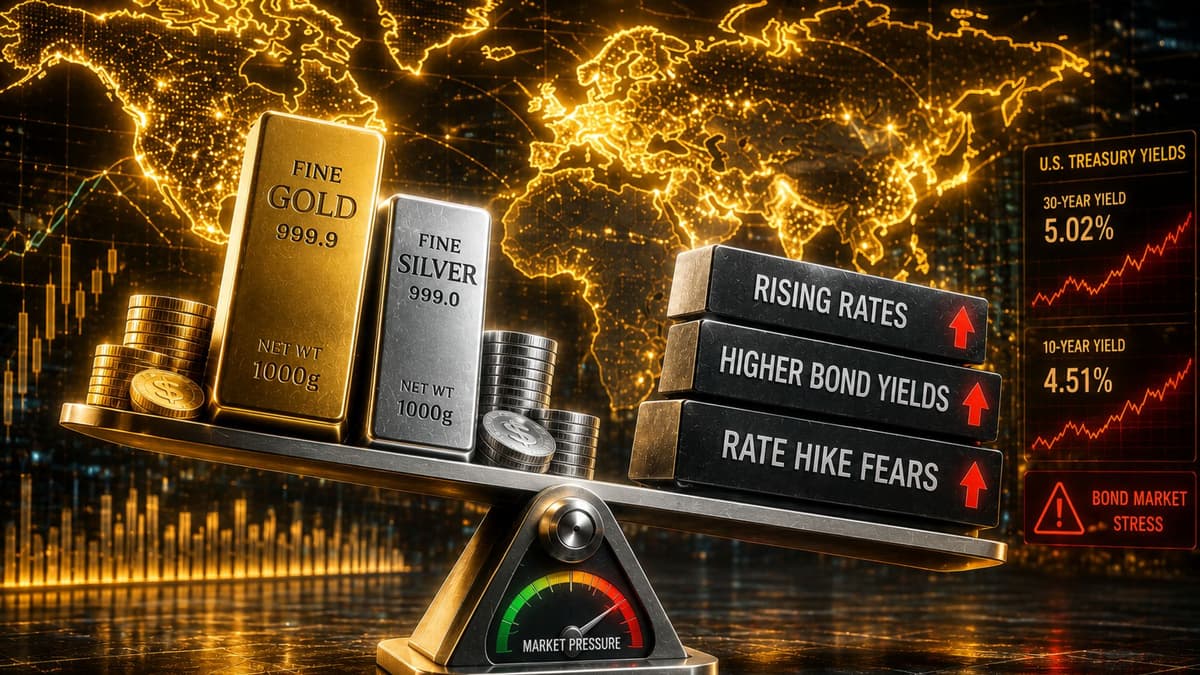
The move is most visible in the long end of the U.S. Treasury curve. The yield on 30-year U.S. bonds has climbed above 5%, its highest level in years, signaling a significant tightening in financial conditions.
How do rising real yields pressure bullion and precious metals?
Rising real yields pressure bullion by making income-generating assets more attractive relative to gold. As returns on long-dated U.S. debt increase after inflation, institutional investors often reduce exposure to non-yielding safe-haven assets.
Crucially, the latest rise in yields is being driven mainly by higher real interest rates, not by a sharp jump in long-term inflation expectations. The 30-year breakeven rate remains near the low-2% range, which suggests that most of the increase in nominal yields reflects a rise in real yields.
That distinction is important for the gold market. If nominal yields rise because inflation expectations are climbing, gold can sometimes hold up better as an inflation hedge. But when real yields rise, gold’s relative appeal tends to diminish more directly.
Higher long-term rates also weigh on broader risk sentiment. That pressure can reduce speculative demand across precious metals, adding to weakness in both gold and silver.
What broader macro risks are affecting the gold price outlook?
The gold price outlook is weakening not only because of rates, but also because of deeper macroeconomic tensions. Markets are grappling with uncertainty around inflation and growing concerns about fiscal sustainability.
These pressures are driving volatility across asset classes. Gold and silver are being pulled in opposite directions by competing forces: higher real yields hurt prices in the near term, while macro uncertainty still supports the long-term case for safe-haven demand.
For now, the bearish side of that equation is dominating. Momentum remains tilted against the precious metals sector unless the rate outlook changes meaningfully.
Could gold prices fall further from here?
Yes, gold could face additional downside if real yields continue to climb. Analysts cited in the source article warn that a break below key support levels could trigger a retest of the lower end of gold’s broader trading range.
Some market participants are eyeing $4,000 per ounce as a potential floor. That level now stands out as a key reference point if selling pressure deepens in XAUUSD.
The near-term path of least resistance appears lower unless markets start to price in softer yields or a clearer Federal Reserve pivot. As long as elevated rates remain in place, gold may struggle to regain strong upside momentum.
What does this mean for Indian gold investors?
Indian investors should watch both U.S. real yields and the rupee-dollar exchange rate. Global gold price weakness can lower international bullion benchmarks, but INR depreciation can partly offset those declines in India.
If U.S. yields stay elevated and XAUUSD remains under pressure, domestic gold prices may still prove relatively resilient if the rupee weakens against the dollar. On the other hand, if the rupee stabilizes while global bullion falls, Indian buyers could see more attractive entry points.
The bigger takeaway for Indian portfolios is that gold’s short-term momentum has weakened, but its strategic role has not disappeared. Tight financial conditions, persistent inflation risks, and rising macro uncertainty could still reinforce gold’s value as a hedge over time.
Indian investors should now track whether the 30-year U.S. Treasury yield stays above 5%, whether the 30-year breakeven rate remains in the low-2% range, and whether gold can avoid a deeper slide toward $4,000 an ounce. Those signals will likely shape the next move in both global bullion and domestic gold prices.