# Gold Price Outlook Turns Fragile as $4,500 Support Comes Into Focus
Gold prices ended the week under heavy pressure as hotter U.S. inflation, rising Treasury yields and a stronger U.S. dollar outweighed safe-haven demand from geopolitical tensions. For Indian investors, the global pullback in bullion matters because any weakness in XAUUSD can be amplified or cushioned by USD/INR moves, making the ₹ gold price trend closely tied to both U.S. macro data and the rupee.
Why did gold prices fall this week?
Gold prices fell because traders shifted their focus from geopolitical risk to sticky inflation, higher bond yields and a stronger U.S. dollar. That combination reduced expectations for Federal Reserve easing and pressured non-yielding assets such as gold.
Spot gold started the week at $4,687.50 per troy ounce. After an early rally, the market lost momentum as each move higher ran into selling pressure tied to inflation data and the dollar’s advance.
Gold first dipped to around $4,650 per ounce overnight early in the week. It then rebounded strongly at the start of the North American session and hit the weekly high above $4,768 per ounce just before 8 pm Eastern on Monday evening.
That strength did not last. Gold spent the rest of the week struggling to hold above $4,700, showing that bullish momentum had weakened materially.
How did U.S. inflation data hurt bullion?
U.S. inflation data was the main trigger. On Tuesday, the U.S. Consumer Price Index rose 0.6% in April and 3.8% year-over-year, pushing spot gold back toward the $4,700 level as traders cut expectations for Federal Reserve rate cuts.
Selling intensified on Wednesday after U.S. producer prices jumped 1.4% in April. That report sent gold down to session lows near $4,680, as the market read the PPI release as evidence that inflation pressures were broadening.
On Thursday, gold tried to stabilize after retail sales rose 0.5% and jobless claims increased to 211,000. But the relief was limited because the U.S. dollar extended a four-day advance, keeping pressure on bullion.
What happened to gold prices on Friday?
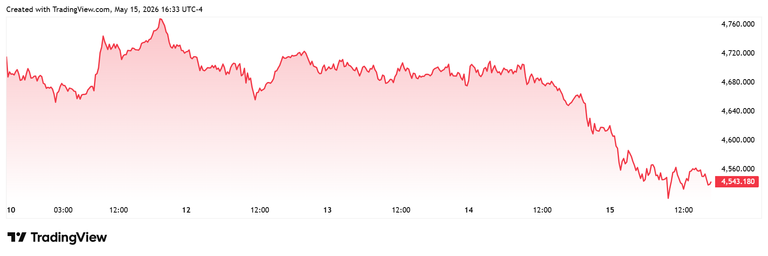
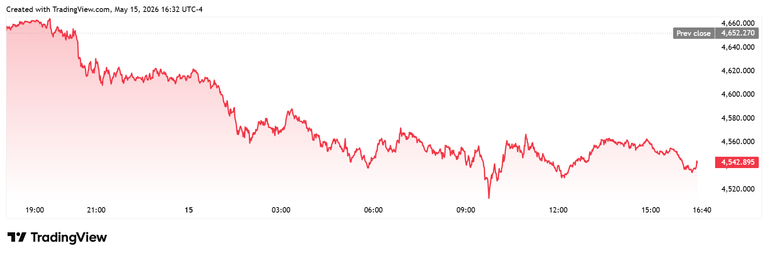
Gold broke sharply lower on Friday as Treasury yields spiked and the U.S. dollar strengthened further. That move pushed spot gold below $4,600 per ounce and brought the market close to a critical technical support zone.
The 10-year U.S. Treasury yield rose to 4.54% on Friday. At the same time, traders focused on the inflationary effects of the Iran war, while oil held above $100, reinforcing the view that the Federal Reserve may need to keep rates higher for longer.
Spot gold fell to the weekly low of $4,511 right at the North American open. It later traded near $4,543 per ounce heading into the weekend.
For Indian investors, a drop in international bullion prices can support local buying interest, especially if festive, wedding or investment demand improves. However, if the dollar stays firm and the rupee weakens, domestic gold prices in INR may not fall as much as XAUUSD suggests.
What does the Kitco weekly gold survey say now?
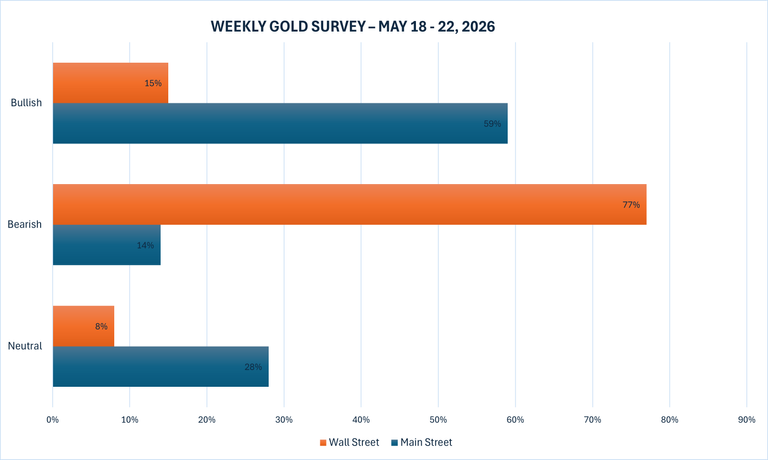
The latest Kitco News Weekly Gold Survey shows a sharp split between professional analysts and retail participants. Wall Street turned notably more cautious on gold’s near-term direction, while Main Street remained broadly bullish despite the late-week selloff.
That divergence matters because it highlights a market caught between weak short-term momentum and stronger long-term support factors such as central bank buying, geopolitical instability and strategic demand for safe-haven assets.
What is Marc Chandler’s gold outlook?
Marc Chandler, managing director at Bannockburn Global Forex, said rising rates and a stronger greenback drove the late-week decline.
“Surging interest rates and an appreciating greenback weighed on gold prices at the end of the week,” Chandler said. He added that gold had been trading inside Tuesday’s range of roughly $4,638 to $4,773, but broke down ahead of the weekend and reached an eight-day low.
Chandler also highlighted the importance of the $4,500 level. He noted that gold has not traded below $4,500 since the end of March, and warned that a decisive break under that support could open the way to $4,350.
What is Adrian Day’s view on gold?
Adrian Day, president of Adrian Day Asset Management, said his near-term stance is “unchanged,” but he expects substantial volatility.
Day said that does not mean prices will stay flat. Instead, he expects gold to remain volatile as competing short-term forces take turns dominating trade.
According to Adrian Day, higher oil prices and global central banks’ tightening bias suggest lower gold prices in the near term. But he added that over the longer term, the drivers that supported gold over the last three years should reassert themselves, especially steady buying from central banks and concerns over the deteriorating global status of the United States.
Why are some analysts still bullish on gold?
Some analysts remain bullish because they believe Friday’s liquidation may have exhausted weak hands, while central bank demand could still support a rebound. They also see the recent pullback as profit-taking rather than a structural reversal.
Rich Checkan, president and COO of Asset Strategies International, said “Up,” arguing that calmer market conditions could help gold recover. He said that although no immediate end is in sight, “cooler heads are prevailing,” and that relative calm should benefit gold.
Darin Newsom, senior market analyst at Barchart.com, also said “Up.” He argued that Friday’s meltdown may have cleared out a large share of sell orders in the futures market.
Newsom added that continued support from global central banks could spark a short-term rally. From a technical perspective, he noted that the June gold contract tested its previous daily closing low of $4,533.30, which could attract fresh buying.
He acknowledged that this call goes against the idea that a trending market usually stays in motion until an outside force changes it. Still, he said that outside force could emerge next week.
How are yields, China and geopolitics shaping the next gold move?
Gold’s next move depends heavily on whether U.S. yields stabilize, whether China-related headlines improve risk sentiment, and whether geopolitical tensions intensify or cool. Right now, those forces are pulling the bullion market in different directions.
Daniel Pavilonis, senior commodities broker at RJO Futures, said gold’s late-week slide was mainly a reaction to the lack of an Iran breakthrough involving China, along with rising Treasury yields tied to the possibility of rate hikes.
Pavilonis said, “The long end of the curve is moving higher,” which in his view signals that inflation is likely to remain sticky. He described the broader market tone as risk-off across the board, suggesting that the selloff may have been amplified.
He also said Chinese demand data has not been as strong as before, and that this weakness has affected commodities more broadly, not just gold. By contrast, he noted that energy has not yet become a major demand hotspot despite developments involving Iran, though changes around the Strait of Hormuz would be significant.
Does Daniel Pavilonis expect gold to recover?
Yes, Daniel Pavilonis still expects gold to move higher over time, but he believes the trade has become more difficult than it was a few months ago. He sees room for a temporary reprieve after the sharp drop.
Pavilonis said traders had a good chance earlier in the week to take money off the table and wait for another long entry. He added, “Ultimately, I do think that [gold] is going to grind higher,” but said the market is currently jittery after a strong run across risk assets and some premium is now being stripped out.
He also pointed to uncertainty over whether yields can keep rising much further from current levels. That question will remain crucial for both gold and the broader precious metals complex.
Why does the Trump-Xi meeting matter for gold?
The Trump-Xi meeting matters because any outcome that calms markets and pushes yields lower could help gold stabilize. A disappointing outcome, by contrast, could keep volatility high.
Pavilonis said he will be watching how the next few trading sessions develop and how Donald Trump emerges from talks with China’s Xi. He suggested that if Trump can frame the talks positively and calm yields, that could improve sentiment.
He also floated the possibility that stepping away from Hormuz could help China and make relations more reciprocal. But he stressed uncertainty, saying the market had expected something major to come from meetings with China and that nothing came out.
Why is $4,500 such an important gold level for investors?
The $4,500 per ounce level is critical because it is both a psychological support and a closely watched technical floor. A sustained break below it could trigger another wave of selling and shift short-term market sentiment decisively bearish.
Marc Chandler said gold has not traded below $4,500 since the end of March. In his view, a break of that level could expose the market to a decline toward $4,350.
For Indian investors, that level is especially important because a global drop toward $4,350 in XAUUSD could create lower entry opportunities in bullion, gold ETFs and sovereign gold-linked strategies. Still, the actual domestic impact will depend on the rupee, import costs and local demand trends.
The immediate watchpoint is clear: if U.S. yields remain elevated, the dollar extends its rally and inflation data stays hot, gold may keep testing support. If yields cool, central bank demand reasserts itself and geopolitical risk deepens, bullion could find buyers again near $4,500 and $4,533.30 in the sessions ahead.