# Gold Price Outlook Turns Bullish After Ceasefire, Fed Week Looms
Gold prices ended a fourth straight winning week as easing Middle East tensions, a reopened Strait of Hormuz, and falling U.S. Treasury yields kept Wall Street broadly bullish on bullion. For Indian investors, the next move in gold will depend not just on geopolitics but also on upcoming U.S. data, Federal Reserve signals, and the rupee’s reaction to global risk sentiment.
What happened to gold prices this week?
Gold rose for a fourth consecutive week, but it failed to hold above the key $4,900 per ounce mark. Spot gold began the week at $4,676.77 per ounce, dipped near $4,645 for the weekly low, and then climbed steadily before ending the week at $4,829 per ounce.
How did XAUUSD trade through the week?
By 9:00 p.m. Sunday evening, spot gold was already trading above $4,715 per ounce. During Monday’s North American session, bullion established firm support at $4,700.
Asian and European traders then pushed gold to $4,790 per ounce by 3:00 a.m. Tuesday morning. By the time North American trading began on Tuesday, $4,770 had become near-term support.
At 11:15 a.m. Eastern on Tuesday, gold broke above $4,800 per ounce. By 9:15 p.m., spot gold printed a midweek high above $4,850 per ounce.
Where did gold consolidate?
After the midweek rally, gold retested support at $4,800 late in the European session. It then moved into a consolidation range between $4,790 and $4,835 through Wednesday and Thursday.
What triggered Friday’s sharp move?
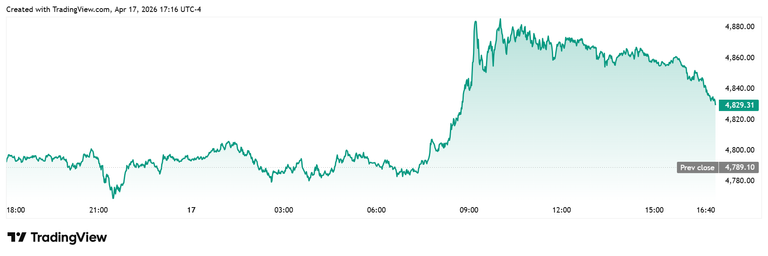
Friday brought the biggest price swing of the week as traders reacted to fast-moving Middle East headlines. Spot gold surged from the day’s low of $4,786 at 7:00 a.m. Eastern to above $4,890 just after 9:00 a.m.
The move coincided with Iran’s 8:45 a.m. announcement that the Strait of Hormuz was fully reopened following the ceasefire between Israel and Lebanon. Soon after, U.S. President Donald Trump’s 9:05 a.m. Truth Social post confirmed the agreement.
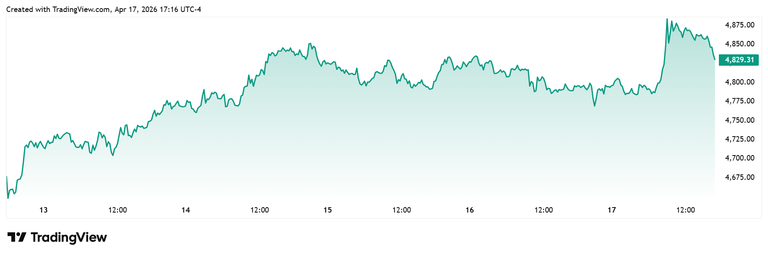
Even so, gold could not break decisively through $4,900 per ounce. After several successful retests of support near $4,850 during Friday’s session, traders took profits about half an hour before the equity close, leaving spot gold at $4,829 per ounce by week’s end.
Why are Wall Street analysts bullish on gold now?
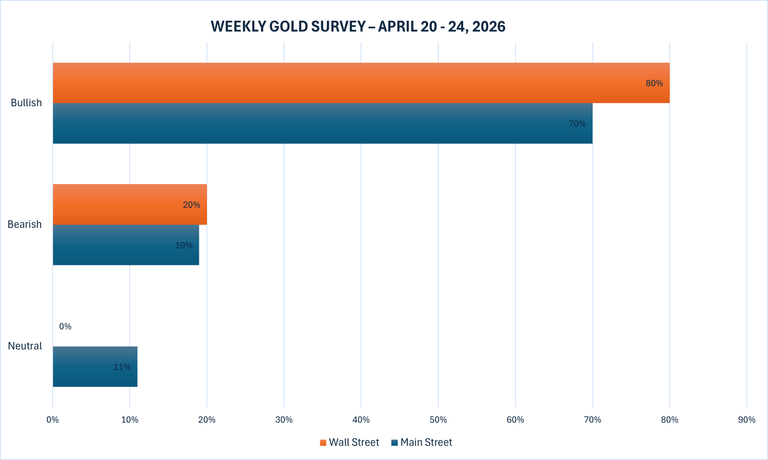
Wall Street turned bullish again because gold has now posted four straight weekly gains and geopolitical risks have eased without fully disappearing. The latest Kitco News Weekly Gold Survey showed both Wall Street and Main Street back in bullish territory.
What did Rich Checkan say?
Rich Checkan, president and COO of Asset Strategies International, expects gold and silver to move higher if ceasefires hold. He said, “Up,” adding that gold and silver have recently benefited from “cooler heads prevailing in the Middle East.”
According to Checkan, precious metals have been moving up with ceasefires and moving down with open hostilities. He said that as long as the fragile ceasefires last between the U.S. and Iran and between Israel and Lebanon, gold and silver should continue rebounding from their recent corrections.
Why do some analysts still expect gold to fall?
Some analysts remain cautious because technical indicators suggest gold may be overbought near important resistance. The main bearish argument is that futures are approaching levels where momentum has stalled before.
What is Darin Newsom’s technical view?
Darin Newsom, senior market analyst at Barchart.com, said “Down.” He pointed to the June gold contract’s 50-day moving average at $4,938.50 as a key resistance level.
Newsom noted that the futures contract has not traded above the 50-day moving average since March 18. He also said daily stochastics show June gold as overbought with readings near or above 90%.
Still, Newsom also undercut the predictive power of the setup. He said, “Does any of this actually mean anything? Absolutely not. We’ll see what weekend social media posts and headlines bring.”
For traders in India, that means headline risk remains unusually high. Gold price action in XAUUSD could shift quickly on geopolitical updates, and domestic gold rates may also swing with the USD/INR exchange rate.
How does the Strait of Hormuz reopening affect gold, oil and stocks?
The reopening of the Strait of Hormuz matters because it signals easing energy-market stress, which can reduce panic demand for safe-haven assets such as gold. At the same time, lower oil volatility can support equities and improve overall risk appetite.
What is Daniel Pavilonis watching?
Daniel Pavilonis, senior commodities broker at RJO Futures, said traders should watch the interplay between energy, bonds, and equities to understand where gold goes next.
He told Kitco News that in energy markets, physical prices stayed higher for longer than paper prices. He said volatility over roughly eight weeks washed out much of the futures-market trading.
Pavilonis said early trades were easy, but later $15 swings both ways forced many traders out of the market. That process left mainly hedgers and very under-leveraged traders still willing to take a view.
Why does the futures curve matter for bullion?
Pavilonis said the market is now trading the future price of normalization. He noted that May is trading down sharply, June is also down, and the whole curve is narrowing all the way to June of next year.
In his view, that shape suggests the market is anticipating normalization after the reopening of the Strait of Hormuz. If energy stress continues to fade, some safe-haven demand for bullion may soften in the short term.
For Indian investors, this also matters because softer crude oil expectations can influence India’s inflation outlook and the rupee. A more stable INR can cushion imported gold prices even when global spot gold remains elevated in U.S. dollar terms.
What do Treasury yields and risk sentiment mean for gold prices next week?
Treasury yields may be the most important macro signal for gold in the near term. Falling yields tend to support non-yielding assets such as gold because they reduce the opportunity cost of holding bullion.
Why is the 10-year U.S. Treasury yield important?
Pavilonis said, “I think the biggest tell is the 10-year yield.” He observed that yields were going up and now they’re dropping.
He also noted that stocks had a massive break to the upside, a move he linked partly to the energy-market volatility that washed out many short positions. In his view, what began as a short-covering rally may now be turning into a broader rally where investors actually want to buy risk assets.
Is gold in a relief rally or a new breakout?
Pavilonis said the metals did not see a big V-bottom, and he believes the market is currently seeing a relief rally. He added that gold and silver are likely experiencing a retracement, though the move does not yet look as strong as the rally in equities.
That leaves the short-term outlook mixed. Gold still has support from falling yields and geopolitical uncertainty, but the current market tone appears risk-on across the board, which could shift investor attention toward stocks first.
Will equities overshadow gold in the short term?
Yes, at least initially, equities may attract more capital than precious metals if risk appetite keeps improving. Gold remains supported, but it is no longer the first destination for fresh momentum money.
What did Pavilonis say about investor focus?
Pavilonis said, “I think gold is not at the forefront that it was in terms of interest in getting long; I think right now the main focus is on stocks.” He added that gold is still there, but it is “more in the shadow of the stock market right now.”
He expects interest in gold to improve over the next couple of weeks or so as bullion comes out of the shadows. But for now, he said, it is not the first thing that people want to come in and buy.
For Indian investors, that is an important cue. If global equity markets stay firm while U.S. yields ease, gold may consolidate rather than surge. In India, local gold prices will also depend on the rupee, import costs, and domestic festival and wedding demand.
What should Indian gold investors watch next?
Indian investors should watch U.S. domestic data, Federal Reserve communication, and whether gold can finally clear $4,900 per ounce. The next directional move in global bullion could quickly feed into domestic prices, especially if USD/INR weakens.
A sustained break above $4,900 would strengthen the bullish case after four consecutive weekly gains. But if risk-on sentiment deepens and gold remains capped below the $4,938.50 50-day moving average flagged by Darin Newsom, bullion may continue to consolidate even as the broader long-term trend stays constructive.
The key watchpoint now is simple: if falling Treasury yields persist while ceasefire optimism holds, gold may keep drawing support beneath the market. If geopolitical calm expands and equities keep rallying, Indian buyers may get a period of sideways trade instead of an immediate breakout.