# Gold Price Outlook: Sprott Sees Bigger Institutional Buying Ahead
Gold may face short-term pressure from rising U.S. Treasury yields, but Sprott Inc. says the bigger medium-term story still favors bullion. Ryan McIntyre, Senior Managing Partner at Sprott Inc., told Kitco News that the next major wave of gold demand from institutions has still not fully arrived, even after central banks, individual investors, and some ETF buyers helped drive the rally since 2022.
For Indian investors, that matters because global gold price trends, U.S. yields, and geopolitical risks often feed directly into domestic bullion rates in rupees. If institutional demand broadens while financial stress worsens, gold prices in India could stay supported even if XAUUSD faces near-term volatility.
Why does Sprott still expect more institutional gold buying?
Sprott expects more institutional gold buying because Ryan McIntyre believes the biggest wave of professional allocation has not yet happened. He said central banks started the trend a few years ago, then individual investors and some institutions entered through ETFs in mid-2024, but widespread institutional participation still lies ahead.
According to McIntyre, the sequence of demand has been clear. Central banks were the early buyers, individual investors became more active in mid-2024, and some institutional money also came in through exchange-traded funds. He said signals for U.S. rate cuts at the end of last summer in Jackson Hole helped support gold until the recent conflict with Iran.
McIntyre said he still broadly holds the same thesis he outlined earlier: the next big wave of investment demand for gold will come from wider institutional buy-in. In his view, recent price weakness does not change the long-term case for holding gold in a portfolio.
How has gold performed despite the recent pullback?
Gold has fallen sharply since late January, and McIntyre said the decline became especially pronounced in the first weeks of the Iran war. Even so, he does not see any major change in the long-term drivers that have supported gold since 2022.
That distinction is important for investors tracking XAUUSD and physical bullion. Short-term price corrections can reflect shifting liquidity and yield expectations, while the strategic case for gold as a safe-haven and store of value can remain intact.
What is pressuring gold prices in the short term?
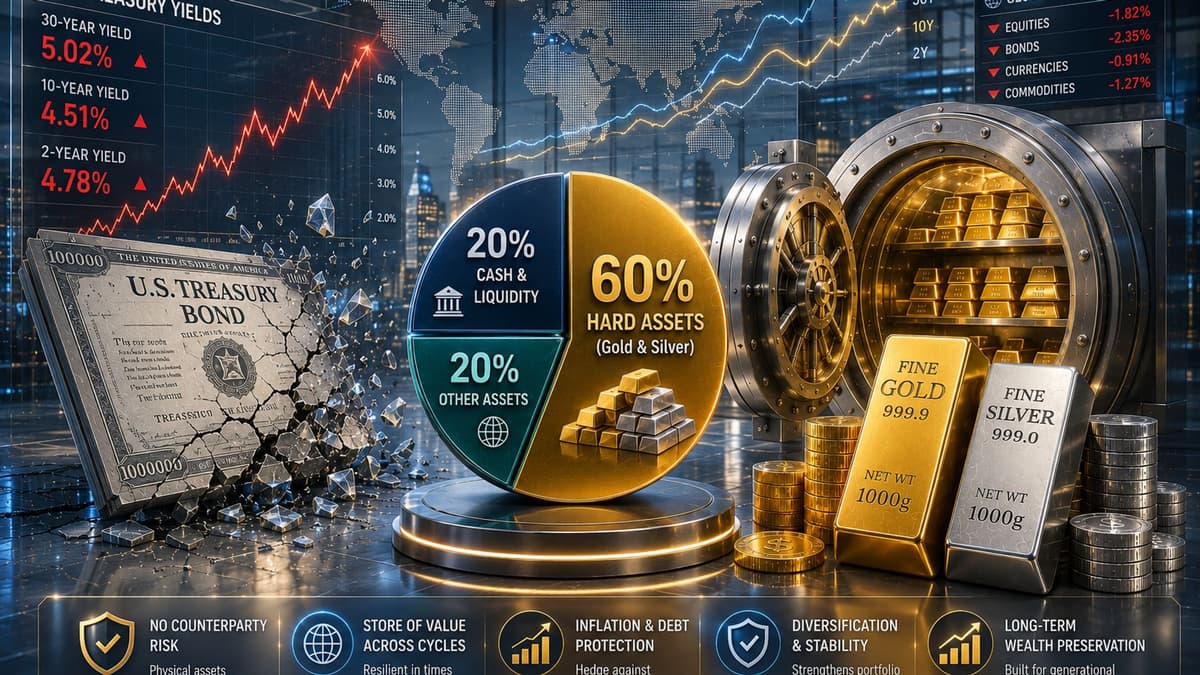
Rising U.S. Treasury yields are the main short-term headwind for gold, according to McIntyre. He said the increase in yields since the Iran conflict began has raised gold’s opportunity cost and encouraged some investors to prefer the U.S. dollar because it is even more liquid.
McIntyre said the only thing that has really changed for gold is the opportunity cost, which investors usually measure against Treasuries. When bond yields rise, non-yielding assets such as gold can look less attractive in the near term, especially to marginal buyers.
He stressed, however, that this shift does not alter the core reason investors own gold. In his view, gold remains a portfolio asset designed to protect against deeper financial and monetary risks.
How much have Treasury yields moved?
McIntyre said that if an investor held a 10-year U.S. Treasury note in January and compared it with conditions now, yields are up by 30 to 40 basis points. He estimated that such a move would translate into a loss of roughly 3% to 4% in the value of those Treasury holdings over that period.
He said that is a significant drawdown for an asset class many investors still consider highly stable. For gold investors, the point is that rising yields can hurt bond prices and temporarily cap bullion upside, but they can also expose broader stress inside the financial system.
For Indian investors, higher U.S. yields often affect global risk sentiment, the U.S. dollar, and imported gold prices. A firmer dollar can pressure emerging-market currencies, including the Indian rupee, which can in turn keep local gold prices elevated even if international gold softens.
Why does Sprott think rising yields could still help gold later?
Sprott’s bullish medium-term view is that the reasons yields are rising are ultimately positive for gold and negative for bonds. McIntyre said the long-term financial outlook is deteriorating, not improving, and he believes governments will likely have to print more money in most plausible scenarios.
He argued that worsening fiscal conditions make paper assets tied to sovereign debt less attractive over time. In that environment, gold stands to benefit because investors often buy bullion when they worry about currency debasement, deficit financing, and the long-term value of fiat money.
McIntyre put it plainly: more money printing would be good for gold and bad for holding bonds. That view aligns with a classic precious metals thesis in which higher nominal yields do not necessarily hurt gold over the medium term if those yields reflect rising fiscal stress or inflation concerns.
What does this mean for Indian gold buyers?
Indian investors should watch both XAUUSD and the USD/INR exchange rate. If global fiscal stress lifts safe-haven demand for bullion while the rupee weakens, domestic gold prices can remain resilient even during global pullbacks.
That matters for households, long-term savers, and portfolio allocators in India. Gold often serves both as a financial hedge and as a consumption asset, so global macro trends can have an amplified local impact.
Why have institutions been slow to buy gold?
McIntyre said institutions have been slow to buy gold for two main reasons: they lack internal commodities expertise, and equities have performed so well that many managers felt no urgency to diversify. He said many institutions lost their in-house knowledge of commodities and gold after the broad commodity correction that ran through about the end of 2015.
According to McIntyre, banks, institutional money managers, and endowments reduced or eliminated exposure to commodities and gold after that downturn. As a result, many organizations no longer had the internal expertise needed to make a proactive allocation decision.
He described gold as a separate asset class unto itself, distinct even within the commodities complex. In his view, that makes institutional hesitation even more understandable because many firms no longer have specialists who can confidently advocate for bullion exposure.
How did the post-2015 commodity correction change institutional behavior?
McIntyre said that before the end of 2015, some institutions still had meaningful knowledge in commodities. But after the major correction across the commodity complex, many of them effectively "blew out" any exposure they had to commodities and gold.
That retreat led to a loss of institutional memory. Once those teams and mandates disappeared, institutions had fewer people capable of rebuilding a gold strategy from the ground up.
He also pointed to incentives inside large organizations. From what he called a "careerist perspective," doing nothing is often easier than making an unconventional allocation call, even when the long-term case is strong.
Why have equities blocked institutional flows into gold?
Strong equity returns have been a major roadblock because institutions did not feel forced to look elsewhere while stock markets kept working. McIntyre said that since 2015, equities have generally performed so well that many professional investors saw little reason to shift capital into gold despite bullion’s strong multi-year gains.
He argued that this is one of the key explanations for delayed institutional adoption. If the S&P 500 and similar equity benchmarks continue to deliver, institutions can postpone difficult diversification decisions.
McIntyre said that behavior will likely persist until the end of the cycle. In his view, institutions may only act decisively when the S&P 500 stops working and starts moving the other way.
What could trigger a bigger institutional move into bullion?
A meaningful equity market reversal could force institutions into gold, according to McIntyre. He said investors will postpone the decision as long as they can unless they feel compelled to act.
That potential trigger matters for Indian investors with exposure to both domestic and global equities. If international equity markets weaken sharply, demand for safe-haven assets such as gold could broaden beyond retail and central bank buying into larger institutional allocations.
Has Bitcoin diverted institutional attention away from gold?
Yes, McIntyre said Bitcoin may have absorbed some of the time, attention, and capital that might otherwise have gone to gold or commodities. He said the two are somewhat tied together because institutions must allocate resources to study alternative assets, and those resources are limited.
He illustrated that point with a meeting Sprott held last summer with a very large family office in Europe. At the start of the meeting, McIntyre asked what exposure the family office had to gold or commodities.
The answer surprised him: absolutely zero. McIntyre said that was very unusual for an institution of that scale, especially one with a long-term time horizon and wealth protection likely near the top of its priorities.
What example did McIntyre give about Bitcoin versus gold?
McIntyre said the European family office was a very old family, so he assumed it would have accumulated at least some gold over time. But that was not the case.
Instead, the family office said it had just put "$200 or $300 million" into Bitcoin. McIntyre said this likely happened in July or August, and he was struck by the contrast: the institution was willing to commit hundreds of millions of dollars to Bitcoin, yet it still could not get comfortable owning gold or commodities.
That comparison highlights a broader allocation trend across global wealth pools. For Indian investors, it suggests gold is still under-owned in some major portfolios, which could leave room for future demand if institutional sentiment shifts.
Why could silver lag gold in this environment?
Silver may face a tougher near-term path than gold because the Iran conflict clouds global growth expectations and weighs on industrial demand. McIntyre’s view, as presented in the Kitco News interview, is that silver will likely follow gold higher over time, but its industrial exposure makes the short-term outlook more difficult.
That matters because silver is both a precious metal and an industrial input. When investors worry about slower economic growth, silver can underperform gold even during periods of geopolitical stress.
For Indian buyers, this means gold may remain the cleaner safe-haven trade while silver could be more sensitive to changes in manufacturing expectations and risk appetite. Investors tracking precious metals should therefore watch not only bullion demand but also growth signals linked to the Iran conflict and the broader global economy.
What should Indian investors watch next for gold prices?
Indian investors should watch U.S. Treasury yields, Federal Reserve rate-cut signals, the Iran conflict, equity market momentum, and signs of institutional inflows into bullion ETFs and physical gold. McIntyre’s message is that short-term gold price weakness does not invalidate the larger bull case tied to worsening fiscal conditions and still-limited institutional ownership.
If Treasury yields keep rising because investors demand more compensation for fiscal risk, gold could remain volatile in the near term. But if equity markets weaken, institutional diversification accelerates, or money-printing concerns intensify, gold may regain momentum more forcefully.
For India, the added watchpoint is the rupee. Even modest moves in international gold prices can translate into larger swings in local bullion rates when USD/INR changes, making global macro signals especially important for Indian savers and investors.
The next key test is whether institutions continue to wait or finally start building meaningful exposure. If that shift begins, it could become the next major leg higher for gold prices.